Fast Facts
HD Hyundai Robotics invested 13 billion won ($9.7 million) in AIDIN Robotics on September 11, 2026, securing a stake in the company that makes force and tactile sensors for humanoid hands. HD Hyundai Robotics tactile sensor investment targets shipbuilding and heavy-industry applications, where a robot needs to feel the difference between grinding a weld and damaging the hull. For procurement teams, the signal is clear: the humanoid race is shifting from who can build the best body to who can secure the sensing layer that makes the body useful.
HD Hyundai Robotics tactile sensor investment landed on September 11, 2026, when the shipbuilding giant announced it had acquired a stake in AIDIN Robotics for 13 billion Korean won, roughly $9.7 million. The investment secures core technologies for humanoid robots and strengthens HD Hyundai’s position in the physical AI business, according to the company’s announcement.
The procurement implication is not about the dollar figure. It is about what HD Hyundai bought: the layer of the humanoid stack that most vendors treat as a detail and most buyers never ask about until deployment fails. HD Hyundai Robotics tactile sensor investment is a bet that sensing—not actuation, not locomotion, not AI model size—is the bottleneck that determines whether a humanoid robot can do useful work.
What AIDIN Robotics Actually Makes
AIDIN Robotics designs and manufactures capacitive force and tactile sensors in-house. The company’s sensors are regarded as core components for humanoid robots because of their performance, cost competitiveness, and miniaturization capabilities. Its product line includes a 3-axis force and torque sensor that measures ground reaction force of up to 2,000 N when mounted on a robot ankle, and a tactile sensor (ATT) that identifies the point of contact of the hand.
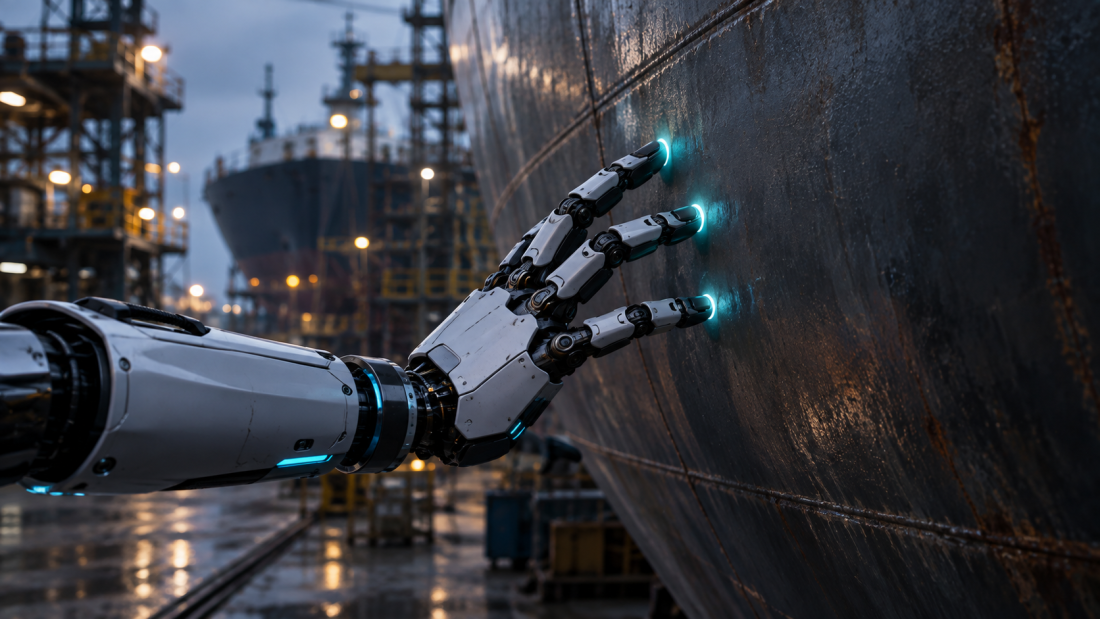
That last capability matters more than it sounds. A robot hand without tactile feedback cannot tell whether it is gripping a delicate component or crushing it. It cannot feel the difference between a surface that is smooth and one that is about to slip. HD Hyundai Robotics tactile sensor investment gives HD Hyundai access to the sensing layer that makes a five-fingered hand functional rather than decorative.
The companies will combine AIDIN’s force and tactile sensors and control technology with HD Hyundai Robotics’ robot platforms, and plan to develop a five-finger robotic hand tailored for shipbuilding and heavy-industry sites. They will also jointly develop robotic solutions to automate surface-treatment processes such as polishing and grinding, with initial deployment planned for shipbuilding and heavy-industry sites before expanding to other manufacturing sectors in Korea and U.S. shipyards.
Why Shipbuilding Is the Proving Ground
Shipbuilding is one of the hardest environments for robotics. The work is high-mix, low-volume, and physically punishing. A human welder adjusts their grip based on feel—the vibration of the torch, the resistance of the metal, the sound of the arc. HD Hyundai Robotics tactile sensor investment is an attempt to give a robot that same sense of feel.
The grinding and polishing tasks HD Hyundai and AIDIN plan to automate are especially tactile. A robot polishing a hull needs to apply consistent pressure across a curved surface without gouging the steel. A robot grinding a weld needs to remove the right amount of material without weakening the joint. Neither task can be done reliably with vision alone. HD Hyundai Robotics tactile sensor investment is a recognition that force feedback is not optional in these environments.
The investment also connects to HD Hyundai’s broader humanoid strategy. The company has been developing welding humanoids for shipyards through a partnership with U.S.-based Persona AI, with HD Hyundai Robotics leading system integration, welding quality analysis, and control technologies. AIDIN’s sensors become the tactile layer for that platform.
The Procurement Signal
For buyers evaluating humanoid robots for industrial deployment, HD Hyundai Robotics tactile sensor investment points to a question most procurement teams are not asking: what does the robot feel? Not what it sees. Not how it moves. What it feels.
A humanoid with excellent vision and locomotion but no tactile feedback is limited to tasks where contact can be treated as a binary event—grab, release, move on. A humanoid with force and tactile sensing can do the tasks that actually require dexterity: assembly, surface treatment, inspection, manipulation of flexible materials.
⚠ Fiction—composite scenario, not a real event: A procurement manager at a heavy-equipment manufacturer evaluates two humanoid vendors for a deburring application. Vendor A’s robot has better vision and a faster gait. Vendor B’s robot has a tactile-sensing hand. The manager chooses Vendor B because the task requires feeling the edge of the burr, not just seeing it. The robot’s ability to sense force is the difference between a finished part and a scrapped one.
The industrial robotics market has spent years optimizing for vision and mobility. HD Hyundai Robotics tactile sensor investment is a signal that the next competitive frontier is touch.
Global Implications
For manufacturers outside Korea, the investment has a different kind of relevance. AIDIN’s sensors are designed for cost competitiveness and miniaturization—characteristics that matter in emerging markets where capital budgets are tighter and the case for automation must pencil out faster. A humanoid platform that can be equipped with affordable force sensing is more likely to reach deployment in Nigeria or Southeast Asia than one that requires expensive, proprietary sensor packages.
HD Hyundai has said the collaboration will expand to other manufacturing sectors and U.S. shipyards. The sensors themselves are not shipbuilding-specific. They are general-purpose components for any robot that needs to interact with the physical world. HD Hyundai Robotics tactile sensor investment is a bet that the same sensing layer that enables a shipyard welding hand will enable factory assembly, warehouse picking, and every other task where the robot needs to know how hard it is pressing.
💡 CreedTec Analyst’s Note — Daniel Ikechukwu
Strategic Impact: HD Hyundai Robotics tactile sensor investment shifts the humanoid conversation from body to sense. Vendors that can demonstrate force and tactile feedback will outperform those that compete on vision and locomotion alone in any task requiring contact with a variable surface.
Stop: Evaluating humanoid robots on vision benchmarks and gait videos without auditing the sensing layer that determines whether the hand can actually do the work.
Start: Asking humanoid vendors what force and tactile sensors they use, whether the sensors are proprietary or sourced, and how the robot’s control system uses that feedback.
Watch: Whether AIDIN’s sensors appear in HD Hyundai’s welding humanoid pilot and whether the partnership extends to other Korean manufacturers beyond shipbuilding.
ROI Outlook: Tactile sensing adds cost to the robot but reduces scrap and rework in tasks where a robot without force feedback would fail. The premium for sensing is lower than the cost of a damaged hull or a scrapped assembly.
Sources:
- The Elec, “HD Hyundai Robotics Invests 13 Billion Won in AIDIN ROBOTICS,”
- KED Global, “HD Hyundai Robotics invests $9.7 mn in Korean physical AI startup,”
- Chosun, “HD Hyundai Robotics Invests 13 Billion Won to Develop Shipbuilding Robotic Hand,”
- Yonhap, “HD Hyundai affiliates partner to develop AI-powered welding robots for shipyards,”
Further Reading:
- Teradyne Robotics Posts First-Ever $100M Quarter on AI Demand
- Maven Robotics Exits Stealth With $100M for Warehouse Bots
- Boston Dynamics Atlas Beats Tesla Optimus to Production
- China Robot Hands Are Winning the Volume War
- CJ Logistics Humanoid Robot Deployment Is the First Real Test of Physical AI Economics
Subscribe to CreedTec’s weekly briefing—robotics sensing economics, humanoid deployment signals, and the procurement questions behind the hardware headlines.