Fast Facts
CJ Logistics deployed two humanoid robots on a live packaging line at an Olive Young fulfillment center on September 3, 2026—the first commercial humanoid deployment in South Korean logistics history. The robots handle real work in a real facility, not a controlled demo. This isn’t a prototype showcase. It’s the first data point for a question procurement teams will ask repeatedly over the next decade: what does a humanoid robot actually cost to deploy and operate, and when does it pay back? CJ Logistics humanoid robot deployment is now the benchmark every other logistics operator will measure against.
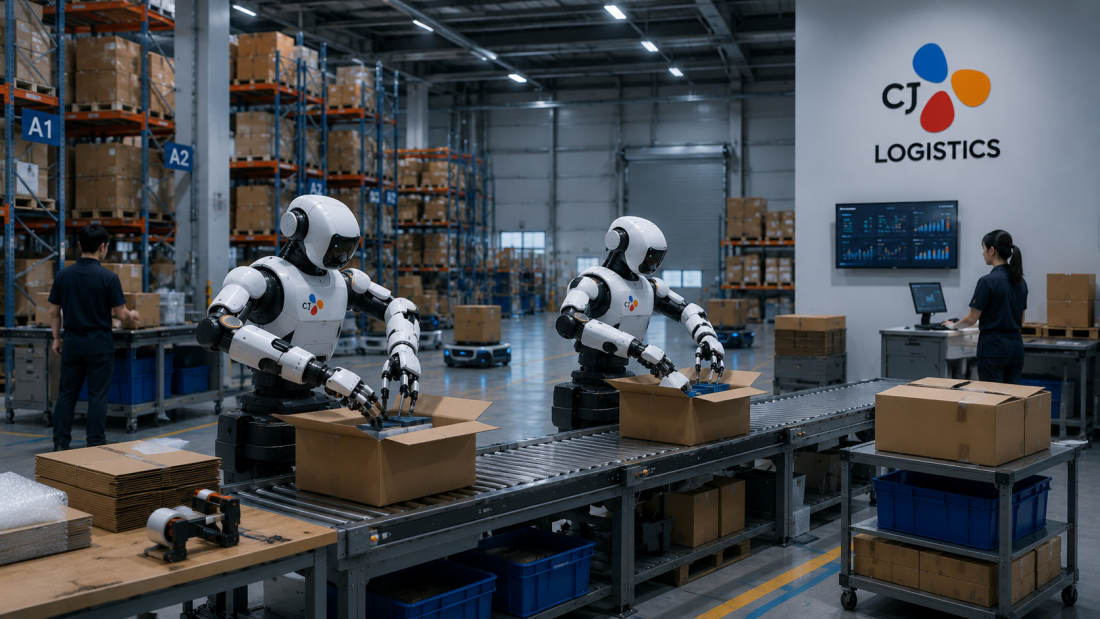
CJ Logistics humanoid robot deployment officially moved humanoids from demonstration to live operation on September 3, when the company placed two dual-arm machines on a packaging line at an Olive Young fulfillment center in Yongin, South Korea. The robots are performing a specific, valuable task: inserting cushioning materials into shipping boxes. It’s not a flashy demo. It’s real work. The world’s first humanoid robots on a logistics line in Korea have entered “a stage where they play a role in actual logistics operations,” said Kim Jung-hee, head of CJ Logistics’ TES Logistics Technology Research Institute.
That stage shift—from demonstration to deployment—is the real story. South Korea’s logistics industry is the proving ground, and CJ Logistics humanoid robot deployment is the first company to put humanoids on the clock.
Why Logistics, Not Manufacturing, Is the First Real Test
Manufacturing has been the default answer to “where will humanoids go first?” Standardized parts, fixed steps, and repetitive motions make factory floors an obvious candidate. Logistics has a different challenge: warehouses handle countless items of varying shapes, sizes, and materials, with conditions shifting by order. Carrying and placing objects demands less precision than assembly work, but the variability is higher.
CJ Logistics chose packaging—the most repetitive task in the fulfillment chain—as the entry point. The robots insert cushioning into boxes. It’s simple, repeatable, and measurable. The company plans to expand to picking, sorting, inspection, and ultimately develop a universal logistics humanoid capable of performing multiple processes consecutively.
That’s the roadmap. Packaging → picking → sorting → inspection → universal logistics. CJ Logistics humanoid robot deployment is phase one.
The Partners Behind the Machines
CJ Logistics didn’t build the robots alone. The company established strategic partnerships with:
The robots will be trained not only on field data but also on simulation-generated data to improve their adaptability to new products and work environments. That’s the data flywheel: real-world deployment generates real-world data, which trains better models, which enable broader deployment.
The Competitive Landscape: Korea’s Humanoid Race
CJ Logistics isn’t operating in a vacuum. The broader Korean robotics ecosystem is accelerating rapidly:
CJ Logistics is also part of the industry ministry’s K-Humanoid Alliance, a government-backed consortium pushing domestic humanoid development.
The Unanswered Question: What Does This Actually Cost?
Here’s what every procurement head wants to know: what did CJ Logistics pay, and what’s the payback period? CJ Logistics hasn’t disclosed deployment cost, per-unit pricing, or ROI projections. The company framed the decision around flexibility and scalability—robots that can perform various tasks without requiring changes to existing workspaces.
That’s a defensible argument, but it’s not a financial one. Procurement teams need numbers. CJ Logistics humanoid robot deployment will generate those numbers over the next 12-18 months. The question is whether the data will support the hype.
⚠ Fiction—composite scenario, not a real event: A logistics operator in Southeast Asia reads about the CJ Logistics deployment and budgets for a 10-robot pilot. The vendor quote comes back at $150,000 per unit plus annual maintenance and software updates. The operator runs the numbers: at local labor rates, payback stretches past five years. The pilot is postponed. The lesson: a headline deployment doesn’t guarantee a replicable business case.
Global Implications
South Korea is racing China’s hardware lead and the U.S. edge in robotics AI. The government’s plan to buy 1,080 domestically made humanoids by 2030 is a demand-side signal that procurement budgets are being allocated. CJ Logistics humanoid robot deployment is the first commercial proof point.
For operators in other markets, the takeaway is straightforward: if a major logistics player with significant resources is deploying humanoids now, the technology is past the prototype stage. But the economic case at scale is still unproven. The data from CJ Logistics humanoid robot deployment will determine whether humanoids become a standard logistics tool or a niche experiment.
💡 CreedTec Analyst’s Note — Daniel Ikechukwu
Strategic Impact: CJ Logistics’ deployment is a genuine milestone, but it’s a single data point. Procurement teams should treat it as a leading indicator, not a proven business case. The real signal will be the second and third deployments, where unit economics become measurable.
Stop: Assuming a headline deployment means the technology is cost-effective at scale.
Start: Tracking CJ Logistics’ next expansion phases—picking, sorting, inspection—for hints on which tasks pencil out first.
Watch: Whether CJ Logistics discloses deployment cost and ROI data over the next 12 months.
ROI Outlook: Positive for early adopters willing to accept pilot-stage economics; uncertain for operators expecting near-term payback at current pricing levels.
Sources:
- Chosun English: “CJ Logistics Deploys Humanoid Robots in First South Korean Logistics Center”
- Aju Press: “Humanoid robots trade the racetrack for the packing line”
- Korea Herald: Photo News coverage of CJ Logistics deployment
Further Reading:
- What Surgie Robot Surgery Really Proves Is a Cost Story, Not a Medical One
- Unitree’s TIME Cover Hides a 9% Industrial Deployment Problem
- Humanoid Robot Production Numbers: The 50,000-Unit Claim Nobody Can Verify
- Top Robotics Companies Transforming the Industry in 2026
- The Industrial Robot Cost Guides Everyone’s Reading Assume You Pay US Wages
Subscribe to CreedTec’s weekly briefing—robotics economics, deployment data, and the procurement signals behind the hardware headlines.