Fast Factas
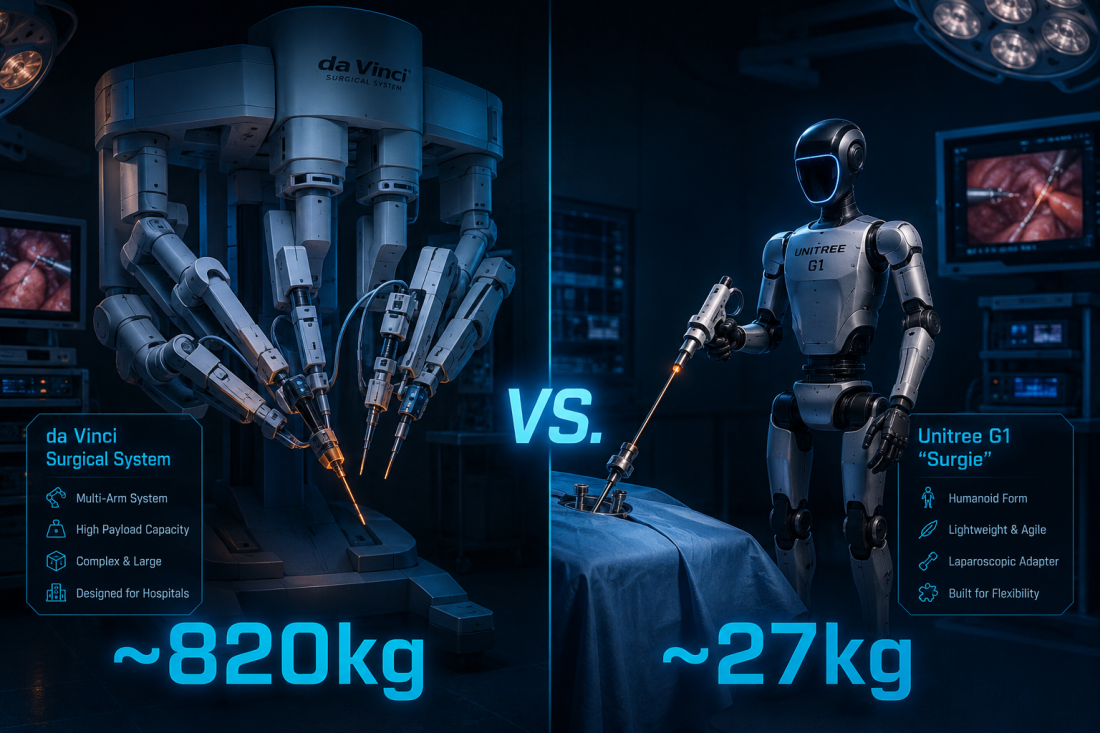
Surgie robot surgery really proves is a cost story, not a medical one. UC San Diego researchers used a teleoperated Unitree G1 — a mass-market humanoid robot — to remove gallbladders from live pigs in the world’s first such procedure, nicknaming the setup “Surgie.” The surgery itself is proof-of-concept, not clinical-ready. The more consequential finding is that general-purpose hardware costing a fraction of a purpose-built surgical robot performed a task that has historically required a machine weighing nearly a ton and costing millions.
- ~27kg / 1.5m — weight and height of the Unitree G1 humanoid used as “Surgie”
- ~820kg — weight of a standard da Vinci Surgical System
- $500K–several million — typical da Vinci system cost
- 2 — live-animal gallbladder surgeries completed: one with a human assistant, one fully robot-paired
- 0 — autonomous decision-making; every procedure was surgeon-teleoperated
A Familiar Procedure, an Unfamiliar Machine
Robotic surgery isn’t new — Intuitive Surgical’s da Vinci system has been in operating rooms for over two decades. What’s new is the hardware underneath Surgie: a Unitree G1, a general-purpose humanoid never designed for an operating room, fitted with physical adapters to grip standard laparoscopic tools. The team didn’t build a bespoke surgical machine. They taught an off-the-shelf robot to hold a scalpel.
“It’s a fraction of the cost and it takes a fraction of the space in an operating room. So it’s easy to deploy, anywhere from rural areas, to the battlefield, and even to space.” — Shanglei Liu, Assistant Professor of Surgery, UC San Diego
Why the Space Constraint Matters as Much as the Price Tag
A da Vinci system’s size isn’t a minor detail — it dictates which facilities can even house one. Dr. Ryan Broderick noted the humanoid fit into the same physical space traditionally used for a human bedside assistant during laparoscopic surgery, rather than requiring a dedicated, purpose-built room. That’s a capital and facilities barrier collapsing, not just a hardware cost one.
The Access Problem This Actually Targets
The researchers were explicit about the intended use case: extending specialist surgical skill to places that could never justify a multi-million-dollar system. Michael Yip, the UC San Diego professor leading the work, said the team has shown humanoid robots can perform real procedures in an operating room that could eventually save lives. The setup keeps a licensed surgeon in full control via teleoperation — the robot is a remote extension of specialist skill, not a replacement for it.
⚠ Illustrative scenario (fictional): A rural clinic in West Africa has a general practitioner but no surgeon within a day’s travel. A teleoperated humanoid system, controlled remotely by a specialist in Lagos or Abuja, could in principle bring a gallbladder removal within reach locally — the same underlying economics driving Surgie’s design, applied to a market da Vinci-class systems were never priced for.
Global Implications: Cheap Hardware, Not Fewer Regulations
This is a preclinical, animal-only trial — recalibration and latency issues persisted during both procedures, and no regulatory body has evaluated the system for human use. For operators and health systems in underserved regions, the honest takeaway isn’t “this technology is ready” — it’s that the capital barrier separating advanced surgical access from rural and low-resource settings is falling faster than the regulatory and reliability work needed to actually deploy it safely.
💡 CreedTec Analyst’s Note — Daniel Ikechukwu
Strategic Impact: Mass-market humanoid hardware is collapsing the capital barrier that kept advanced surgical robotics concentrated in wealthy, well-resourced hospital systems.
Stop: Treating “robot surgery” headlines as evidence of near-term clinical deployment.
Start: Tracking general-purpose humanoid platforms as a distinct, lower-cost category from purpose-built medical robotics.
Watch: Whether recalibration and latency issues improve enough for a human-trial application within the next two years.
ROI Outlook: Premature for direct investment today; a genuine long-term signal for health systems in underserved and remote regions to monitor closely.
Access to specialist care shouldn’t depend on a million-dollar machine. Subscribe to CreedTec’s newsletter for how cheap hardware is reshaping who gets access to advanced technology.
Further reading on CreedTec:
China’s Robot Hands Are Winning the Volume War · Top Robotics Companies Transforming the Industry in 2026 · Apollo 2 Humanoid Robot Training · Unitree’s Rideable, Wall-Smashing Robot · Industrial AI Pilot Projects in Nigeria