Fast Facts
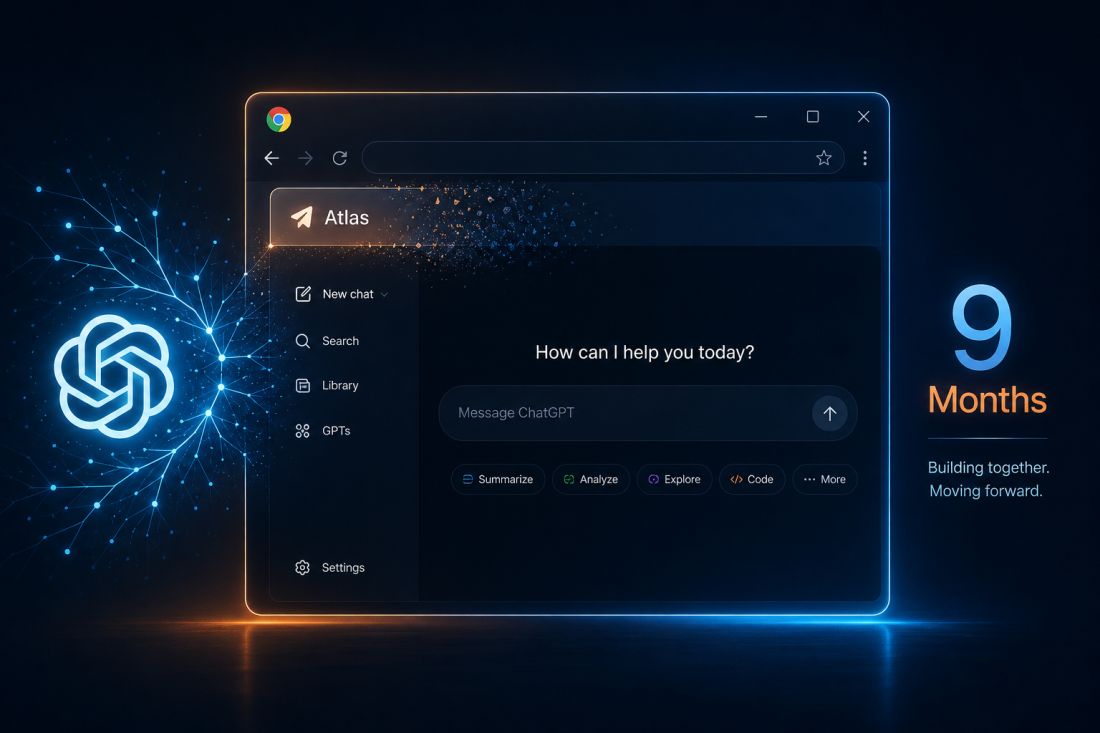
OpenAI Atlas shutdown is a lesson in what browsers actually cost. OpenAI is sunsetting ChatGPT Atlas, its standalone AI browser, on August 9, 2026 — just nine months after launch. The company isn’t retreating from AI-powered browsing; it’s folding the same features into a Chrome extension and its ChatGPT desktop app instead. The real story isn’t the shutdown — it’s that even OpenAI concluded a standalone browser wasn’t worth the infrastructure cost required to compete with Chrome.
- 9 months — Atlas’s lifespan, October 2025 to August 9, 2026 deprecation
- 2nd — major OpenAI product cut this year, after Sora
- 6 tested, 1 fixed — AI browsers tricked by the “BioShocking” prompt-injection attack; only OpenAI shipped an effective patch
- 3 — replacement surfaces: Chrome extension, in-app browser, and a remote cloud browser inside ChatGPT Work
A Fast Reversal From a Company That Doesn’t Usually Reverse Fast
OpenAI launched Atlas in October 2025 as a standalone browser built around chatting with the web itself. OpenAI confirmed plans to “sunset” Atlas, with deprecation scheduled for August 9, alongside a slew of ChatGPT Work announcements. Nine months is a short lifespan for a flagship product from the industry’s most closely watched AI lab — and that timeline is the more useful data point here than the shutdown itself.
“All these capabilities were built on what we learned from Atlas users who took a leap of faith on a new browser.” — James Sun, OpenAI
Why Building a Browser Was the Expensive Choice
A browser isn’t just a UI — it’s a permanent security and compatibility commitment, competing against a product Google has funded for two decades. OpenAI appears to have concluded the browser is a feature, not the destination, folding Atlas’s agentic capabilities into a Chrome extension and a more capable ChatGPT desktop app instead. That’s a lower-maintenance path to the same functionality — you inherit Chrome’s security patching and compatibility work instead of owning it yourself.
The Cost Nobody Priced In: Security Debt
Standalone AI browsers carry a risk cost beyond engineering hours. Security firm LayerX recently tricked six AI browsers into leaking user credentials via a prompt-injection technique called “BioShocking” — Atlas, Perplexity’s Comet, Anthropic’s Claude extension, and three smaller browsers all initially fell for it; OpenAI was the only vendor to ship an effective fix. An agent with browsing permissions and stored logins is a genuinely new attack surface, one every AI browser vendor is currently paying for, largely alone.
⚠ Illustrative scenario (fictional): A mid-size operations team builds an internal workflow around Atlas’s agentic browsing, automating a weekly reporting task. Nine months later, they’re rebuilding that workflow around a Chrome extension instead — not because the underlying idea failed, but because the platform it was built on was never designed to last past a single product cycle.
Global Implications: A Warning for Every “AI Browser” Pitch
OpenAI’s reversal followed a directive from applications CEO Fidji Simo to cut “side quests,” the same push that closed the Sora video app. For buyers and operators anywhere, including emerging markets evaluating AI tooling vendors, the lesson travels directly: a standalone browser product from even the best-funded AI lab in the world lasted nine months. Any vendor pitching a similar standalone product deserves a direct question about maintenance economics, not just a feature demo.
💡 CreedTec Analyst’s Note — Daniel Ikechukwu
Strategic Impact: Standalone AI browsers carry infrastructure costs that rarely show up in a product demo — and even OpenAI wasn’t willing to keep paying them.
Stop: Assuming a product’s backing by a major AI lab guarantees long-term support or product-market fit.
Start: Asking AI tooling vendors directly how they plan to sustain infrastructure-heavy products beyond the current hype cycle.
Watch: Whether Perplexity’s Comet and The Browser Company’s Dia follow the same standalone-to-embedded pivot within the next year.
ROI Outlook: Cautionary for teams building workflows around any single-vendor standalone AI browser; favorable for those using browser-agnostic extensions instead.
A tool built around a nine-month product shouldn’t be your workflow’s foundation. Subscribe to CreedTec’s newsletter for the infrastructure risk signals AI vendors don’t lead with.
Further reading on CreedTec:
What Is Artificial Intelligence in 2026? · Dell’s Rack-Scale AI Systems · KPMG’s AI Report on Hallucinations · Meta’s AI Product Problem · 2026 AI Regulation and Compliance