Fast Facts
Dell rack-scale AI systems recorded 757% revenue growth in Q4 FY2026 and 181% ISG growth in Q1 FY2027. But the number is not the story. The story is what it signals: the unit of enterprise AI infrastructure has shifted from the server to the rack. That shift changes how manufacturers buy, deploy, and budget for AI compute — and most enterprise buyers haven’t updated their procurement frameworks to match.
📊 By the Numbers
| Stat | Value |
|---|---|
| 757% | AI-optimized server revenue growth, Q4 FY2026 — Dell Technologies SEC filing |
| $43B | AI server backlog entering FY2027 — Jeff Clarke, Dell COO |
| $60B | Raised FY2027 AI server revenue target — Dell Q1 FY27 earnings, June 2026 |
Dell rack-scale AI systems are no longer a product line. They are the financial engine of the company’s transformation — and a signal about where enterprise AI infrastructure is heading that extends well beyond Dell’s quarterly results.
Dell’s Q1 FY2027 results reported ISG revenue of $29.0 billion — up 181% year over year — with AI-optimized server revenue of $16.1 billion, up 757% year over year. The company raised its full-year AI server revenue outlook to $60 billion and projected total revenue of $167 billion at the midpoint, up nearly 50% year over year. These are not incremental figures. They represent a fundamental shift in what Dell sells and who buys it.
The Rack Is Now the Product
For decades, the server was the unit of enterprise compute procurement. You bought servers, integrated them into your data center, managed cooling, and built your infrastructure stack from individual components upward.
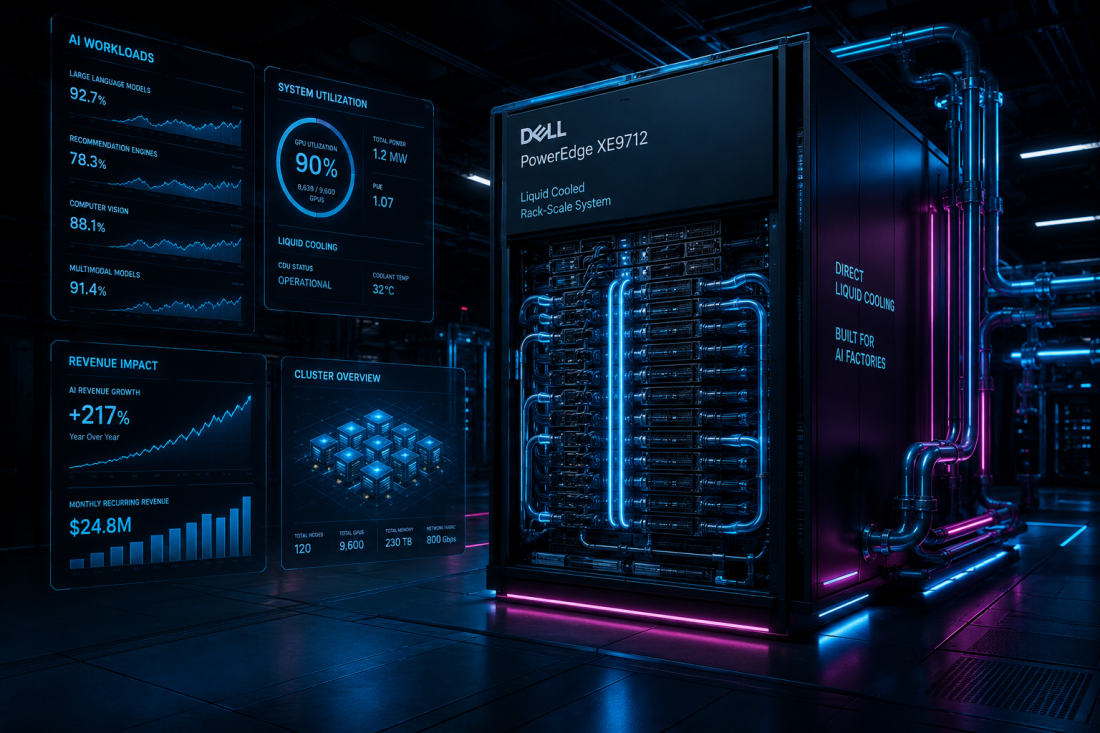
Dell’s Integrated Rack Scalable Systems (IRSS) architecture — anchored by the PowerEdge XE9712, built around NVIDIA’s GB300 NVL72 with 36 Grace CPUs and 72 Blackwell GPUs per rack — changes that model at the foundation. The rack ships as a validated, liquid-cooled, fully integrated unit. Power densities now trend toward 500 kW per rack. You are not buying a server. You are buying an AI factory module that requires site-level power and cooling infrastructure planning before the purchase order is written.
Dell was first to ship the XE9712 with NVIDIA GB300 NVL72 to CoreWeave, establishing the rack-scale deployment benchmark for cloud and enterprise AI infrastructure. That first-mover position in rack-scale fulfillment is now translating directly into the backlog figures that define Dell’s FY27 outlook.
“We closed more than $64 billion in AI-optimized server orders, shipped more than $25 billion throughout the year, and are entering FY27 with record backlog of $43 billion — powerful proof that our engineering leadership and differentiated AI solutions are winning.”— Jeff Clarke, Vice Chairman and COO, Dell Technologies (FY2026 Q4 Earnings)
The Integration Cost Enterprise Buyers Underweight
The financial logic of rack-scale procurement is not contained in the purchase price. Hidden integration costs — power infrastructure upgrades, liquid cooling installation, facility modification for high-TDP racks — routinely exceed the hardware cost in enterprise deployments. Dell’s IRSS program includes site evaluation, power and cooling design, and deployment services as part of the engagement, which shifts integration risk from the buyer to the vendor.
For manufacturers and industrial operators evaluating on-premise AI compute, this changes the total cost of ownership calculation significantly. The server price is the visible cost. The facility readiness for 500 kW rack-scale systems is the invisible one — and it is the variable that most procurement frameworks are not yet capturing.
⚠ Fiction — Illustrative Scenario
A manufacturing CTO approves an AI infrastructure budget based on per-server pricing. The rack-scale deployment arrives. The data center’s power infrastructure supports 150 kW per rack. The XE9712 requires 400 kW. The facility modification costs exceed the hardware cost by 40%. The budget was approved six months before anyone checked the power specs.
What Q1 FY27 Signals for Enterprise Buyers
According to Futurum Research’s analysis of Dell’s Q4 FY2026 results, the company described “a component environment where demand outpaces supply, elevating input costs and extending lead times.” Dell’s CFO David Kennedy raised the FY27 AI server revenue target to $60 billion, noting the AI opportunity “shows no signs of slowing.”
For enterprise buyers, extended lead times mean procurement decisions made today determine deployment timelines in 2027. The AI server TAM is projected to grow from approximately $120 billion in 2024 to over $310 billion by 2027, according to IDC and Dell’Oro Group projections. Organizations that delay infrastructure commitments while competitors deploy will face both a capability gap and a queue position problem — lead times compound as backlog grows.
CoreWeave’s own capacity constraints demonstrate what happens when AI infrastructure demand outpaces procurement planning. The organizations avoiding that position are the ones in Dell’s $43 billion backlog now.
Global Implications
Dell’s rack-scale architecture is not a US-only story. Sovereign AI programs across the Middle East, Southeast Asia, and Europe are acquiring rack-scale AI infrastructure to build national compute capacity. Industrial AI decision-making in manufacturing requires on-premise compute at a scale that server-by-server procurement cannot efficiently support. The rack-scale model accelerates deployment velocity for enterprise customers — but only if their facility infrastructure is prepared in advance. For emerging market industrial operators, that prerequisite is the primary bottleneck, not budget.
💡 CreedTec Analyst’s Note
By Daniel Ikechukwu — Strategic Impact Assessment
Strategic Impact: Dell’s rack-scale revenue figures confirm that the unit of enterprise AI infrastructure procurement has moved from server to rack. This is not a product upgrade — it is a procurement paradigm shift that requires facility infrastructure, power planning, and total cost of ownership frameworks to be redesigned before the purchase decision, not after.
- ⛔ Stop: Budgeting AI infrastructure on per-server pricing alone. Rack-scale systems require power density assessments, liquid cooling infrastructure plans, and facility modification budgets that should appear in the business case before vendor selection.
- ✅ Start: Engaging Dell’s site evaluation and deployment services before committing to rack-scale procurement. The IRSS program includes pre-deployment infrastructure assessment — use it as a planning input, not a post-sale service.
- 👁 Watch: Dell’s FY27 Q2 results. If AI-optimized server revenue tracks toward the $60 billion full-year target, lead times will extend further. The procurement window for FY27 delivery is narrowing with each earnings beat.
ROI Outlook: Industrial AI ROI in on-premise deployments depends on compute availability matching workload demand. Rack-scale systems deliver higher throughput per deployment cycle — but only when facility infrastructure is correctly sized from the start. The ROI case for rack-scale AI is strong; the execution risk is entirely in the site preparation layer.
📬 CreedTec Weekly
If your organization is planning AI infrastructure investment in 2026–2027 and hasn’t assessed rack-scale power and cooling requirements, your procurement timeline is already behind. Subscribe to CreedTec’s weekly briefing — industrial AI systems, infrastructure strategy, and the financial logic behind the machines. → creedtec.online