This article is part of CreedTec’s Enterprise Automation TCO Week, a 4-day analytical series breaking down the hidden financial metrics behind the world’s largest Industrial AI and robotics ecosystems.
Fast Facts
The Siemens Xcelerator hidden integration cost isn’t a secret—it is a metric calculation most factory finance teams aren’t factoring in before signing. While the platform delivers documented operational outcomes, implementation services typically run 1.5x to 3x the software license fee. Factory CFOs who build their ROI models solely on software licensing fail to realize the total integration debt until late in the deployment cycle.
📊 By the Numbers
- 1.5x–3x — Industry benchmark for implementation service cost relative to first-year license fee across enterprise industrial software (ERP Research, 2026; Qualimero, citing Trovarit study, 2026)
- 51% — Share of enterprise software implementations that run over budget (Panorama Consulting, 2025)
- 25%+ — Hidden cost add-on from storage overages, API limits, and sandbox fees alone in cloud enterprise deployments (Qualimero, 2026)
- 700+ — Certified partner sellers on the Siemens Xcelerator Marketplace — each a potential integration touchpoint with its own cost structure (Siemens, 2026)
The Siemens Xcelerator hidden integration cost isn’t a secret Siemens is keeping. It’s a calculation most factory finance teams aren’t making. When procurement approves an Xcelerator deployment based on the license figure in the vendor proposal, they’re pricing roughly half the investment. The rest — system integration, data migration, partner configuration, training, API connections — arrives on separate invoices, on a separate timeline, against a budget that was never built to absorb it.
This is not a Siemens-specific problem. It is a structural feature of every enterprise industrial cloud platform. What makes Xcelerator worth examining specifically is the scale of its ecosystem — 700+ certified partners, each an interoperability asset and a potential cost node simultaneously.
The License Is the Entry Ticket, Not the Full Price
According to ERP Research’s 2026 implementation cost breakdown, the industry benchmark for implementation services runs 1.5x to 3x the first-year software license or subscription fee — and for complex, highly customised enterprise deployments, that ratio can exceed 3x. Siemens Xcelerator deployments sit firmly in the complex category: multi-system IT/OT integration, legacy PLC connectivity, edge device configuration, and partner ecosystem onboarding all add to the service stack before a single production workflow goes live.
Siemens’ own published case studies show what a well-executed deployment delivers — DMG MORI achieved a 40% reduction in production ramp-up time and a 75% reduction in unproductive testing using Xcelerator’s digital twin technology. Northrop Grumman reduced rework by 90%. These are real, documented results. They are also the results of deployments that were scoped, resourced, and integrated correctly — which is precisely the investment the headline license number doesn’t capture.
Why the Partner Network Multiplies Siemens Xcelerator Hidden Integration Costs
Siemens positions Xcelerator’s 700+ certified partner network as its core differentiator — an interoperable ecosystem of vetted hardware, software, and services providers that extends the platform’s capability well beyond what Siemens builds directly. That positioning is accurate. The integration architecture that allows AI systems to make real decisions on factory floors depends on exactly this kind of ecosystem depth.
What the partner network also creates is a layered integration surface. Each certified partner connection — however pre-vetted for interoperability — requires configuration, testing, and ongoing maintenance. The AI productivity paradox applies directly here: the more capable the platform, the more implementation effort is required to realize that capability. According to Qualimero’s 2026 enterprise cost analysis, cloud platform hidden costs from storage overages, API rate limits, and sandbox environment fees alone add 20% or more to budget projections that were built on license cost alone.
“Implementation services often cost 1.5x to 3x the license fees — and hidden costs like storage overages and API limits can add 20% or more on top of that.”
— Qualimero Enterprise Cost Analysis, 2026 (citing Trovarit study)
Calculating the True Software Implementation Cost Structure
The most expensive phase of an Xcelerator deployment isn’t operations — it’s the period between contract signature and production go-live. Data migration from legacy MES and SCADA systems, staff training on new workflows, custom API development for non-standard equipment, and the internal project management overhead of coordinating across Siemens, system integrators, and certified partners all accumulate before the platform generates a single efficiency metric.
Stakeholder fear of budget overruns mid-cycle is one of the most documented causes of industrial AI platform underperformance — and it applies directly to Xcelerator deployments where the integration phase runs longer or costlier than the original model. According to Panorama Consulting’s 2025 benchmarks, 51% of enterprise software implementations exceed their approved budget. The majority of overruns originate not from software licensing but from the indirect operational costs that only become visible after the project moves into production.
⚠ Fiction — Illustrative Scenario
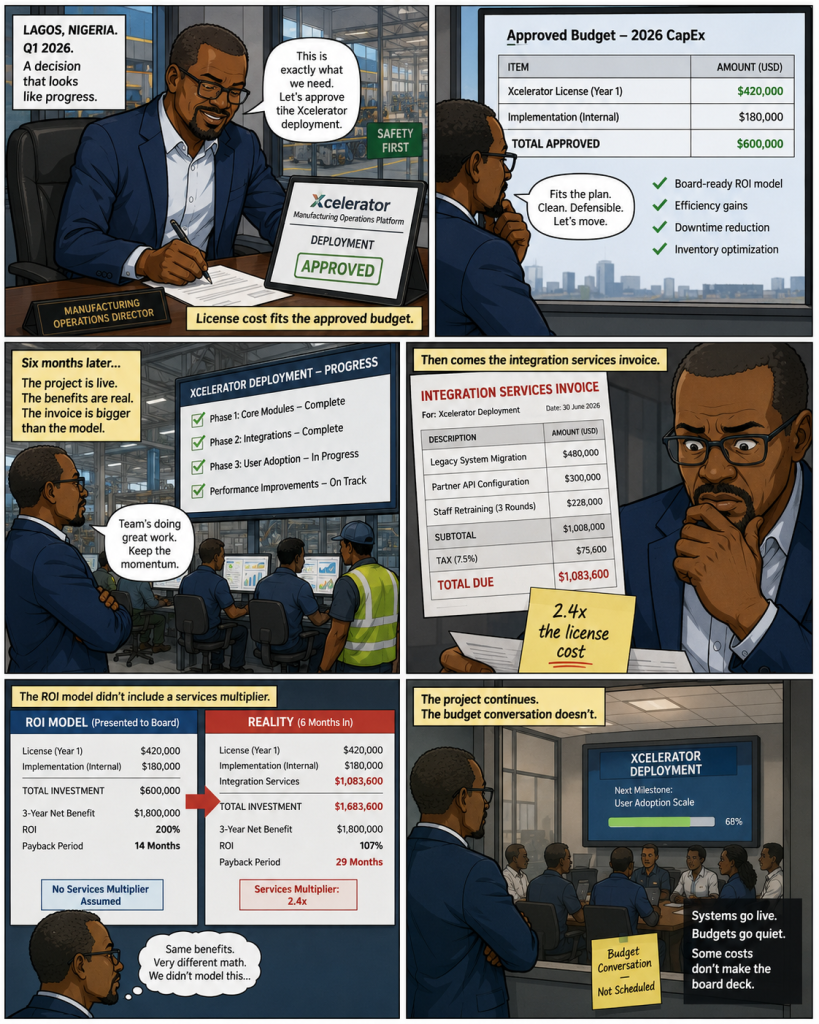
A manufacturing operations director at a mid-size facility in Lagos approves an Xcelerator deployment in Q1 2026. The license cost fits the approved budget. Six months in, the integration services invoice — covering legacy system migration, partner API configuration, and three rounds of staff retraining — comes to 2.4x the license figure. The ROI model built for board approval didn’t include a services multiplier. The project continues. The budget conversation doesn’t.
Emerging Market Deployments Carry an Additional Layer
For facilities in Nigeria, West Africa, and Southeast Asia adopting Xcelerator, the integration cost structure carries an additional variable: most certified Siemens partners operate from Europe, North America, or East Asia. Remote integration engagements — time zone overhead, travel costs for on-site validation, and the absence of local certified partners — add to the services bill in ways that a procurement team working from a global benchmark won’t automatically price.
Trustworthy industrial AI deployments in 2026 require TCO models built for the actual deployment environment, not the vendor’s reference case. The Xcelerator platform’s documented results are achievable in emerging markets — but only when the integration budget reflects the actual cost of getting there, not the cost of getting there in Stuttgart.
💡 CreedTec Analyst’s Note
Daniel Ikechukwu — Strategic Impact
Siemens Xcelerator is a credible industrial platform with documented results. The ROI miscalculation problem is not the platform’s fault — it’s a procurement framing problem that the vendor’s sales process has no structural incentive to correct. The license number that wins board approval is not the number that determines whether the deployment delivers. The integration services multiplier is. Factory CFOs who build their business case on license cost alone are pricing a fraction of the investment they’re about to make.
- Stop: Building Xcelerator ROI models against the license cost alone. The Trovarit-sourced benchmark of 1.5x–3x implementation services is the starting multiplier, not the ceiling.
- Start: Requesting a fully itemised services estimate — integration, migration, training, partner configuration, sandbox, and API costs — before budget approval, not after contract signature.
- Watch: Siemens’ Altair acquisition deepening the platform’s simulation and AI capabilities. More capability means more integration surface, which means the services multiplier for new deployments is likely to move upward, not down, over the next 18 months.
ROI Outlook: Xcelerator deployments scoped with a full TCO model — license plus 2x services plus 12-month operational overhead — will recover investment faster than those budgeted on license alone. The gap between the two models isn’t a rounding error. For a mid-size facility, it’s often the difference between a 24-month and a 48-month payback period.
FAQ: Siemens Xcelerator Hidden Integration Cost & TCO
What is the standard implementation services multiplier for industrial software?
Independent research from groups like ERP Research and Trovarit shows that enterprise implementation services routinely run 1.5x to 3x the cost of the first-year software license fee. For highly customized enterprise manufacturing setups, this ratio can climb even higher.
What hidden costs commonly inflate industrial cloud platform budgets?
Beyond the baseline software subscription or license fee, total cost of ownership (TCO) spikes from unbudgeted data migration, customized API limits, edge computing hardware configuration, sandbox testing environment overhead, and ongoing staff workflow training.
Industrial platform cost analysis, procurement strategy, and ROI frameworks — built for operators who need the honest picture before they sign.