Fast Facts
The Siemens AI IoT platform edge isn’t the AI — it’s the data behind it. Siemens unveiled Digital Twin Composer at CES 2026, combining industrial IoT data, AI, and photorealistic digital twins into one platform. PepsiCo’s pilot deployment caught up to 90% of design issues before construction began and lifted projected throughput 20%. The AI models behind this — NVIDIA Omniverse, Microsoft’s Azure OpenAI Service — are available to any competitor. What isn’t available to competitors is the decades of proprietary industrial IoT data Siemens already has running through its installed equipment base.
- 90% — design issues PepsiCo’s Digital Twin Composer pilot identified before physical construction
- 20% — projected throughput increase from the same pilot
- 9 — new AI-powered industrial copilots Siemens unveiled at CES 2026
- 99.5%+ — accuracy claimed for AI vision-based defect detection in the Siemens-NVIDIA Industrial AI Operating System
- Mid-2026 — Digital Twin Composer’s availability on the Xcelerator Marketplace
What Actually Launched at CES 2026
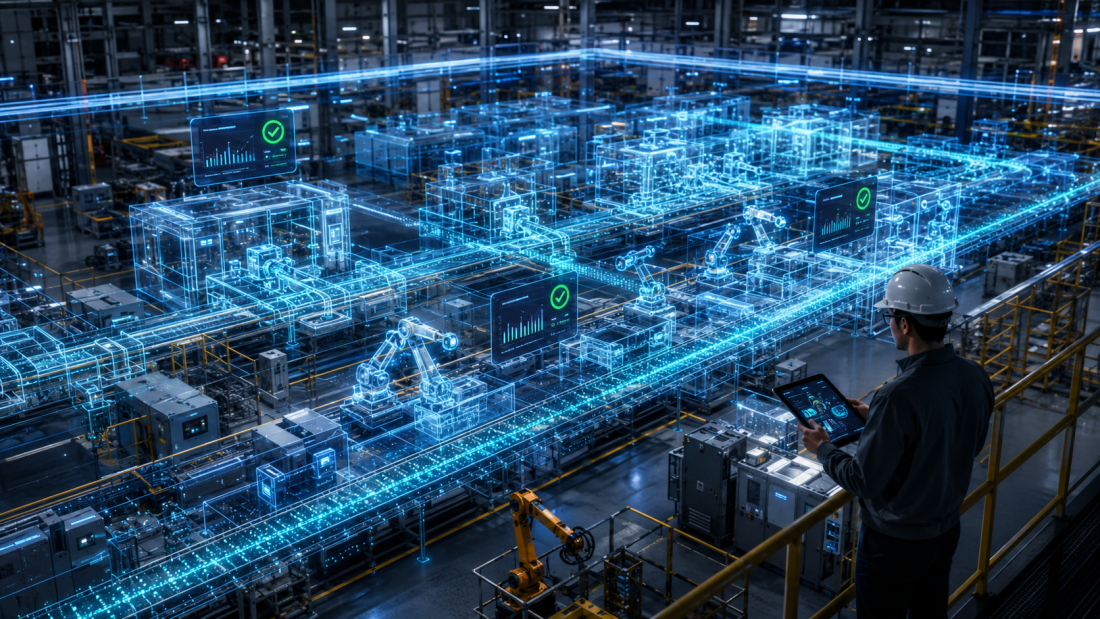
Digital Twin Composer merges 2D and 3D digital twin data with live operational information from manufacturing execution systems, plus physics-based simulation built on NVIDIA Omniverse. PepsiCo used it to simulate upgrades to US facilities before committing capital, catching design issues and lifting throughput projections before a single physical change was made.
“Industrial AI is no longer a feature; it’s a force that will reshape the next century.” — Roland Busch, President and CEO, Siemens AG
Why the AI Models Aren’t the Real Moat
The AI components powering Siemens’ platform aren’t exclusive. Siemens’ Industrial Copilot runs on Microsoft’s Azure OpenAI Service, the same generative AI infrastructure available to any enterprise customer. NVIDIA Omniverse, the simulation engine behind Digital Twin Composer, is likewise sold to competitors. Any well-funded rival could license the same underlying AI tomorrow. What they couldn’t replicate overnight is what Siemens already has running through decades of installed SIMATIC controllers and sensor networks across thousands of factories worldwide.
The Data Advantage Behind the 90% Number
PepsiCo’s result — catching 90% of design issues before construction — wasn’t primarily an AI achievement. It required years of accumulated operational data from manufacturing execution systems already running on Siemens infrastructure, feeding a simulation model that had real historical patterns to compare against. A generic AI tool bolted onto a factory with no comparable data history couldn’t replicate that number, regardless of which language model powers it. The AI is the interface; the proprietary industrial IoT data is the actual asset.
⚠ Illustrative scenario (fictional): A manufacturer evaluates two AI platform vendors: one offering a newer, flashier generative AI interface, and one with a decade of the manufacturer’s own sensor and equipment data already integrated. The flashier platform demos better in the sales meeting. Six months into deployment, it can’t match the older platform’s prediction accuracy — because it has no historical data to learn from, only the manufacturer’s live feed starting from day one.
Global Implications: The Real Question for Buyers Everywhere
For manufacturers evaluating industrial AI platforms in any market, the Siemens example reframes the right procurement question. It’s not “does this vendor have AI” — every serious vendor does now. It’s “how much historical operational data does this vendor already have on equipment and processes like mine, and how portable is that advantage if I switch providers later.” Vendor lock-in risk and data portability deserve as much scrutiny as the AI feature list itself.
💡 CreedTec Analyst’s Note — Daniel Ikechukwu
Strategic Impact: Proprietary historical IoT data, not AI model access, is the durable competitive advantage behind platforms like Siemens’ Digital Twin Composer.
Stop: Evaluating industrial AI vendors primarily on which AI models or copilots they’ve integrated.
Start: Asking vendors how much historical operational data underlies their platform’s predictions, and how portable your own data would be if you switched providers.
Watch: Whether Digital Twin Composer’s mid-2026 marketplace launch attracts customers beyond Siemens’ existing installed base.
ROI Outlook: Strong for existing Siemens customers with years of compatible operational data; less certain for new customers starting a data history from zero.
The AI in a platform demo isn’t the asset — the data behind it is. Subscribe to CreedTec’s newsletter for the vendor questions procurement teams skip.
Further reading on CreedTec:
The Dark Data IIoT Opportunity Is Hiding in Files You Already Own · AT&T’s Industrial IoT Logistics Play Is About Margin, Not Bandwidth · Myriota’s Hybrid Satellite-Cellular IoT Network · Industrial IoT ROI in 2026 · The IIoT Sensor Data Training Gap