
This article is part of CreedTec’s Enterprise Automation TCO Week, a 4-day analytical series breaking down the hidden financial metrics behind the world’s largest Industrial AI and robotics ecosystems.
Fast Facts
The IIoT sensor data training gap is the factory AI problem hiding in plain sight. SCADA systems routinely smooth sensor readings to suppress nuisance alarms — which means the data most factory AI models train on is a cleaned, sanitised version of reality. The model never learns from actual factory noise. Then it deploys into it. And fails.
📊 By the Numbers
- 99.5%+ — Accuracy threshold industrial AI models must meet, versus 95% for consumer AI — leaving near-zero margin for training data quality gaps (Jeff Winter, VP Critical Manufacturing, IIoT World Days 2025)
- 24–30% — Real-world performance drop when AI policies transfer from sanitised simulation environments to live hardware (Yang et al., arXiv, August 2025)
- Cost of app — In many IIoT deployments, the cost of data integration exceeds the cost of the application itself, per FumaxTech’s 2026 IIoT acquisition analysis
- 10 samples — Minimum real-world anchor images needed to produce reliable AI inspection models using generative synthetic data (IIoT World, March 2026)
The IIoT sensor data training gap isn’t being discussed in most factory AI deployments — and that silence is expensive. Across industrial facilities running predictive maintenance, quality control, and anomaly detection systems, the AI models making real-time decisions were trained on data that doesn’t reflect real-time reality. Not because of simulation software. Because of the data pipeline sitting between the sensor and the training dataset.
The mechanism is well-documented and almost universally overlooked: traditional SCADA systems routinely smooth sensor readings to suppress nuisance alarms. The outliers, spikes, and irregular readings that define real factory conditions get filtered out before the data reaches storage. Then that smoothed dataset becomes the training corpus for the AI. The model learns a version of the factory that exists nowhere except the historian database.
What SCADA Smoothing Actually Does to an AI Model
Predictive maintenance algorithms depend on detecting micro-anomalies — the subtle deviations in vibration frequency, temperature drift, or pressure variance that precede equipment failure by hours or days. According to FumaxTech’s 2026 IIoT data acquisition analysis, “traditional SCADA systems often smooth data to avoid nuisance alarms, but this practice strips away the very anomalies that predictive maintenance algorithms need to detect incipient failures.”
That is not a peripheral engineering note. It describes a structural contradiction at the core of most factory AI deployments: the system designed to protect operators from alarm fatigue is simultaneously destroying the training signal the AI needs to do its job. IIoT time-series data corruption from power instability compounds this further — the real sensor stream is noisier than the smoothed record in ways the model has never encountered.
The 99.5% Standard Leaves No Room for Clean-Data Fantasy
At IIoT World Days 2025, Jeff Winter, VP of Business Strategy at Critical Manufacturing, made the accuracy requirement explicit: while consumer AI succeeds at 95% accuracy, industrial models require 99.5% or above — because a false positive that halts a production line and a false negative that misses a critical failure both carry direct financial consequences. There is no tolerance band for a model trained on optimistic data operating in a pessimistic environment.
The 24–30% performance drop documented when AI policies transfer from sanitised simulation to live hardware isn’t exclusively a robotics problem. It applies equally to any IIoT model whose training data was pre-processed into a version of reality that the deployment environment doesn’t match. IIoT ROI calculations that don’t account for this gap are built on a flawed baseline — they model the performance of the trained system, not the performance of the deployed one.
“Industrial sensor data streams are inherently noisy. Outliers, gaps, and faulty readings are not exceptions — they are the norm.”
— FumaxTech IIoT Data Acquisition Analysis, 2026
The Fix Is Smaller Than the Problem Sounds
IIoT World’s March 2026 analysis of zero-defect manufacturing documented that generative synthetic data tools now allow manufacturers to train robust inspection models from as few as ten real-world samples — provided those samples are drawn from the actual production environment, not a controlled test setup. The same principle applies to the sensor data training gap: the fix isn’t rebuilding the entire data pipeline. It’s ensuring that a representative sample of raw, unsmoothed sensor data — including the spikes and outliers SCADA typically filters — is included in every training dataset.
Fixing IIoT data latency and improving data pipeline architecture addresses part of this — but the training gap requires a deliberate data governance decision, not just a connectivity upgrade. The IT/OT data ownership clash is precisely what prevents this decision from being made: OT teams control the SCADA configuration, IT teams manage the data pipeline, and neither team owns responsibility for training data quality.
⚠ Fiction — Illustrative Scenario
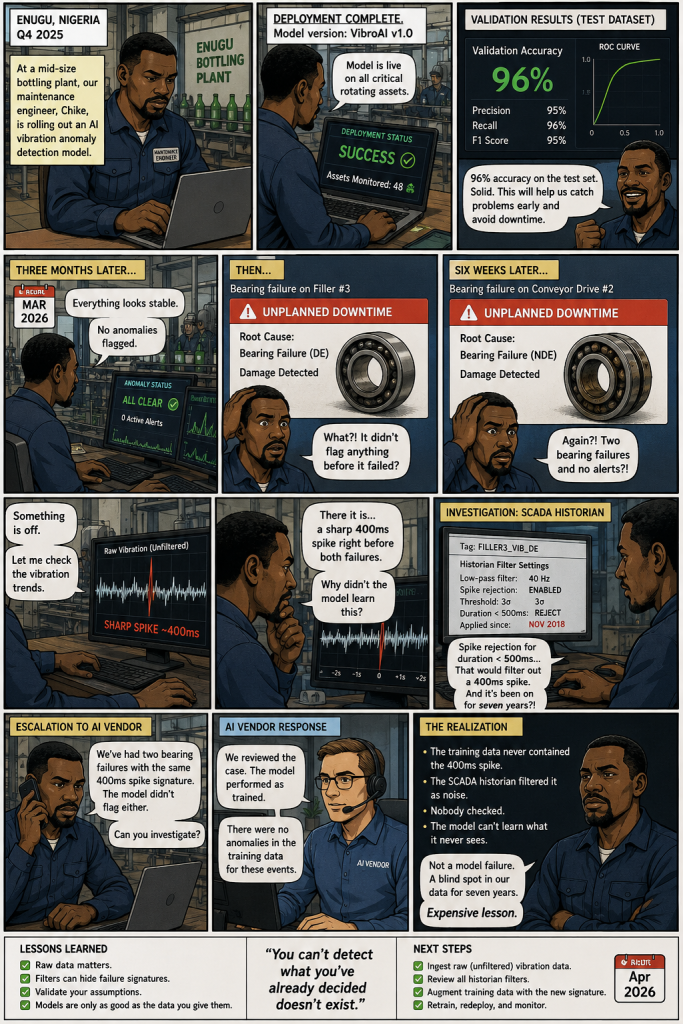
A maintenance engineer at a mid-size bottling plant in Enugu deploys a vibration anomaly detection model in Q4 2025. Validation accuracy on the test dataset runs at 96%. Three months into live operation, the model misses two bearing failures that produce a signature it has never seen — a sharp 400ms spike that the SCADA historian had been filtering as noise for seven years. The engineer escalates to the AI vendor. The vendor confirms the model performed as trained. The training data never contained that spike. Nobody had checked.
Emerging Market Factories Inherit the Worst of Both Problems
For facilities in Nigeria, Ghana, and Southeast Asia, the IIoT sensor data training gap compounds with a local infrastructure reality: power instability, equipment age, and non-standard component sourcing create sensor noise profiles that even a well-constructed training dataset from a stable European production environment won’t contain. The audit-driven IIoT adoption crisis is partly a symptom of this — facilities that deployed AI systems without validating training data quality are now discovering the gap when the model fails to perform.
The Canadian Institute for Cybersecurity’s 2025 IIoT testbed research confirms that “simulations or small-scale setups often fail to reflect the nuanced behaviors of real IIoT deployments” — with protocol heterogeneity, device variability, and environmental conditions all contributing to a gap between the training environment and the production environment. Emerging market facilities operating multi-vendor, multi-protocol factory floors face this gap at its widest.
💡 CreedTec Analyst’s Note
Daniel Ikechukwu — Strategic Impact
The IIoT sensor data training gap is the most structurally overlooked source of factory AI underperformance in 2026. It isn’t a technology failure — it is a data governance failure that sits at the intersection of OT configuration decisions and IT data pipeline management. The SCADA smoothing that protects operators from alarm fatigue is simultaneously corrupting the training signal for every AI model downstream. Fixing it requires a deliberate policy decision, not a platform upgrade. And it costs far less than absorbing the performance gap it creates.
- Stop: Validating IIoT AI models only on processed historian data. If the validation dataset doesn’t include raw, unsmoothed sensor streams, the validation result tells you nothing about deployment performance.
- Start: Auditing the data pipeline between your SCADA system and your AI training dataset. Identify where smoothing, filtering, or gap-filling occurs — and ensure a representative sample of raw signal is preserved for training.
- Watch: Edge AI platforms that process raw sensor data locally before it reaches the historian. These architectures preserve the anomaly signal that SCADA cloud pipelines discard — and the facilities deploying them are building training datasets that actually reflect their production environment.
ROI Outlook: A training data audit and pipeline correction for a mid-size IIoT deployment typically costs less than two days of engineering time. The cost of one missed critical failure event — bearing, pump, compressor — almost always exceeds the annual maintenance budget for the AI platform itself. The audit is the cheapest insurance in the facility.
Frequently Asked Questions
How do I know if my factory AI model has a sensor data training gap?
Three indicators: the model performs well on historical validation but underperforms in live deployment; it generates frequent false negatives on real failure events that weren’t in the training data; and your training dataset was sourced exclusively from SCADA historian exports without raw sensor logs. If all three apply, the training gap is almost certainly present.
What should procurement teams require from IIoT AI vendors about training data?
Two specific disclosures before contract signature: the exact data source and pre-processing pipeline used to construct the training dataset, and documented validation performance on raw, unsmoothed sensor data from an environment comparable to your facility. If the vendor cannot provide both, the validation numbers in their proposal are not measuring what you think they are measuring.
Is this gap worse for facilities in Nigeria or West Africa than elsewhere?
Structurally, yes. Power instability, multi-vendor equipment, and non-standard component sourcing create sensor noise profiles that most off-the-shelf training datasets — built against stable Western or East Asian production environments — don’t contain. Local raw data collection and real-world anchoring are not optional for these facilities. They are the variable that determines whether the AI performs as purchased.
IIoT data strategy, sensor architecture intelligence, and AI deployment analysis — built for operators who want performance, not just promises.