Last Updated 2026
Fast Facts
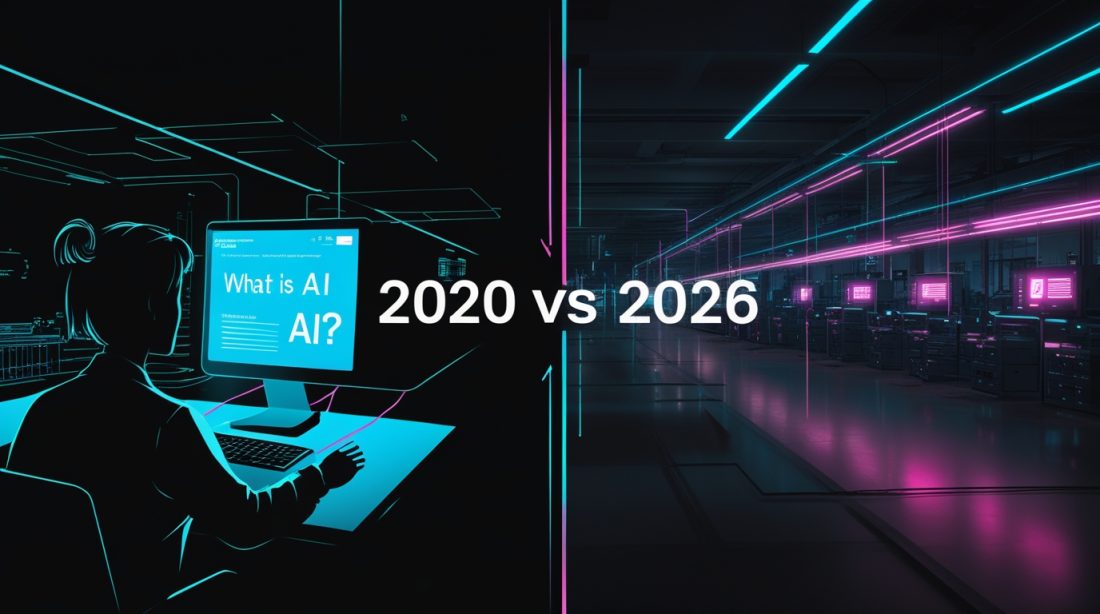
In 2020, “what is artificial intelligence?” was a definition question. In 2026, it’s a decision question — because 88% of organizations already use it in at least one business function. If you’re still asking what AI is, you’re not a beginner. You’re behind. And the gap between your understanding and your competitors’ deployment is measurable in revenue, not curiosity.
📊 By the Numbers — 2026
- $514.5B — Global AI market in 2026, up 19% from $390.9B in 2025 (Stanford AI Index / CompaniesHistory, 2026)
- 88% — Share of organizations using AI in at least one business function (Stanford AI Index, 2026)
- 65% — Generative AI adoption rate in 2026, double the rate from ten months earlier (Stanford AI Index, 2026)
- $15.7T — AI’s projected contribution to the global economy by 2030 (PwC Global AI Study)
- 53% — Share of organizations citing data privacy as their top AI challenge (ResourceRA, 2026)
What is artificial intelligence in 2026 is no longer a question about definition. The textbook answer — machines that simulate human reasoning — was adequate in 2020 when AI was still largely experimental. In 2026, with 88% of global organizations actively deploying AI in business functions, the question has shifted from “what is it?” to “what is it doing, who controls it, and what happens if my organisation hasn’t started yet?”
That shift matters because the cost of not understanding AI has changed. In 2020, not knowing what AI was meant you missed a trend. In 2026, it means your competitors are using it to make decisions faster, cheaper, and at scale — while your teams are still debating the definition.
Three Types of AI Running Businesses Right Now
The word “AI” in 2026 covers three distinct operational systems that behave very differently and carry very different financial implications. Understanding the distinction is the real beginner’s guide — not because it’s academic, but because procurement decisions, hiring decisions, and operational risk all depend on which type you’re dealing with.
Narrow AI — the most widely deployed — does one thing well: image recognition, demand forecasting, fraud detection, quality control. It is not general intelligence. It cannot reason outside its trained domain. According to the Stanford AI Index 2026, 65% of generative AI adoption and the vast majority of enterprise deployments are narrow AI systems embedded in specific workflows. Industrial AI decision-making in factories runs almost entirely on narrow AI — and it’s already making calls worth $260,000 per hour in automotive settings.
Generative AI — the fastest-growing category — produces text, images, code, and synthetic data from prompts. ChatGPT recorded 900 million weekly active users by February 2026, more than doubling from 400 million a year earlier. It is reshaping content, software development, and customer operations at a pace that no prior technology adoption curve has matched.
Agentic AI — the emerging frontier — takes autonomous actions toward complex goals without step-by-step human prompting. It doesn’t just answer questions; it executes workflows, books meetings, writes and deploys code, and triggers purchasing decisions. Autonomous AI systems are the category that most organisations have not yet priced into their governance models — and the one that carries the highest operational risk when deployed without accountability frameworks.
The Economic Reality Most Beginner Guides Skip
Most introductions to AI explain what it can do. The more useful explanation is what it costs your organisation not to engage with it. According to the World Economic Forum’s Future of Jobs Report, 86% of employers anticipate AI will transform their business operations by 2030. The 14% that don’t are either in industries genuinely insulated from automation — or they are underestimating it in a way that will be visible in their competitive position within three years.
PwC’s projection of $15.7 trillion in AI-generated economic value by 2030 is not evenly distributed. It accrues disproportionately to organisations that have moved from understanding to deployment — and to the countries and regions that have built the policy and infrastructure to support that transition. The AI productivity paradox is real: adoption without operational integration produces cost without return. The beginner’s guide that matters in 2026 isn’t about what AI is. It’s about how to deploy it so the investment compounds.
“88% of organisations now use AI in at least one business function. The question is no longer whether to adopt — it’s whether your adoption is generating return or just generating cost.”
— Stanford AI Index, 2026
⚠ Fiction — Illustrative Scenario
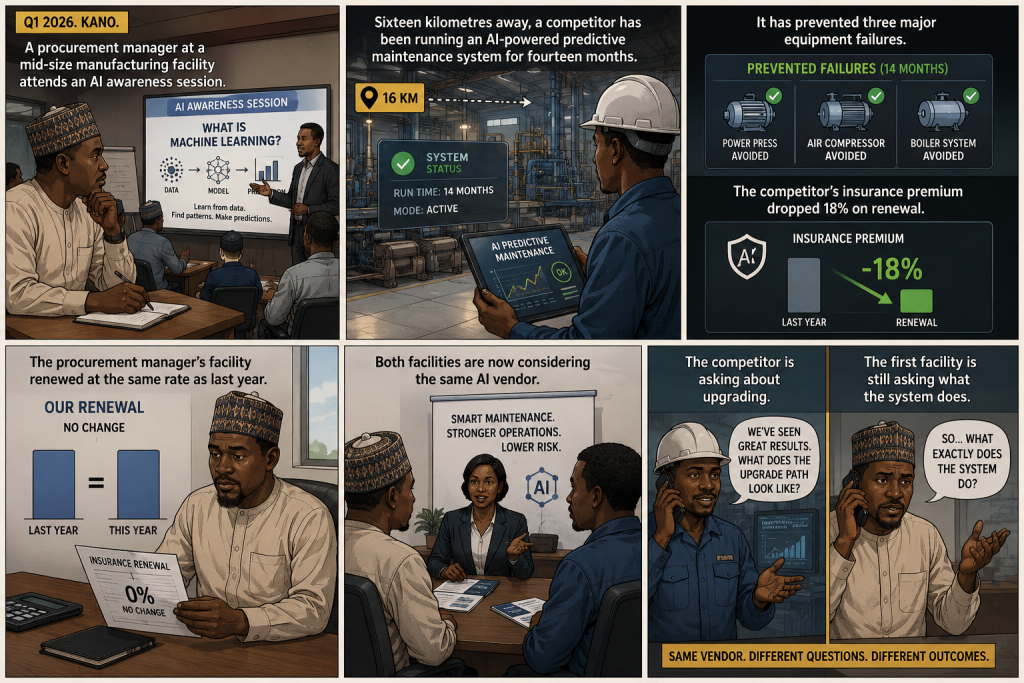
A procurement manager at a mid-size manufacturing facility in Kano attends an AI awareness session in Q1 2026. The session explains what machine learning is. Sixteen kilometres away, a competitor has been running an AI-powered predictive maintenance system for fourteen months. It has prevented three major equipment failures. The competitor’s insurance premium dropped 18% on renewal. The procurement manager’s facility renewed at the same rate as last year. Both facilities are now considering the same AI vendor. The competitor is asking about upgrading. The first facility is still asking what the system does.
What AI Means for Emerging Market Operators in 2026
For businesses in Nigeria, Ghana, and Southeast Asia, the “what is AI” conversation is often still framed as a distant technology adoption question. The 2026 data suggests it shouldn’t be. Industrial AI pilot projects in Nigeria are demonstrating that the operational and financial case for narrow AI deployment in manufacturing, agriculture, and logistics is achievable at current infrastructure levels — without enterprise-scale IT investment.
The risk for emerging market operators is not that AI is inaccessible. It’s that the gap between understanding and deployment is widening while competitors — locally and globally — are closing it. Trustworthy AI deployments with proven ROI in 2026 share one characteristic: they started from a specific operational problem, not a general exploration of “what AI is.” The beginner’s guide that drives results is problem-first, not technology-first.
💡 CreedTec Analyst’s Note
Daniel Ikechukwu — Strategic Impact
The “what is AI” question in 2026 carries a hidden cost for every organisation that is still answering it philosophically. The AI market at $514.5 billion and growing at 19% annually is not waiting for stragglers. The organisations generating return from AI in 2026 didn’t start with a comprehensive understanding of artificial intelligence — they started with a specific problem and a deployable narrow AI tool. The definition came later. The competitive advantage came from moving.
- Stop: Treating AI education as a prerequisite to AI adoption. Operational pilots generate more useful understanding than any amount of definition-reading — and they generate revenue simultaneously.
- Start: Identifying one measurable operational problem — downtime, defect rate, demand forecasting error — and finding a narrow AI tool with a documented deployment track record in your sector. That is your beginner’s guide in practice.
- Watch: Agentic AI entering operational workflows in 2026–2027. Unlike narrow AI, agentic systems make autonomous decisions with real-world consequences. Understanding what it is before it is deployed in your organisation is not academic. It is governance.
ROI Outlook: Organisations that move from definition to deployment on a single narrow AI use case in 2026 typically recover their initial investment within 12–18 months through measurable operational improvement. The question “what is AI?” becomes self-answering once a system is live. The organisations still asking it in 2027 will be the ones whose competitors’ deployments have already compounded for two years.
Frequently Asked Questions
What is the simplest definition of artificial intelligence in 2026?
AI is software that makes decisions or produces outputs by learning from data, rather than following explicit rules written by a programmer. In 2026, it spans narrow task-specific systems, generative tools that create content, and agentic systems that take autonomous multi-step actions. The type matters more than the definition — each carries different operational implications.
How should a business with no AI experience start in 2026?
Start with a specific, measurable operational problem — not a general AI strategy. Identify one process where the cost of error or inefficiency is quantifiable: equipment downtime, quality defect rate, demand forecast accuracy. Find a narrow AI tool with documented deployment results in your sector and run a 90-day pilot with clear success metrics. The technology education follows from the operational experience.
What is the procurement risk of buying AI tools without understanding them?
Three specific risks: paying for capability you don’t use (the most common), deploying without a performance benchmark (so you can’t tell if it’s working), and signing contracts that give the vendor ownership of the data your operations generate. All three are addressable before signature — none of them require deep technical knowledge, only the right procurement questions.
AI strategy, deployment intelligence, and operational analysis — built for operators ready to move from understanding to return.