Fast Facts
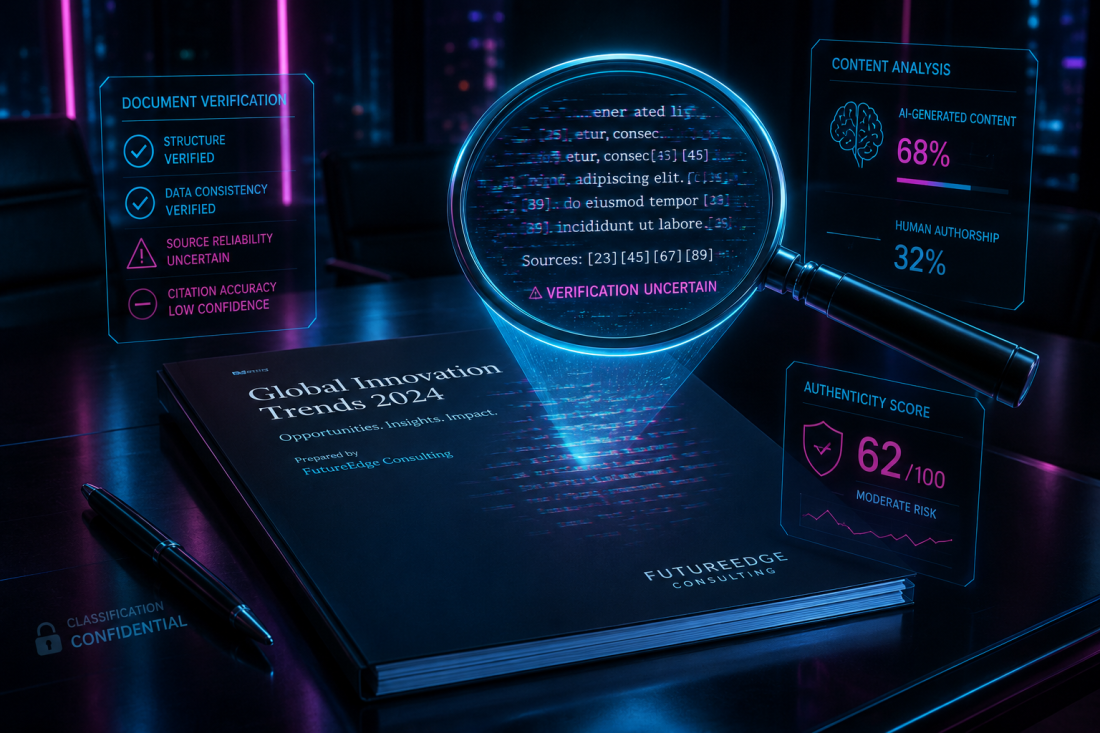
KPMG AI report hallucinations were exposed this week after GPTZero found 40 of 45 citations in KPMG’s flagship agentic AI report were fabricated or wrong. EY and Deloitte have already faced the same finding. The real risk isn’t embarrassment — it’s enterprises making multi-million dollar AI investments on invented evidence.
| Metric | Finding |
|---|---|
| 40/45 | Citations in KPMG’s AI report were fabricated or incorrect (GPTZero, 2026) |
| 16/27 | Sources in EY Canada’s AI report were fabricated or broken (GPTZero, 2026) |
| 4th | Professional-services firm caught publishing AI-fabricated content within a matter of months |
KPMG AI report hallucinations did not surface in a fringe white paper. They appeared in “Total Experience: Redefining Excellence in the Age of Agentic AI” — a flagship October 2025 report from one of the world’s most trusted consulting firms, published to guide enterprises on AI adoption.
GPTZero’s forensic review found that 40 of 45 citations were fabricated, mangled, or misattributed. Only five correctly pointed to real sources. UBS, the UK’s National Health Service, Swiss Federal Railways, and Transport for London all told the Financial Times that the report’s claims about their AI usage were untrue or misleading. KPMG has since pulled the report and launched an internal review, stating it “takes the accuracy and integrity of its published content seriously.”
That statement would carry more weight if the report had not contradicted KPMG’s own data — citing 55% of CEOs who rank AI as their top investment priority, while KPMG’s own 2025 CEO Outlook, published the same month, put the number at 71%.
What the GPTZero Audit Reveals About KPMG AI Report Hallucinations
GPTZero, led by Princeton researcher and CEO Edward Tian, coined a phrase for the pattern: “vibe citing.” The AI appears to stitch together fragments of real sources, invent plausible-sounding titles, or mangle references beyond recognition — producing citations that look authoritative until someone actually clicks them.
One citation offered a 2019 railway press release as evidence of AI-agent deployment — despite the term “AI agent” not entering common usage until 2024. The model also repeatedly confused article subjects with their authors.
This is not a KPMG-specific failure. EY Canada’s December 2025 cybersecurity report was pulled after GPTZero found 16 of 27 sources fabricated or broken. Deloitte Australia refunded a government client after AI-generated errors appeared in a taxpayer-funded document. KPMG is now the fourth professional services firm — alongside two law firms — caught publishing AI-fabricated content in recent months.
“For AI fabrications to be trickling down from a consultancy of KPMG’s stature, it poisons the well of information — increasing the risk of second-hand hallucinations.”— Edward Tian, CEO, GPTZero (via the Financial Times)
The Governance Problem Nobody Is Naming
Consulting firms occupy a specific role in the AI economy: enterprises pay them to evaluate technology objectively and provide evidence-based recommendations. That relationship carries an implicit warranty of verification.
When AI generates citations and nobody checks whether those citations exist, that warranty collapses. As CreedTec has documented through the Amelia AI failure case study, AI governance failures don’t announce themselves in advance. They surface in the output — at the exact moment a client commits to a decision built on fabricated evidence.
McKinsey reportedly deployed 12,000 AI agents across its operations last year, shortly after laying off approximately 5,000 employees. The efficiency argument is real. But efficiency that bypasses verification is not competitive advantage. It is liability accumulation.
⚠ Fiction — Illustrative Scenario
A procurement director in Southeast Asia references a Big Four AI report to justify a $4.2 million vendor contract. Three statistics supporting the ROI case — each attributed to named industry bodies — cannot be verified because the sources don’t exist. The vendor is selected. The project fails. The board blames the procurement team. Nobody re-reads the citations.
The Financial Risk of Consulting Firm AI Hallucinations
Every enterprise that has used Big Four AI reports to justify technology spend should ask: were those citations independently verified before the decision was made? For most organizations, the answer is no — because the entire value of an institutional report is the assumption that someone else already did the verification.
If that assumption is now broken, the downstream exposure is not a headline. It is misallocated capital, failed implementations, and audit findings that trace back to invented sources. Tian’s phrase “second-hand hallucinations” captures the mechanism: enterprises receive fabricated content from trusted institutions and repeat it internally as established fact, building strategy on fiction at arm’s length.
Global Implications
Enterprises in West Africa, Southeast Asia, and South Asia increasingly rely on international consulting reports to benchmark AI investment decisions. Those markets now carry a credibility risk that no disclaimer footnote addresses. The question for procurement teams globally is no longer “is this source credible?” — it is “was this source verified before it was published?” Those are no longer the same question.
💡 CreedTec Analyst’s Note
By Daniel Ikechukwu — Strategic Impact Assessment
Strategic Impact: The KPMG hallucination scandal exposes a systemic governance failure in how consulting firms use AI for content production. The trust relationship between enterprise buyers and institutional research is now a financial risk variable — not a baseline assumption.
- ⛔ Stop: Accepting citations in AI reports at face value — even from Big Four firms. Spot-check three to five references before using any AI research to justify a procurement or strategy decision.
- ✅ Start: Treating AI-generated content in vendor and consulting reports as unverified by default. Build citation verification into your AI governance checklist as a pre-decision step.
- 👁 Watch: GPTZero’s ongoing investigation pipeline. Four professional services firms in months is a pattern, not an anomaly — and the next report your team relies on may already be in their queue.
ROI Outlook: Organizations that implement citation verification before procurement will avoid the compounding cost of decisions made on fabricated evidence. The Deloitte Australia government refund establishes legal precedent: clients can demand financial accountability when AI errors reach published reports. That precedent is now active.
FAQ: Enterprise AI Governance & Consulting Errors
What caused the KPMG AI report hallucinations?
A programmatic forensic audit discovered that 40 out of 45 citations in a flagship agentic AI report from the firm were completely fabricated, distorted, or misattributed by unverified generative models.
How can enterprises prevent second-hand AI hallucinations?
Organizations must implement automated document verification tools like GPTZero alongside strict human-in-the-loop review checklists before utilizing external research to justify large procurement investments.
📬 CreedTec Weekly
If your team relies on consulting reports to guide AI investment, you need to know which ones have been verified — and which ones haven’t. Subscribe to CreedTec’s weekly briefing — industrial AI, governance, and the financial logic behind the machines. → creedtec.online