Fast Facts
Google DeepMind’s Gemini Robotics 2, unveiled Thursday, gives humanoid robots whole-body control — coordinating walking, balance, and manipulation together instead of as isolated tasks. The demo is impressive. The line worth reading twice is buried in the announcement: Google’s own tests showed stronger performance from simple two-finger grippers than from humanlike multi-finger hands. For buyers, that’s a bigger signal than the whole-body choreography — it points at what’s commercially ready now versus what’s still a research demo.
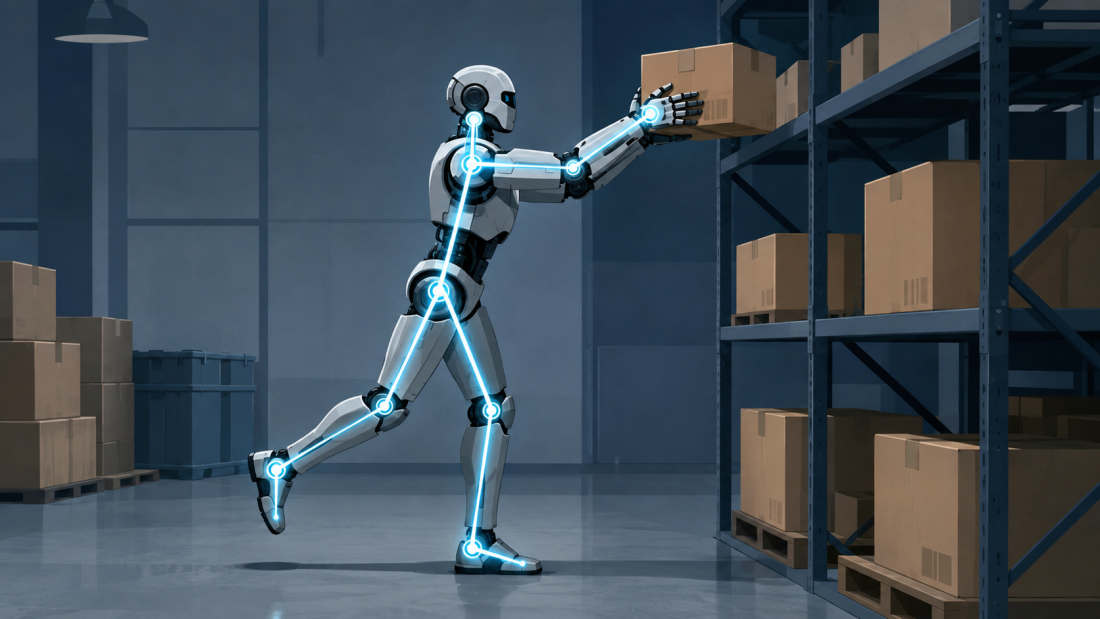
Whole-body control is the headline capability of Gemini Robotics 2, a three-model AI system Google DeepMind unveiled Thursday that lets humanoid robots coordinate movement across their entire bodies rather than executing isolated, pre-programmed motions, according to Bloomberg. The system was demonstrated on Apptronik’s Apollo 2 humanoid, walking, crouching, bending, and placing objects on shelves while reasoning through the sequence in real time.
Why Whole-Body Control Isn’t the Number That Matters Most
3 Models
Gemini Robotics 2 ships as three separate systems: a vision-language-action model for motor control, Gemini Robotics ER 2 as the embodied-reasoning “brain,” and On-Device 2, which adapts to new two-arm robot designs with fewer than 200 examples.
Source: SiliconANGLE, July 30, 2026
The architecture matters economically as much as technically. Gemini Robotics ER 2 crafts a high-level plan and hands it to a lower-level vision-language-action model that turns instructions into motor commands — a division of labor that lets Google sell the reasoning layer broadly through Google AI Studio and its Enterprise Agent Platform, while keeping the actual motor-control models restricted to selected early-access partners, according to Robotics & Automation News. That’s a scarcity strategy, not a technical limitation — the same pattern chip makers use when they sell broad access to mid-tier products while rationing their most advanced hardware to strategic partners.
“Distant goal.”— Google DeepMind, describing true dexterity in the Gemini Robotics 2 announcement
The Detail Google Buried That Buyers Should Lead With
Tests showed stronger performance with two-finger grippers than multifinger hands, according to The AI Insider. That single line undercuts a lot of the industry’s five-fingered marketing imagery. If Google’s own testing — from the lab pushing whole-body control the hardest — finds simpler end effectors outperforming humanlike hands right now, buyers chasing dexterous, humanlike grippers for near-term deployment may be paying a premium for capability that underperforms cheaper tooling. See our earlier coverage of Unitree’s TIME cover hiding a 9% industrial deployment problem, where the same gap between demo capability and deployable reality shows up in a different robotics category entirely.
Google also introduced ASIMOV-Agentic, a safety benchmark that tests whether robots refuse unsafe commands and request human help rather than executing them — a meaningful governance signal, though DeepMind itself acknowledged the overall system remains slow and that true dexterity is still a distant goal. That candor is unusual for a product launch and worth taking at face value: whole-body control coordination is real progress, but it is not yet a production-ready capability.
⚠ Fiction — composite scenario, not a real event: A warehouse operator signs a pilot contract for humanoid robots specifically for their five-finger dexterous grippers, drawn in by demo footage of delicate object handling. Six months into deployment, the two-finger-gripper units on the same platform are outperforming the dexterous-hand units on throughput and reliability for the actual sorting tasks the warehouse needs — the fancier hardware was solving a problem the operator didn’t actually have.
Global Implications
Gemini Robotics 2’s multi-robot collaboration feature — letting several machines coordinate on tasks spanning hundreds of steps — points toward fleet-level deployment as the real commercial target, not single-robot showcases. Google’s tiered access model, with the reasoning layer broadly available and the motor-control layer restricted to early-access partners, will likely determine who gets first-mover advantage in whole-body control applications long before general availability arrives.
For manufacturers in Nigeria, West Africa, and Southeast Asia evaluating humanoid robotics platforms, the practical lesson from Google’s own gripper data is to specify hardware based on the actual task, not the most impressive demo. A two-finger gripper handling a defined, repetitive task will likely outperform and outlast a dexterous hand chasing generalized manipulation that even Google calls a distant goal. See our analysis of China’s robot hands winning the volume war for how that same simpler-hardware-wins pattern is already playing out at the component level.
💡 CreedTec Analyst’s Note — Daniel Ikechukwu
Strategic Impact: Whole-body control coordination is the genuine technical advance in this release. The commercially relevant finding is quieter: simpler grippers currently outperform humanlike hands, which should reshape near-term hardware specification decisions more than the flashy demo does.
Stop: Specifying dexterous, multi-finger end effectors by default for tasks that a simpler two-finger gripper could handle just as well or better today.
Start: Asking any humanoid robotics vendor for task-specific performance data comparing gripper types, not just whole-body demo footage.
Watch: Whether Gemini Robotics 2’s early-access partner list expands, and whether Apptronik’s Apollo 2 becomes the reference platform other robotics makers benchmark against.
ROI Outlook: Buyers who match gripper complexity to actual task requirements, rather than to demo aesthetics, will see faster payback than those who over-specify humanlike dexterity for jobs that don’t need it.
Whole-body control is the part of this announcement built for headlines. The two-finger gripper data is the part built for procurement decisions — and it’s the one Google’s own tests, not its marketing, are pointing to.
Subscribe to CreedTec’s newsletter — it tracks which robotics capabilities are demo-ready versus deployment-ready, starting with what the vendors’ own data actually shows.
Sources
- Bloomberg — original announcement coverage
- SiliconANGLE — three-model architecture breakdown
- The AI Insider — gripper performance and ASIMOV-Agentic benchmark details
- Robotics & Automation News — Apptronik Apollo 2 demonstration and access tiers
- Google DeepMind — official Gemini Robotics ER 2 announcement
Further reading: Unitree’s TIME Cover Hides a 9% Industrial Deployment Problem · China’s Robot Hands Are Winning the Volume War · World Labs’ Sim-to-Real Leap Let Robots Run an Hour Alone · Top Robotics Companies in 2026 · Humanoid’s $1.35B Round Exposes the Robot Pre-Orders Gap