Fast Facts
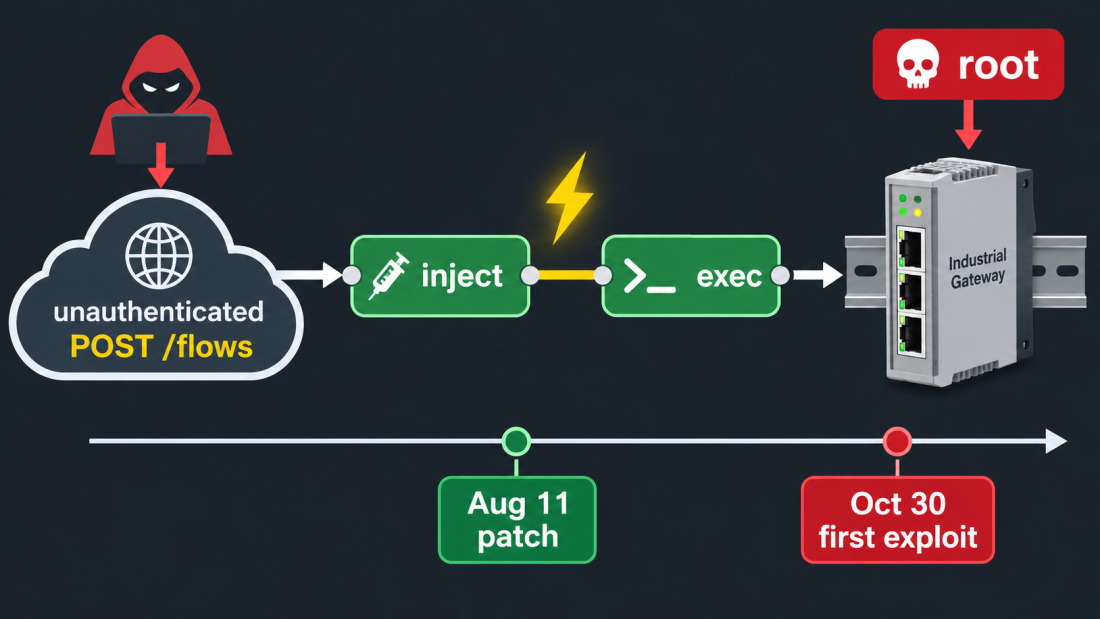
Attackers are exploiting CVE-2026-58115, a CVSS 10.0 missing-authentication flaw in Node-RED on Siemens (ETR: SIE) SIMATIC IoT2050 Advanced gateways. VulnCheck’s decoy caught the first complete Node-RED exploitation attempt on October 30, and Siemens had shipped the fix on August 11.
The lesson is the gap: roughly eighty days passed between patch and attack. Plants should check three things today: whether the gateway runs Node-RED, whether its editor port is reachable from outside, and whether the firmware is at V4.3.4.1 or later.
Edge gateways are the quiet middle of industrial IoT, translating machine data for cloud dashboards. When one runs an open flow editor, it becomes a command line for strangers. The latest Node-RED exploitation shows how little an attacker needs, and how long a known fix can sit unapplied.
How the Node-RED Exploitation Works
Node-RED is a flow-based tool that wires event-driven steps together in a browser editor. Siemens’ advisory SSA-834709 says affected IoT2050 Advanced devices (article number 6ES7647-0BA00-1YA2) running Industrial OS with Node-RED installed do not enforce authentication on that HTTP interface. An unauthenticated attacker can create malicious flows and run code with maximum privileges.
VulnCheck researcher Patrick Garrity described the first request as a complete exploit: one POST deployed a flow, triggered it automatically and pulled a binary from an attacker’s server behind three layers of encoding. He called the flaw trivial to weaponize
because an inject node and an exec node chain into instant command execution. Some later requests planted webshells inside flows. Those survive a reboot, while the downloaded bot, stored in memory, does not.
| Metric | Details |
|---|---|
| CVSS score | 10.0 |
| Siemens advisory date | Aug 11 |
| Exploitation attempts | 16 attempts, Oct 30 to Nov 1 |
| Fixed Industrial OS version | V4.3.4.1 |
Sources: Siemens SSA-834709; VulnCheck canary data, as reported by Help Net Security (Nov 3, 2026).
What We Do and Do Not Know
VulnCheck did not retrieve the advertised Linux binary, so nobody outside the attacker can say whether it is a cryptominer, a DDoS bot or a reverse shell. The same address in Microsoft’s network, geolocating to Brazil, sent 16 attacks at the Node-RED flaw and 125 hits across eight different CVEs, from Apache Solr to Gitea. Garrity reads that as opportunistic mass scanning, and a rented or compromised cloud machine says little about who is behind it.
The canary emulates a Node-RED instance, so this is evidence that unsecured editors get found automatically, not proof that any named factory was breached. VulnCheck added the flaw to its own exploited catalog, while Help Net Security noted CISA had not listed it in its Known Exploited Vulnerabilities catalog at the time of writing.
The Patch Gap Is the Story
Siemens’ fix and the attack are separated by about eighty days. Industrial devices rarely get the monthly patch cadence of office laptops, since downtime has a price. SecurityWeek reports a Honeywell survey in which only 21% of industrial security leaders have a complete OT asset inventory, even as 88% call their programs mature. You cannot patch a gateway you have not listed. See our analysis where we explain why industrial AI infrastructure needs protection before it scales.
Ownership makes it worse. Gateways sit between IT and OT, and each side assumes the other watches them. See our analysis where we explain why IT and OT teams clash over IIoT data ownership, because an orphaned gateway is where a three-month gap lives.
What Plant Teams Should Do This Week
Siemens lists two mitigations if immediate updating is impossible: uninstall Node-RED or harden it using the Node-RED user guide. Practical hardening means enabling adminAuth and keeping port 1880 off the internet. VulnCheck’s advice is to find every Node-RED instance, including those embedded inside OT products, and confirm whether it is reachable from outside the network. Devices without Node-RED are outside the advisory.
Segmentation limits the blast radius when a patch lags. See our analysis where we explain how industrial Wi-Fi zoning keeps IIoT networks reliable, and how legacy PLC constraints slow every change. For the wider risk picture, see our analysis where we explain the industrial AI safety concerns plant managers face in 2026.
⚠️ Hypothetical scenario: A Lagos bottling plant bought an IoT2050 gateway through an integrator in 2024. The integrator left Node-RED running for dashboards and port 1880 open for remote support. Nobody on the plant’s list owns the box, and the August advisory went to an inbox the integrator no longer reads. A scan finds it in November. Production keeps running, but the gateway may be quietly working for someone else until an audit catches it.
💡 CreedTec Analyst’s Note by Daniel Ikechukwu
Strategic Impact
This Node-RED exploitation is a procurement and ownership failure more than a coding one. A fix existed for eighty days, so the exposed cost sits in asset inventory, support contracts and who answers for an embedded gateway.
Stop / Start / Watch
- Stop: leaving flow editors reachable from the internet or open without adminAuth.
- Start: an owner, a version and a patch deadline for every gateway on site.
- Watch: whether CISA adds CVE-2026-58115 to its KEV catalog and whether VulnCheck identifies the payload.
ROI Outlook
An inventory sweep and a firmware update cost engineer hours, while a Node-RED exploitation incident on a root-level gateway can cost a line stoppage and an incident review. For emerging-market plants running integrator-installed edge boxes, the cheapest control is knowing the box exists.
— Daniel Ikechukwu
Do you know which gateways in your plant run open editors?
The CreedTec Industrial IoT Brief tracks exploited OT flaws and gives you the checklist before the audit does.
Subscribe to the IIoT Brief
Sources
- Help Net Security: Attackers exploit critical Node-RED flaw (Nov 3, 2026)
- VulnCheck: Exploitation Targeting Node-RED, a Tool Embedded in ICS Products (Nov 2, 2026)
- Siemens ProductCERT advisory SSA-834709 (Aug 11, 2026)
- heise online: Siemens Simatic IoT2050 targeted
- SecurityWeek ICS/OT: Honeywell OT security survey coverage