Fast Facts
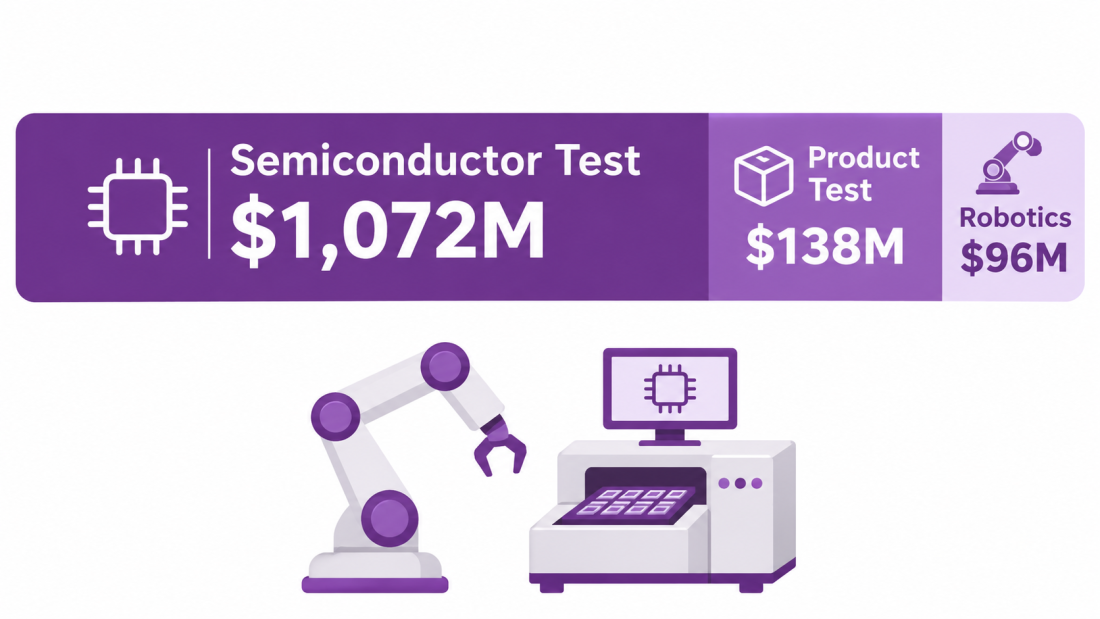
The Teradyne Q3 results (NASDAQ: TER), filed with the SEC for the quarter ended September 27, show revenue of $1,306 million, up 70% from $769 million, and non-GAAP EPS of $2.29. Semiconductor Test brought in $1,072 million, Product Test $138 million and Robotics $96 million, which Teradyne says was its best third quarter and a return to profitability.
The money is made by testing AI chips, not by selling robots. Robotics is about 7% of revenue by our arithmetic, and its profit was not quantified. The Q4 guide of $1.25 to $1.35 billion points to a plateau at a very high level.
Teradyne sells to both ends of industrial AI: the machines that test the chips, and the cobots that move parts on factory floors. The Teradyne Q3 results show how lopsided that mix has become, and what it implies for anyone buying or valuing robots.
What the Teradyne Q3 Results Show
Per the company’s 8-K, GAAP net income attributable to Teradyne was $342.4 million, against $118.1 million a year earlier per Goldesel, with GAAP EPS of $2.17. CEO Greg Smith said results beat the top of guidance and that “demand extended across the AI value chain.” Teradyne also bought back $99.3 million of stock in the quarter and held $460.7 million in cash.
$1,306M revenue | +70% | Robotics $96M
Source: Teradyne 8-K. Robotics share of about 7% and Semiconductor Test share of about 82% are our arithmetic from the segment figures.
Where the Money Comes From
The Teradyne Q3 results carry one more AI signal. An automated MarketBeat summary of the call, not verified against filings, puts AI-related revenue above 60% of the total and a record $301 million in memory test. Treat those as indicative. The 8-K itself confirms the segment totals. For context on how AI demand lifts industrial suppliers unevenly, see our analysis where we explain why TSMC’s Q3 results show AI demand is capped by packaging, not orders. Memory is a shared pressure point too: see how the AI memory shortage drove Samsung’s 250-fold profit surge.
Robotics: Profitable, but Small
Within the Teradyne Q3 results, Robotics, which houses the Universal Robots cobot line, delivered $96 million and, per the release, achieved profitability. The company gave no segment profit figure, so the size of the turnaround is unknown. The MarketBeat summary says Smith expects physical AI to become a significant robotics driver, with broad adoption likelier in 2028 than 2027, aside from one large customer. That is a hedge worth noting, and it comes from an automated summary rather than the transcript.
“Demand extended across the AI value chain.”
— Greg Smith, CEO, Teradyne
The unit also operates under legal pressure. See our analysis where we explain how Teradyne’s cobot copyright lawsuit froze Elite Robots out of Germany. Rivals and funding trends matter here too, as in why five deals took 80% of $1.56B in industrial robotics funding.
The Guide and the Signal
The guide after the Teradyne Q3 results matters too. Q4 revenue guidance of $1,250 to $1,350 million has a midpoint near $1,300 million, essentially flat on Q3 by our arithmetic. Non-GAAP EPS guidance of $1.95 to $2.25 has a midpoint of $2.10, below Q3’s $2.29. The MarketBeat summary adds that gross margin fell 70 basis points sequentially on mix and that inventory rose ahead of expected 2027 growth, half for demand and half for components that could become scarce. Industrial peers show a similar pattern of strong AI exposure and softer automation: see our analysis where we explain how Honeywell’s Q3 results show data center orders doubling as automation lags.
⚠️ Hypothetical scenario: A Lagos packaging plant is quoted for two cobots and asks whether the vendor will still support the product line in five years. The Teradyne Q3 results suggest a parent funded by chip testing, which lowers the odds that the robot unit is cut for cash reasons. It does not guarantee pricing or support terms, so the plant should still ask for them in writing.
💡 CreedTec Analyst’s Note by Daniel Ikechukwu
Strategic Impact
Teradyne is an AI-test company with a robotics division, not the reverse. For buyers, that makes the robot line a cross-subsidized business: stable while chip testing booms, exposed if it turns.
Stop / Start / Watch
- Stop: reading a robotics vendor’s group revenue as proof of robotics demand.
- Start: asking for segment-level profit and a support commitment before signing multi-year cobot contracts.
- Watch: whether Robotics profit is disclosed in the 10-Q, and whether Q4 lands inside the guide.
ROI Outlook
The robotics return is unproven at $96 million a quarter with no stated profit. The chip-test return is real but cyclical. Do not extrapolate either from one quarter.
— Daniel Ikechukwu