Fast Facts
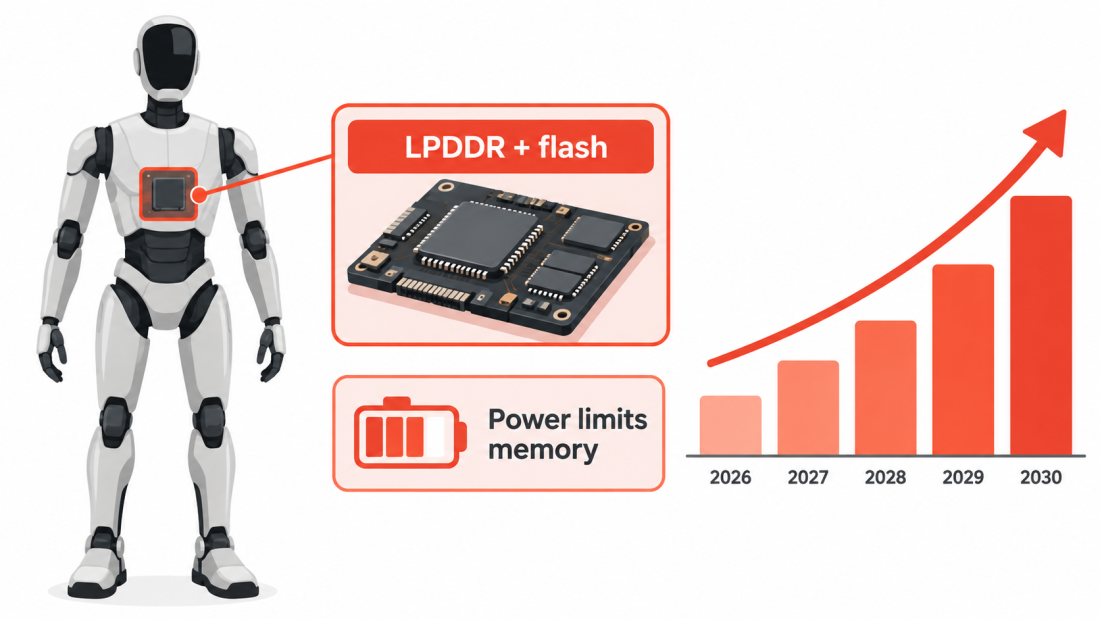
Humanoid robot memory demand could rise from about 8,300 terabits of DRAM in 2026 to about 172,000 terabits in 2030, roughly 20 times, according to Counterpoint Research figures reported on October 11 and 12. Per-robot DRAM is projected to rise from about 19 GB to about 39 GB.
Most of that growth is unit volume, not bigger memory per robot. It is a single-firm forecast off a tiny base, and Tesla’s own memory trimming cuts against the per-robot assumption. Use this guide to read it correctly.
Memory makers have found a new story: robots. The headline is dramatic, but humanoid robot memory demand is easy to misread. This guide explains what the forecast measures, what it leaves out, and how a buyer or investor should test it.
What the Forecast Says About Humanoid Robot Memory Demand
Counterpoint’s figures, as relayed by 24/7 Wall St. and JoongAng Daily, cover DRAM in robot computing systems only, not storage. The total rises about 20.7 times between 2026 and 2030, while DRAM per robot rises about 2.05 times. Divide one by the other and unit growth is roughly 10 times. By our arithmetic that implies about 55,000 humanoids in 2026 and about 550,000 in 2030, which is not a number Counterpoint published, so treat it as an inference.
8,300 to 172,000 terabits | 19 GB to 39 GB per robot
Counterpoint Research via 24/7 Wall St. and JoongAng Daily. The implied unit counts are our arithmetic. The full report was not available to us.
Why Robots Use Low-Power Memory
Analysts quoted by JoongAng Daily expect humanoids to use low-power DRAM (LPDDR) and high-capacity flash rather than the high-bandwidth memory (HBM) used in data-center accelerators, because robots run on batteries. Samsung has begun sampling LPDDR6 and says it wants removable SSDs to become a standard robotics solution within five years. SK hynix is reportedly working with NVIDIA on low-power memory for Jetson Thor, said to carry 128 GB of LPDDR5X.
“Memory demand is directly proportional to the number of robots deployed.”
— Lee Su-rim, DS Investment & Securities
That quote, translated from Korean, is the whole thesis: humanoid robot memory demand tracks robots shipped, so any shipment shortfall flows straight through. See our analysis where we explain why the 50,000-unit humanoid production claim is nobody-can-verify territory.
Three Reasons to Discount the Headline
Three points argue for caution on humanoid robot memory demand headlines. First, the base is tiny and the forecast is for 2030. 24/7 Wall St. notes Micron’s Automotive and Embedded segment alone earned $6.82 billion in fiscal Q4 revenue, so robots need years to matter at scale. Second, per-robot memory may not double. Elon Musk said Tesla cut memory on its AI5 chip in half to 72 GB, and on AI6 by a third to 144 GB, to secure volume for Optimus. Third, Micron’s own comparison point is above 200 GB per autonomous vehicle, far above 39 GB per robot, and CEO Sanjay Mehrotra said vehicles are “the first major deployment of physical AI.”
The cycle risk is also real: new capacity arriving from late 2028 could move prices more than robots offset. See our analysis where we explain how Micron’s take-or-pay memory contracts lock in $100B with no cancellation clause, and the memory price metric that could break your 2026 AI hardware budget.
How Buyers and Investors Should Use It
Treat the forecast for humanoid robot memory demand as a shipment bet on a memory chart. If you buy robots, ask vendors which memory they use and whether supply is contracted, because component price swings reach robot quotes. If you invest, test the unit assumption first. See our analysis where we explain the seven checks to run on a humanoid robot spec sheet. For the wider shortage context, see how the AI memory shortage is squeezing everyone.
⚠️ Hypothetical scenario: A Lagos logistics firm budgets for ten humanoids in 2028 and gets a quote that rises mid-negotiation because the vendor’s memory cost moved. With no price-adjustment clause, the firm absorbs it. Understanding humanoid robot memory demand would have prompted a clause on component pass-through before signing.
💡 CreedTec Analyst’s Note by Daniel Ikechukwu
Strategic Impact
Memory is a small slice of today’s DRAM market and a growing slice of a robot’s bill of materials. The strategic point is exposure: robot makers inherit the memory cycle, and emerging-market buyers with weaker bargaining power feel price swings first.
Stop / Start / Watch
- Stop: treating “20x” as a revenue forecast. It is capacity, for one firm, to 2030.
- Start: asking vendors for memory specs and component pass-through terms.
- Watch: Optimus volumes, Jetson Thor memory configurations, and the late-2028 DRAM supply wave.
ROI Outlook
No return can be computed from this forecast. The decision-useful figure is unit growth, and it has not been published. Until it is, size any memory-linked investment as an option, not a thesis.
— Daniel Ikechukwu