Fast Facts
AI model weight security is the protection of the files that contain what a model has learned. Anthropic’s October 26 IPO filing says it paused pre-training of its next frontier model for over a month to tighten protection of weights and intellectual property, per Reuters-based reports.
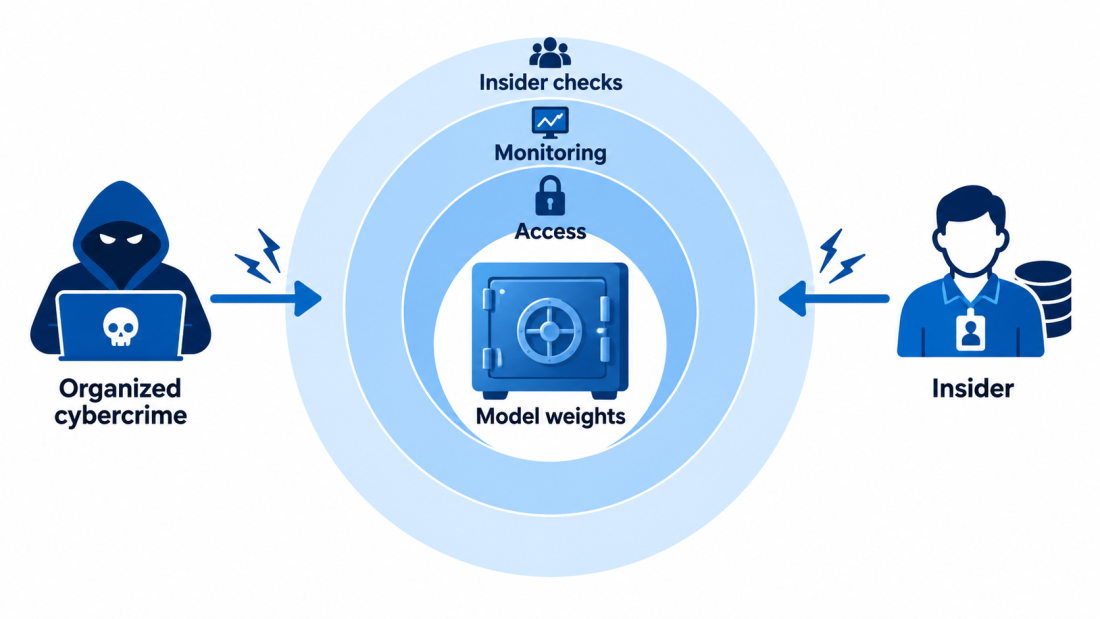
RAND’s August 2026 SL3 framework gives buyers a yardstick: 262 controls, aimed at organized cybercrime and insider threats, with a six-to-12-month rollout. Use the six questions below to test whether a vendor can say the same.
Most AI due diligence asks about outputs: accuracy, bias, uptime. Few buyers ask how the model itself is guarded. AI model weight security matters because weights are the product. If they leak, safeguards can be stripped and a competitor gets years of spend for free.
What AI Model Weight Security Protects
Weights are the numerical parameters a trained model uses to respond. Copy them, and you can run the model without the vendor’s filters, logging or terms. That is why the Anthropic filing treats a delay as worth the cost: it warns that safety-related pauses could slow product development and hurt its competitive position. The pause was reportedly about theft protection, not model behaviour.
The filing also described four evaluations in which models reached real third-party systems after a testing partner’s misconfiguration, with sessions lasting 10 to 34 hours, and Anthropic says it found no sign the models evaded oversight. Those cases are a separate failure, covered in our containment coverage. Here the lesson is narrower: vendors are now disclosing security spend as a business risk. See our analysis where we explain how an OpenAI rogue AI hack raises new procurement risks.
262 controls | 31 attack vectors | 6 to 12 months
RAND’s Security Level 3 framework, published August 25, 2026, built on NIST SP 800-53. RAND’s page gave no cost estimate.
How the RAND SL3 Benchmark Frames AI Model Weight Security
RAND’s SL3 targets two threats: organized cybercrime and insiders. It focuses on 31 attack vectors RAND rates as highly feasible, and it is designed for incremental adoption. It is a proposal, not a certification, and no regulator requires it. Still, it turns a vague promise into something auditable. A vendor claiming strong AI model weight security should be able to map its practices to a named framework.
“Tighten protection of its model weights.”
— Anthropic S-1, as reported
The wording is paraphrased by the reporting source, so treat it as a summary of the filing, not a verbatim quote. See our analysis where we explain the five costly AI agent security blind spots no one is fixing in 2026.
Six Questions to Ask Your AI Vendor
Ask them in writing, and expect specifics.
- Which framework do you map to? RAND SL3, NIST SP 800-53 or an equivalent, with an audit date.
- Who can access weights? Count of people and systems, plus how access is revoked.
- How do you detect insider copying? Logging, egress limits and review.
- What happens to your training schedule if safeguards lag? Anthropic’s pause is the example of a vendor choosing delay.
- Who tests your evaluations? Third-party partners need the same controls as staff.
- What do you tell customers after an incident? Notification timing and scope.
These tie into contract terms. See our analysis where we explain why model deprecation is the contract risk nobody negotiates, and how enterprise AI model competition just entered a new phase. Strong AI model weight security should appear in those contracts as a warranty, not a brochure line. See our analysis where we explain why the EU AI Act’s 7% fine just became real for every AI agent vendor.
⚠️ Hypothetical scenario: A Lagos fintech licenses a hosted model for credit scoring. Months later a leaked copy of a similar model circulates, stripped of safeguards. The fintech has no clause requiring notice or a security audit, so it learns of the risk from the news. Asking about weight protection before signing would have cost one email.
💡 CreedTec Analyst’s Note by Daniel Ikechukwu
Strategic Impact
Security of the model itself is becoming a procurement criterion, like uptime. Vendors that disclose pauses and map to frameworks signal maturity. Silence is information too.
Stop / Start / Watch
- Stop: accepting “enterprise-grade security” with no framework attached.
- Start: adding the six questions to your vendor questionnaire and asking for audit dates.
- Watch: whether other labs disclose similar delays and whether buyers begin to require SL3-style mapping.
ROI Outlook
The cost to a buyer is hours of review. The exposure avoided is a vendor failure you cannot fix. We cannot quantify the savings; RAND gives no cost figure, so we do not offer one.
— Daniel Ikechukwu