Fast Facts
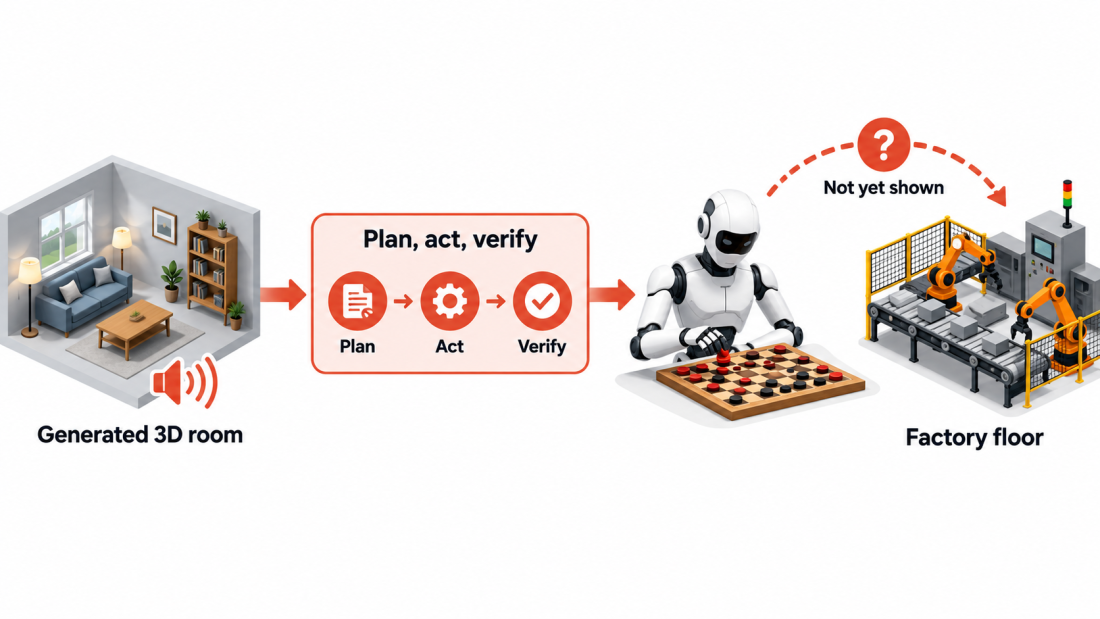
Google DeepMind released the Genie 4 world model on Monday, October 27, as a research preview for trusted testers. It generates audio in the same pass as video and uses Gemini models to plan multi-step tasks inside the simulated world. A demo had Apptronik’s Apollo humanoid play checkers in real time.
No release dates, resolution or frame-rate specs were given, and this account rests largely on one trade-press report of DeepMind’s announcement. For robot buyers the open question is unchanged: does a better simulator close the gap to real floors, or just make the gap harder to see?
World models are moving from video toys to candidate training grounds. The Genie 4 world model is DeepMind’s strongest argument yet that an interactive, steerable simulator can sit in a robotics pipeline. The announcement, however, is a research preview, and the useful facts are in what it does not yet show.
What the Genie 4 World Model Actually Adds
Three changes stand out. Audio is generated alongside the visuals, so sound is tied to events in the scene. Users can steer weather, camera and objects with natural language. And Gemini models run as guiding agents: Gemini 3.8 Flash watches frames and breaks goals into sub-steps, while Gemini 4 Argon handles task decomposition. Outputs carry SynthID watermarks, covering audio for the first time, per the report.
Access is narrow. Trusted testers get it first, Google AI Ultra subscribers will reach it through Project Genie, which currently runs Genie 3 at $200 a month, and developers are promised the Gemini API and Google AI Studio. No dates were announced for either.
Genie 3 baseline: 720p | 24 fps | about 1 minute
These are Genie 3 figures cited for reference. No Genie 4 resolution, frame rate or session length was published in the coverage we reviewed.
The Robot Demo and What It Proves
In the headline robotics demo, Argon paired with the model had Apptronik’s Apollo humanoid play checkers while verifying each move. That shows planning and verification inside a generated world. It does not show a policy trained in that world and then deployed on hardware, which is the claim buyers care about.
“A promising path for future progress.”
— DeepMind, on hybrid world models
Analysts quoted in the coverage flag a reliability paradox: agents trained in imperfect simulations can fail unpredictably in the real world. The improvements reduce that risk but do not remove it. See our analysis where we explain how world models and robot training are crossing over in 2026.
Where Genie 4 Still Falls Short
DeepMind’s own limits matter more than the demos. Visual detail and object permanence can drift in long sessions, especially after many prompt edits. Readable text is unreliable, spatial accuracy degrades as sessions run longer, and complex physical interactions at the edge of training data remain research problems. For training, drift in the Genie 4 world model is the serious one: a policy that learns on a world whose geometry slowly changes may learn the wrong lesson.
The same tension shows up elsewhere. See our analysis where we explain the physics simulation bottleneck, and what the 99% sim-to-real accuracy claim leaves out.
How Genie 4 Fits the Simulation Market
Generated worlds compete with physics engines, not replace them. A physics engine gives measured contact forces. A generated simulator gives variety and speed. The strategic bet is combining them, which is why simulation assets are being bought. See our analysis where we explain why the AMD and World Labs deal is a robot simulation land grab, and how a sim-to-real leap let robots run an hour alone. The Genie 4 world model joins that race with a Google-scale reasoning stack.
⚠️ Hypothetical scenario: A Lagos warehouse operator wants to train pick-and-place for irregular, locally packed cartons. A generated world could produce thousands of carton variations cheaply. But if the carton geometry drifts mid-session, the trained policy meets a different box on the real shelf, so the operator must still validate on physical stock. The Genie 4 world model helps with variety, not with proof.
💡 CreedTec Analyst’s Note by Daniel Ikechukwu
Strategic Impact
The Genie 4 world model pushes simulation from a data tool toward a reasoning environment. Value moves to whoever can verify that a generated world matches real physics, because generation itself is becoming cheap.
Stop / Start / Watch
- Stop: treating an impressive demo, such as a humanoid playing checkers, as evidence of deployable training.
- Start: asking vendors for sim-to-real results on your own objects, with drift measured over long sessions.
- Watch: the Gemini API release date, published specs, and any robotics partner reporting hardware results.
ROI Outlook
Not quantifiable yet. Pricing, access and specs are undisclosed, so budget for pilots, not rollouts. Treat this as an option on cheaper scenario variety, priced at nothing until a developer tier exists.
— Daniel Ikechukwu