Fast Facts
Egocentric robot training data, first-person video of people doing manual tasks, is now being recorded in Karur, India, by workers paid about $2.60 an hour, NPR reported October 14. A textile worker told NPR she earns $90 a month and was not told her recordings would train robots. An Indian firm, Objectways, sells the footage to AI developers.
The story sits against a wider shift: robot makers are moving from simulation-only data toward human video. That makes the data’s origin, price and consent terms a buyer question, not just an ethics one.
Robot learning has a data hunger problem. Simulation is cheap but imperfect, and teleoperation is slow. Human video sits in between, which is why egocentric robot training data is suddenly a commodity. Crypto Briefing reports that robotics and physical AI firms have raised nearly $48 billion so far in 2026, and that developers are leaning on human motion capture and video rather than simulation alone.
What NPR Found in Karur
NPR describes a textile factory, Texworth, where workers wear GoPros and smart glasses to record hand movements. Objectways, a tech firm in the same town, collects egocentric footage and also exocentric, robot’s-eye footage, where workers use robotic claws, for example screwing bottle lids on and off about 100 times. It sells the data to AI developers.
Pay is low. One recorder, Kannagi Periyasaamy, earns about $2.60 an hour and knows the purpose. Shoba Kirubakaran, 40, a factory worker of ten years earning $90 a month, said the company did not tell her the recordings would train robots to replace her. I did not find a factory response in the coverage I read.
~$2.60/hour | $90/month | ~$48B raised
Hourly pay for recording work and a factory worker’s monthly wage, both from NPR; funding raised by robotics and physical AI firms in 2026, per Crypto Briefing. Sources: NPR (via WUSF), October 14, 2026; Crypto Briefing, October 13, 2026.
Why Egocentric Robot Training Data Is Spreading
The reason is performance. Crypto Briefing says Dyna Robotics’ Dyna-2 model rose from 20% to 53% task success in August after its training set grew from 1,000 hours to over a million hours of first-person video. See our analysis where we explain why Dyna’s million-hour breakthrough raises the right questions. More video, cheaper video and video of real jobs is the formula labs are chasing.
Teleoperation remains the other pillar. See our analysis where we explain why teleoperated robots are a data strategy, not a stopgap. Egocentric robot training data is cheaper than a teleoperation rig because the worker only wears a camera.
The Employer-Owned Alternative
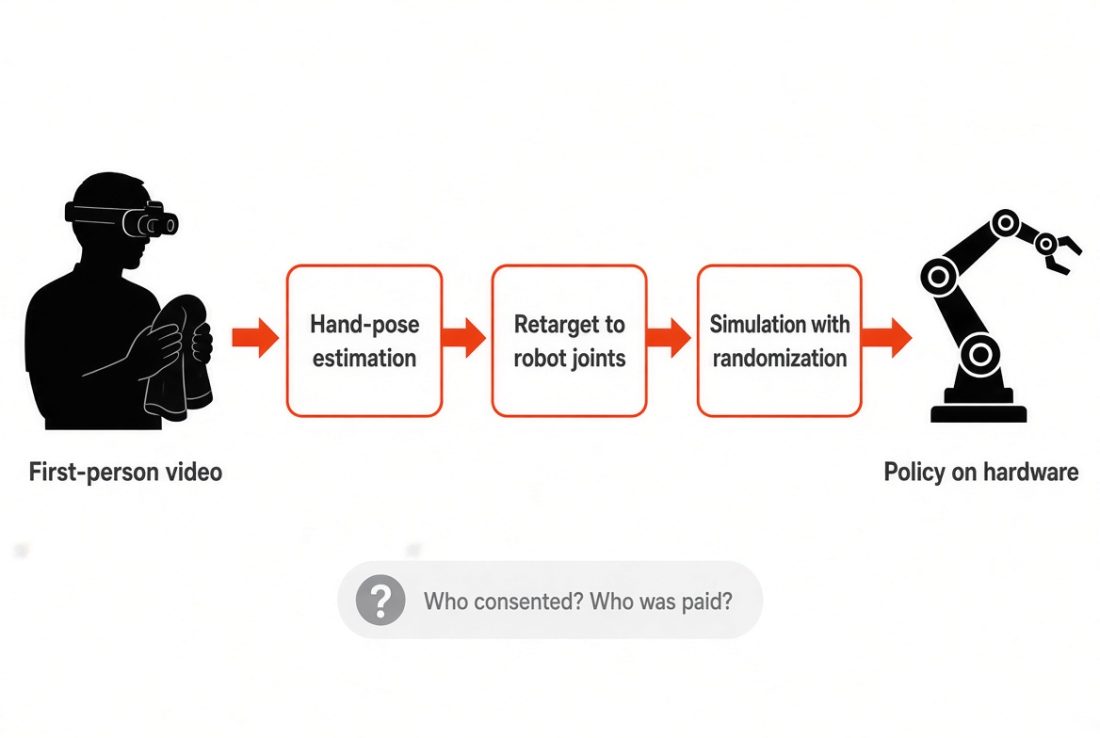
Agile Robots offers an employer-owned version of egocentric robot training data. Its CEO Zhaopeng Chen announced a Robot Academy in Munich on October 8, where workers perform industrial tasks on camera. Hand-pose software estimates 3D joints from the video, the motion is retargeted to robot joints, and policies are trained in simulation with randomized objects, lighting and positions, per Tech Times.
“If human beings can learn from school, why can’t robots?”
— Zhaopeng Chen, CEO, Agile Robots (via Tech Times)
Tech Times notes the article reports no results for policies the Academy produced, and that Agile Robots still uses teleoperation and demonstrations. Sim-to-real transfer remains the unsolved step. Cost shapes the economics of all this. See our analysis where we explain why the industrial robot cost guides everyone reads assume you pay US wages. NPR quotes Objectways CEO Ravi Shankar saying AI robots will cost more than human labor, and one domestic robot retails around $20,000.
Data cost is also being attacked from the synthetic side. See our analysis where we explain how MIT SceneSmith attacks the cost nobody talks about in robot training, and the 40% threshold undercutting a billion-dollar synthetic data race.
⚠️ Hypothetical scenario: A Lagos garment exporter agrees to let a robotics vendor film its sewing line for a discounted automation pilot. The contract says footage may be used for product improvement. Two years later the vendor sells a trained policy to a competitor in Bangladesh. The workers filmed never saw a naira from it, and the exporter cannot say where the video is stored.
💡 CreedTec Analyst’s Note by Daniel Ikechukwu
Strategic Impact
Egocentric robot training data turns routine labor into a data supply chain. The raw material is cheapest where wages are lowest, which links emerging-market workforces directly to the robots that may later compete with them. Buyers inherit the reputational and legal exposure of how that footage was gathered.
Stop / Start / Watch
- Stop: treating training data provenance as the vendor’s private business.
- Start: asking robot vendors for written data-sourcing terms covering consent, pay and worker location.
- Watch: Indian labor and data rules on worker recordings, and any published results from Agile Robots’ Academy.
ROI Outlook
Cheap human video lowers the cost of teaching a robot, but the savings can be reversed by a consent dispute or a ban on tainted data. For Nigerian and Southeast Asian manufacturers, the same logic cuts both ways: your workforce’s motion data is an asset you may be giving away. Price it before you share it.
— Daniel Ikechukwu
Robot data has an origin story. Ask for it. Get the weekly robotics training sims briefing on what vendors leave out. Subscribe free