Fast Facts
Dyna Robotics unveiled DYNA-2 on August 10, 2026, a world-action model trained on more than 1 million hours of human egocentric video, roughly 170 years of continuous experience, with zero robot data used during pretraining. Human video robot training let Dyna report task success rising from 20% to 80-90% on high-precision manufacturing tasks. All of those figures come from Dyna’s own testing, not an independent benchmark, which is exactly why they deserve the same scrutiny as any other vendor-reported result.
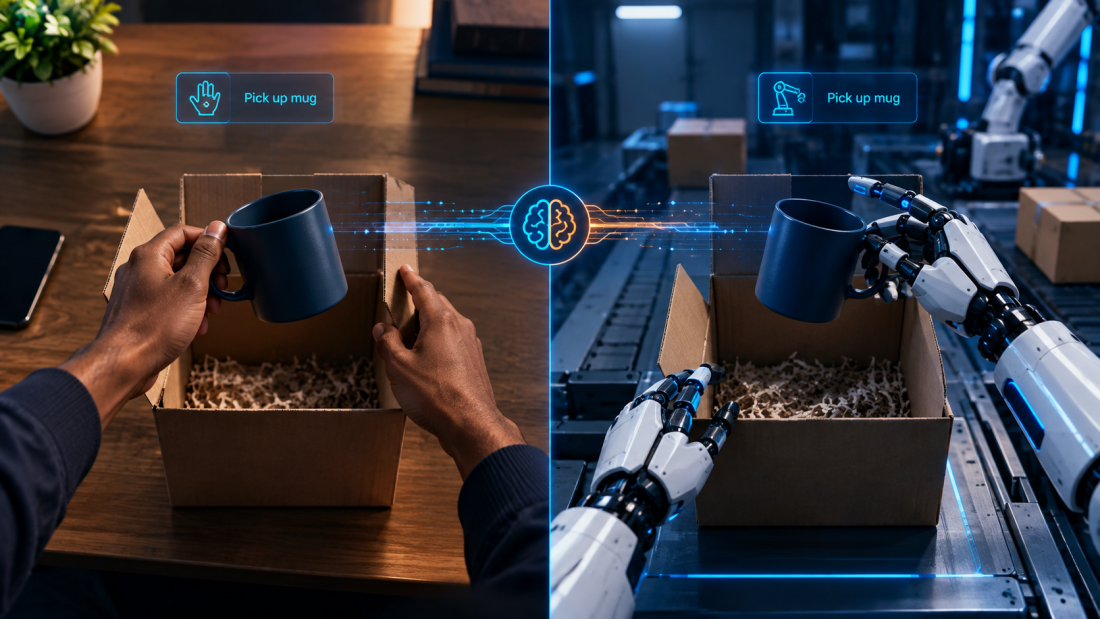
Human video robot training just offered a third path around a data problem that simulation and teleoperation have both struggled to solve on their own. Dyna Robotics, based in Redwood City, California, announced DYNA-2, a World-Action Model pretrained entirely on human egocentric video rather than robot action data, according to Dyna Robotics’ own press release. The training set represents more than 1 million hours, described by the company as roughly 170 years of continuous waking human experience, capturing everyday manipulation tasks like cooking, folding, assembling, and cleaning.
A Different Bottleneck Than Simulation Was Built to Solve
Most of the robotics industry’s data-scarcity conversation in 2026 has centered on simulation: the physical world has produced only about 500,000 hours of high-quality real-world robotic interaction data, while baseline generalization is estimated to require between 1 billion and 10 billion hours. Human video robot training sidesteps that gap entirely by treating video, not robot demonstrations, as the scalable resource. Dyna co-founder Jason Ma put the logic plainly: action data is scarce, but video is everywhere, according to Digital Today’s coverage of the announcement. See our analysis where we explain why synthetic simulation data is already undercutting the real-world data collection race.
1,000,000+ hours — egocentric human video used in DYNA-2’s pretraining, with zero robot action data.
20% → 80-90% — Dyna’s self-reported task success rate improvement on high-precision manufacturing tasks, from pretraining scale alone.
Action data is scarce, but video is everywhere.— Jason Ma, co-founder, Dyna Robotics
Why the Numbers Deserve a Second Look, Not Automatic Belief
Every figure attached to DYNA-2’s performance, the 20-to-90% jump, a 1.55x improvement over Dyna’s own prior model, a 133% gain in instruction-following, comes from Dyna’s internal testing rather than a third-party benchmark, according to Unite.AI’s technical breakdown. That doesn’t make the numbers false. It means human video robot training’s headline results, like most vendor-reported robotics claims this year, should be treated as promising evidence rather than settled fact until an outside lab reproduces them on a shared task set. Notably, Dyna Robotics also issued a correction to its original press release, a small but relevant data point about how carefully these claims are being checked even by the company publishing them.
⚠ Fiction — illustrative scenario: A manufacturing integrator reads that human video robot training pushed task success from 20% to 90% and assumes the same jump will apply directly to its own assembly line’s most difficult task. A pilot deployment shows real improvement, but nowhere near the reported range, because the benchmark task Dyna tested against was simpler and more repetitive than the integrator’s actual production line. The technology wasn’t oversold. The specific number was just never meant to travel to every use case unchanged.
What Actually Looks Novel Here
Independent of the specific percentages, the architectural claim is genuinely distinct from prior approaches: DYNA-2 uses a world-modeling design that predicts future video frames rather than mapping perception directly to action, and Dyna reported cross-embodiment transfer across stationary robot arms, humanoid prototypes, and dexterous robotic hands using only a few hours of local fine-tuning per platform. Human video robot training, if that transfer claim holds up under outside testing, would meaningfully lower the cost of adapting one trained model to multiple robot hardware types. See our related coverage of why MIT’s SceneSmith attacks the cost nobody talks about in robot training and why robot training data companies’ revenue claims deserve the same scrutiny as their technical ones.
Global Implications
For robotics teams outside the well-funded US labs currently dominating this space, human video robot training could lower the entry barrier meaningfully, since ordinary first-person video is far cheaper to source at scale than teleoperated robot demonstrations or high-fidelity simulation licenses. That accessibility only translates into real value once the underlying performance claims are independently verified, which hasn’t happened yet for DYNA-2. See our analysis of why humanoid robot production numbers rarely survive independent verification.
💡 CreedTec Analyst’s Note — Daniel Ikechukwu
Strategic Impact: Human video robot training is a genuinely novel data strategy, but its current evidence base is entirely self-reported, the same evidentiary gap that has undercut trust in other 2026 robotics data claims.
- Stop: Treating Dyna’s specific performance percentages as representative of what any buyer’s own use case will see.
- Start: Requesting a pilot evaluation on your own task set before budgeting around any human video robot training vendor’s published benchmark numbers.
- Watch: Whether an independent lab publishes results reproducing DYNA-2’s cross-embodiment transfer claims on a shared, third-party task set.
ROI Outlook: If the cross-embodiment transfer claim holds under outside testing, human video robot training could meaningfully cut the cost of adapting one model across multiple robot platforms, a real efficiency gain worth tracking even before full verification.
Has DYNA-2’s performance been independently verified?
Not yet. All currently published figures come from Dyna Robotics’ own internal testing rather than a third-party benchmark, so buyers should treat the reported numbers as promising rather than confirmed until outside verification occurs.
Human video robot training is a real, structurally different approach to the industry’s data shortage, not a rebranded version of simulation or teleoperation. Whether the specific numbers behind DYNA-2 hold up outside Dyna’s own lab is the question that will determine whether this becomes a standard technique or a single company’s marketing high point.
Get CreedTec’s next robotics procurement briefing before your next data-strategy vendor evaluation.
Subscribe free
Sources
- PR Newswire, “Dyna Robotics Unveils DYNA-2 World-Action Model,” August 2026
- Unite.AI, “Dyna Robotics Trains DYNA-2 on a Million Hours of Human Video, No Robot Data,” August 2026
- Interesting Engineering, “Humanoid robots trained on 1M hours of human video achieve up to 90% task success,” August 2026
- Digital Today, “Dyna Robotics unveils DYNA-2 trained on 1 million hours of first-person human video,” August 2026