Fast Facts
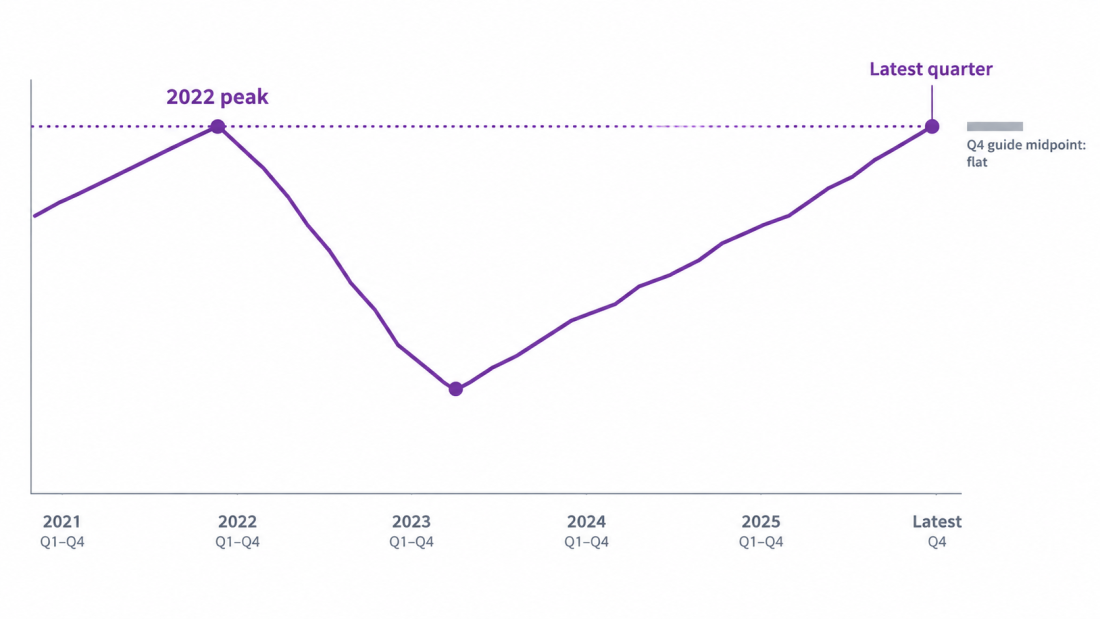
Texas Instruments (NASDAQ: TXN) reported Q3 revenue of $6.06 billion, up 28% from a year earlier, and management called the quarter a Texas Instruments industrial peak: the first new high in industrial after four years. Per one transcript summary, industrial rose more than 40% year over year, while data center rose about 95%.
The catch is the outlook. The Q4 revenue guide of $5.8 billion to $6.3 billion has a midpoint of $6.05 billion, essentially flat on Q3 (author’s arithmetic). The recovery is real, but it is a return to 2022 levels, not a new growth regime.
Industrial buyers have waited years for chip suppliers to say demand is back. On October 21, TI said it. The Texas Instruments industrial peak matters because analog and embedded chips sit inside nearly every PLC, drive, sensor and robot, so TI’s order book is an early read on factory spending.
What the Texas Instruments Industrial Peak Actually Measures
TI’s filing reports operating profit of $2.87 billion, up 73%, and diluted EPS of $2.62 against $1.48 a year earlier. Operating cash flow was $3.42 billion, and capital spending was $463 million. The release cites “continued broad growth in industrial, automotive and data center.”
The industrial figures come from the earnings call, as summarized by TradingKey: up more than 40% year over year and about 10% sequentially, with Q3 revenue only just passing its Q3 2022 level. That is a single-source summary, so treat the exact percentage with care. In Q2, per MarketBeat’s call highlights, industrial grew about 30% and data center roughly doubled.
$6.06B revenue | industrial +40%+ | Q4 guide midpoint $6.05B
Revenue and guidance from TI’s 8-K. The industrial growth rate is from a call-transcript summary, and the flat-midpoint reading is the author’s arithmetic.
“Very strong momentum is real across sectors.”
— Haviv Ilan, TI CEO, on industrial
Ilan listed aerospace and defense, energy infrastructure, test and measurement and robotics as sources of that strength. Robotics is the line to watch in this Texas Instruments industrial peak. It means humanoid and arm builders are now a visible chip customer, not a forecast. See our analysis where we explain why industrial AI demand drives cadence beyond the chip headlines.
Why the Guide Matters More Than the Quarter
A peak after four years of waiting is a recovery, not a boom. See our analysis where we explain why Analog Devices’ industrial revenue jumped 53% and AI chips aren’t the reason. Two analog suppliers now tell the same story: the cycle turned, and AI is a smaller driver than the headlines imply.
The contrast with automation vendors is instructive. Schneider Electric’s Q3 revenue, reported October 16, reached €11.5 billion, with Energy Management up 19% organically but Industrial Automation up only 8%, per Investing.com’s transcript. See our analysis where we explain why Siemens’ record industrial profit isn’t just an AI story. The Texas Instruments industrial peak shows up in components first, and in finished automation later.
Pricing, Lead Times and What Buyers Should Do
Ilan said price movement showed up “mainly on the Analog side” in the second half and called it “a little bit of an uptick, not very significant for this year.” He said TI will report more on 2027 pricing in January. Lead times, he said, “may be ticked a little bit higher.” TI’s inventory was $4.7 billion, and customers have not built stock. Ilan added, “I wish they had a little bit more.”
Those three facts line up: rising demand, thin customer buffers and small price increases starting. See our analysis where we explain the memory price metric that could break your 2026 AI hardware budget. The same procurement discipline applies to analog parts. Capacity also takes time. Ilan said new fab capacity takes about four years to produce output, and 2026 capital spending should land between $2 billion and $3 billion.
For the wider demand picture, see our analysis where we explain how onsemi’s AI data center revenue and industrial recovery fit together.
⚠️ Hypothetical scenario: A Lagos systems integrator quotes a fixed-price sensor and drive retrofit for a bottling plant, valid for nine months. By the time the order lands, parts lead times have stretched and the distributor has repriced. The integrator absorbs the gap. The Texas Instruments industrial peak is good news for suppliers and a margin risk for anyone who quoted early.
💡 CreedTec Analyst’s Note by Daniel Ikechukwu
Strategic Impact
The Texas Instruments industrial peak confirms that industrial demand has turned, and that the first beneficiaries are component makers. A flat Q4 midpoint suggests the sharpest part of the rebound may be behind it. Investors should separate recovery from new growth.
Stop / Start / Watch
- Stop: crediting every industrial chip beat to AI.
- Start: adding price-adjustment clauses and longer lead-time buffers to analog-heavy bills of materials.
- Watch: TI’s January commentary on 2027 pricing and whether industrial holds above its 2022 level.
ROI Outlook
For suppliers, utilization gains lift margins, as TI’s 64% gross margin suggests. For buyers, small price rises compound across a bill of materials. No forward ROI figure is defensible until 2027 pricing is disclosed.
— Daniel Ikechukwu