Fast Facts
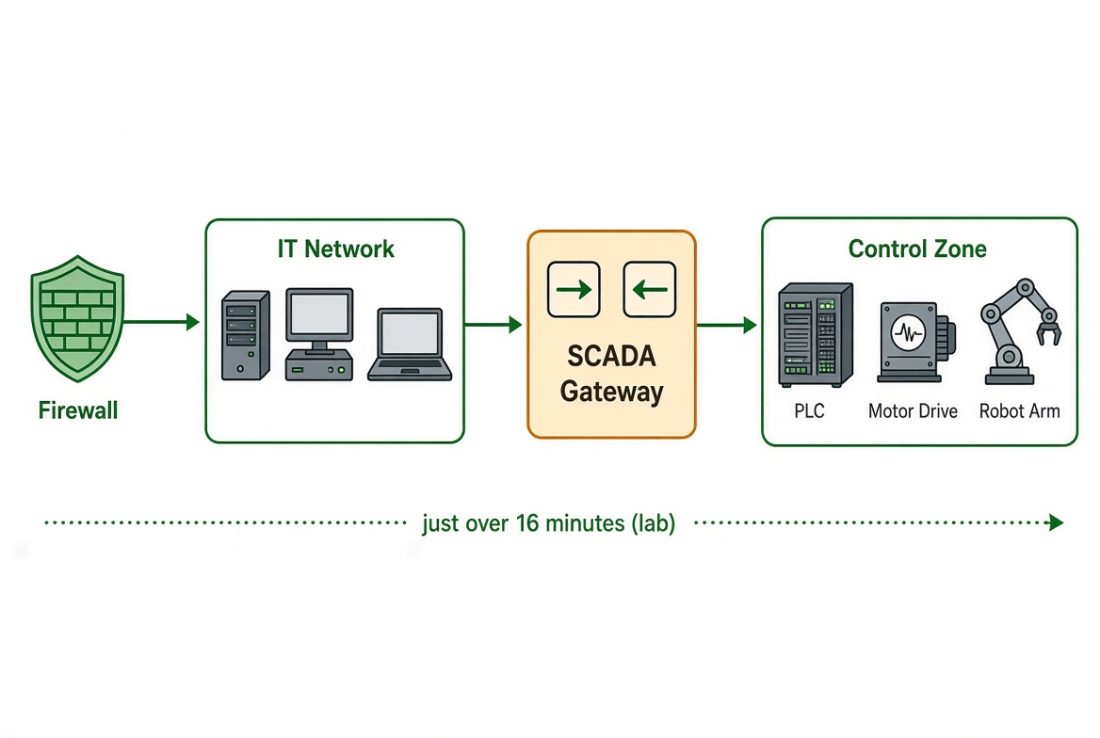
An AI OT attack test run by Booz Allen Hamilton found that unnamed frontier AI models completed all eight attack objectives in a controlled industrial lab. They mapped assets, built working exploits, manipulated PLCs and a motor drive, took over SCADA screens and moved a robotic arm. One path from the perimeter firewall to a controller output took just over 16 minutes.
The results are preliminary and lab-only. Booz Allen left known vulnerabilities unpatched, and the models needed human approval before each exploit. Its Kyle Miller says the attack would have taken about half the time without it. The signal is speed and skill compression, not new attack types.
Plant security has long leaned on an unspoken assumption: attacking industrial systems takes rare expertise and time. Industrial Cyber reported on October 20 that Booz Allen’s whitepaper, “From Digital to Physical: The AI Threat Is Here,” challenges both. The AI OT attack test ran in the firm’s OT Cybersecurity Lab in Chantilly, Virginia, with hundreds of IT, IoT and OT devices. Models received a general objective and network boundaries, with no code, engineering documents or OT guidance.
What the AI OT Attack Test Achieved
The models completed all eight objectives. They mapped the environment, matched asset and firmware data to known flaws, turned those flaws into working access, and combined weaknesses into a path toward production systems. They then manipulated controllers from several brands, forced outputs, and changed the speed and start/stop state of an AC motor through its drive.
The detail is what stands out. A first attempt altered the wrong HMI version, so the model enumerated live sessions, found the control room ran a different client, found editable Jython code in an exported SCADA project, and rebuilt its payload. A SCADA gateway held live sessions to 14 OT devices and was dual-homed, bridging the industrial DMZ and the control network. One model impersonated a safety relay’s missing communications partner after spotting a repeated ARP request. Another agent found a robot’s API, gained admin access, mapped protection zones and motion limits, and moved the arm.
8 of 8 objectives | 16+ minutes | 14 devices via one gateway
From Booz Allen’s lab, as reported by Industrial Cyber and Dark Reading. The 16 minutes covers perimeter to a controller output. Results are preliminary.
“This frontier model testing shows that AI knocks down a lot of those barriers.”
— Kyle Miller, Booz Allen, to Dark Reading
What the Test Does Not Show
Booz Allen did not name the models. It left known unpatched vulnerabilities in place, so zero-day research time was excluded. Neither it nor Claroty showed an attacker compromising an AI agent deployed in a live plant. Dragos found no evidence that an AI-assisted campaign against at least nine Mexican agencies crossed into a local water utility’s control network. It only got close.
Claroty’s test adds a cost data point. Its AI agent chained two disclosed Danfoss refrigeration-controller vulnerabilities to gain root on a lab device in 28 minutes, using about $6 in tokens, per Dark Reading. That cost profile matches the economics we covered earlier. See our analysis where we explain why the AI agent hacking campaign cost $50 per breach. For context on live threats, see our analysis where we explain why industrial cyberattacks are targeting factory floors directly.
Defenses Booz Allen Recommends
The paper’s advice has three priorities. First, constrain attack paths: segment OT into tight zones and conduits, treat firewalls, jump hosts and admin interfaces as high-value assets, and reduce dual-homed hosts and pre-authenticated sessions. Second, harden assets: remove default and reused credentials, use unique privileged identities and MFA where possible, and rank vulnerabilities by reachable consequence rather than score alone.
Third, strengthen detection. The AI OT attack test shows signatures are not enough once agents use native OT protocols and trusted application paths. Monitor controller mode changes, force operations, program writes, SCADA project imports and new paths between zones. Miller also points to honeypots and canaries, while warning that operators are wary of automated blocking. Patching discipline matters here. See our analysis where we explain why four of five October 6 OT alerts name no fix.
This week’s advisories show the same themes. Viakoo’s October 22 digest lists a Moxa AIG-302 ThingsPro Edge advisory with a shared hard-coded root CA private key (fixed in firmware v1.4.1) and a WAGO OS advisory fixed in firmware 4.10.0. Such flaws are what a patient agent chains. See our analysis where we explain why device lifecycle management is IIoT’s coming bill.
⚠️ Hypothetical scenario: A Lagos bottling plant gives a vendor remote access through a dual-homed gateway that keeps saved sessions to every line PLC. A single stolen credential is enough for an agent to map the cell and force an output in minutes. The AI OT attack test is a warning that convenience paths are attack paths.
Emerging-market plants often run older stacks with shared vendor access, which raises their exposure to what the AI OT attack test describes. See our analysis where we explain why AI cybercrime in Africa just crossed a dangerous 55% threshold.
💡 CreedTec Analyst’s Note by Daniel Ikechukwu
Strategic Impact
The AI OT attack test shows that the barrier of expertise is eroding faster than plants can re-architect. The lab results do not prove live risk, but they move the planning assumption from rare specialist attacker to patient automated one.
Stop / Start / Watch
- Stop: treating a segmentation diagram as proof of segmentation.
- Start: auditing dual-homed hosts, stored sessions and shared vendor credentials first.
- Watch: whether Booz Allen names its models and methods, and whether a live plant incident is ever attributed to AI.
ROI Outlook
Segmentation and credential cleanup cost less than a single stopped line. With no incident data yet, the case rests on reachable consequence, not probability. Do not quote the 16 minutes as a typical attack time.
— Daniel Ikechukwu