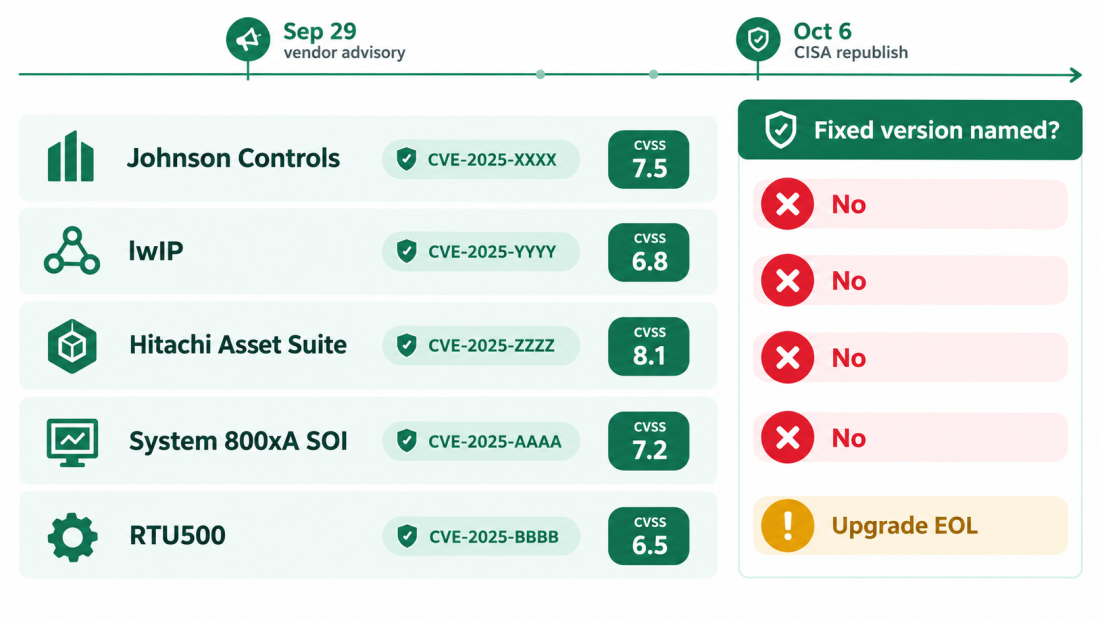
Fast Facts Five CISA ICS advisories published October 6 cover Johnson Controls EasyIO FG, the Savannah lwIP SMTP client, and three Hitachi Energy products. In the text summarized by Viakoo on October 8, four of the five name no product-specific patched version, and the fifth covers end-of-life firmware where the only path is replacement.
The common thread is not one bad vendor. It is embedded code and retired firmware that sit inside gateways, controllers and remote terminal units long after the supplier stops shipping fixes. The practical job this week is inventory, exposure reduction and a supplier conversation, not a patch window.
Anyone running building controllers, substation gear or network-connected embedded devices should read the latest CISA ICS advisories as a lifecycle warning rather than a CVE list. The five items cover Johnson Controls (NYSE: JCI), the open-source lwIP stack, and Hitachi (TSE: 6501) subsidiary Hitachi Energy. Each is a different failure mode: hard-coded credentials, an embedded library, vendor-bundled middleware, unauthenticated servlets, and firmware past end of life.
What the Five Advisories Actually Say
The Johnson Controls EasyIO FG advisory covers CVE-2026-27872 (improper privilege management tied to brute force) and CVE-2026-27873 (hard-coded credentials tied to password spraying). CISA states exploitation could give full unauthorized device access, but says the issues are not remotely exploitable and reports no known public exploitation. It points readers to Johnson Controls advisory JCI-PSA-2026-12 and names no patched firmware version.
The lwIP item is the highest scored. CVE-2026-15340 is a buffer-copy flaw in the lwIP SMTP client 2.2.1 with a CVSS v3 score of 9.8; CISA says it could crash a device and may allow remote code execution, and names no fixed version. Hitachi Energy Asset Suite 9.9.0 and earlier has two unauthenticated servlet weaknesses, CVE-2026-7395 and CVE-2026-11796, and CISA does not confirm a patched release. The System 800xA SOI advisory covers Apache ActiveMQ code injection, CVE-2026-34197 (CVSS 8.8), in versions 2.0.0 through 2.2.0, again with no product-specific fixed version.
5 advisories | 4 with no named fix | 9.8 top CVSS
CISA published five OT advisories on October 6. In its text as summarized by Viakoo, four name no product-specific patched version; the fifth covers end-of-life RTU500 CMU firmware 11.x and earlier. Highest score: CVSS v3 9.8 (lwIP). Source: Viakoo Daily OT Security News, October 8, 2026.
The RTU500 Case Is a Lifecycle Problem
The fifth item concerns Hitachi Energy RTU500 CMU firmware 11.x and prior, which the vendor describes as end of life. The six listed CVEs include CVE-2026-8065, an authentication bypass in the firmware update endpoint that lets an unauthenticated attacker upload arbitrary firmware, and CVE-2026-8066, a directory traversal that can overwrite files. Both carry a 9.1 CVSS v3 rating per aggregator records. Hitachi Energy says currently supported firmware is unaffected and strongly recommends upgrading.
That is a fix, but not a patch. Replacing firmware on a remote terminal unit means planning, validation and site visits. See our analysis where we explain why device lifecycle management is IIoT’s coming bill, because the cost arrives when a supplier retires a version, not when you buy the hardware.
Why These CISA ICS Advisories Hit IIoT Owners Hardest
Embedded components are the hard part. lwIP and ActiveMQ are libraries, so the vulnerable code lives inside products whose vendors may not publish matching advisories on the same day. CISA itself advises asking suppliers whether devices embed the affected version. See our analysis where we explain why most IIoT vendors are not ready for CRA reporting obligations; a vendor that cannot answer which components ship in a device cannot meet a vulnerability reporting duty either.
Exposure reduction is the control that works today. CISA’s guidance is consistent across all five: keep control devices off the public internet, segment OT from business networks, and use a maintained VPN for necessary remote access after assessing operational impact. See our analysis where we explain why industrial cyberattacks are targeting factory floors directly, and why segmentation matters more than any single patch.
Visibility comes first. You cannot scope an advisory against a spreadsheet nobody trusts. See our analysis where we explain how ServiceNow and Armis are tying OT and IoT cyber risk to asset inventory, and our look at why the real cost of legacy equipment integration is not the machines. Under the current CISA ICS advisories, the first deliverable is a verified list of what is running and where it is reachable.
⚠️ Hypothetical scenario: A Lagos water utility runs a few RTU500 units installed years ago, still on firmware 11.x because the vendor visit was always postponed. The advisory lands on a Friday. The asset list shows model names but not firmware versions, and nobody can say whether the update endpoint is reachable from the vendor’s remote-support VPN. Monday is spent finding out. The upgrade, once scoped, needs a site visit and a planned outage the utility never budgeted.
💡 CreedTec Analyst’s Note by Daniel Ikechukwu
Strategic Impact
This week’s CISA ICS advisories show that patch availability, not vulnerability count, is the scarce resource. Owners of long-lived field devices carry the lifecycle risk their suppliers have stopped carrying. The advisory feed is becoming a procurement document.
Stop / Start / Watch
- Stop: treating “no known public exploitation” as a reason to defer inventory work.
- Start: recording firmware version and network reachability for every EasyIO FG, RTU500 and Asset Suite instance, and asking suppliers in writing about embedded lwIP 2.2.1.
- Watch: whether Hitachi Energy and Johnson Controls publish fixed versions, and whether any of these CVEs enters CISA’s Known Exploited Vulnerabilities catalog.
ROI Outlook
The cheapest control is the one already available: segmentation and removing internet exposure cost far less than emergency firmware replacement. The expensive path is deferred upgrades on end-of-life units, where a single site visit and outage can exceed the device’s original value. For emerging-market operators with thin maintenance budgets, a supported-firmware clause in the purchase contract is the highest-return line item.
— Daniel Ikechukwu
Field devices outlive vendor support. Get the weekly industrial IoT briefing on the lifecycle costs vendors leave out. Subscribe free