Fast Facts
The Cognex RealSense deal, a roughly $500 million all-cash acquisition announced September 22, values RealSense’s depth-sensing cameras and on-device AI processors at 5.6-6.3 times projected 2026 revenue. RealSense builds the 3D sensing hardware that gives factory robots and inspection stations spatial awareness, with enough onboard compute to run vision models directly on the device rather than round-tripping data to a server.
For industrial IoT buyers, the multiple itself is the useful data point: it’s the first clean public benchmark for what edge-AI-enabled sensing hardware is actually worth to a strategic acquirer, at a moment when most factory-floor sensor pricing still gets negotiated with far less transparency.
The Cognex RealSense deal adds 3D depth-sensing and robotic-perception technology to Cognex’s (NASDAQ: CGNX) existing industrial machine-vision portfolio, financed entirely from the company’s own cash and investments. RealSense itself has an unusual recent history: Intel spun the unit out as an independent company in July 2025 with $50 million in funding from Intel Capital and MediaTek, after nearly shutting the business down. Fourteen months later, Cognex is paying roughly ten times that spinout funding to bring it in-house, with RealSense’s facial-authentication product line carved out into a separate company before the deal closes.
What the Cognex RealSense Deal Actually Buys
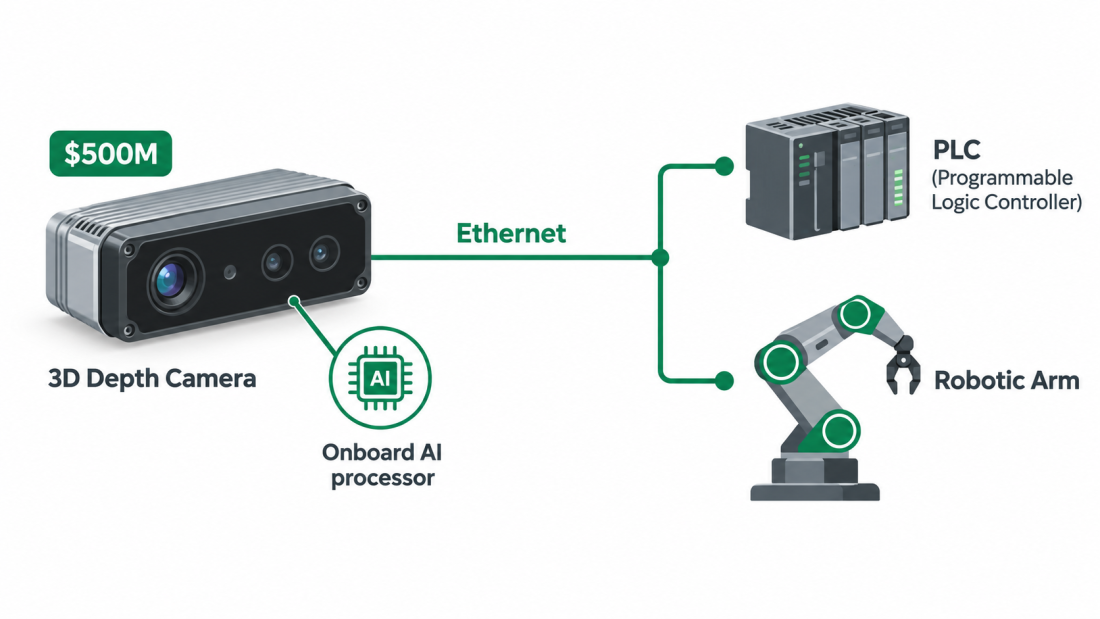
RealSense’s hardware is built specifically for the factory edge: the cameras carry a dedicated AI processor for local inspection workloads and connect over standard Ethernet to PLCs and robots already on the line. Cognex management said on its acquisition call that newer RealSense devices have enough onboard processing capacity to run Cognex’s own trained vision models directly on the camera, rather than sending frames back to a central system for inference. That’s the same edge-compute pattern CreedTec has tracked across industrial gateways more broadly — intelligence moving to where the data is generated, not where it’s stored. See our analysis where we explain how Teltonika’s Oxa turned the embedded IIoT gateway into a component, not a box.
The Multiple Buyers Should Actually Notice
RealSense is projected to generate $80 million to $90 million in 2026 revenue, more than 50% growth over the prior year, which puts the $500 million purchase price at roughly 5.6 to 6.3 times projected revenue by most outlets’ calculations. Add Cognex’s disclosed three-year, $56.5 million employee retention program and roughly $50 million in restricted stock units, and the all-in cost edges closer to $600 million. That revenue multiple is the number worth remembering the next time a sensor or edge-AI vendor quotes a price: a strategic acquirer with full diligence access just paid a specific, disclosed multiple for exactly this category of hardware. See our analysis where we explain how much an industrial IoT sensor actually costs in 2026.
Verified numbers
| Stat | Detail |
|---|---|
| $500M | Cash purchase price behind the Cognex RealSense deal, funded entirely from Cognex’s existing balance sheet |
| 5.6–6.3× | Implied multiple of RealSense’s projected 2026 revenue ($80–90M) — the benchmark the Cognex RealSense deal set |
| $600M → $1.6B | Cognex’s own estimate of the robotic-perception market, today versus 2030, implying 25%+ annual growth |
RealSense has “called that mission the Visual Cortex of Physical AI,” said Nadav Orbach, the company’s founder and CEO.
Why This Matters Beyond Machine Vision
Cognex frames the acquisition as building “a full-stack visual intelligence platform” spanning barcode reading and 2D inspection through 3D depth perception and robotic navigation — language that signals vision is consolidating from a point sensor into a layered IIoT product line the way networking and gateways already have. For plants that buy machine vision and robotic perception from separate vendors today, a combined Cognex-RealSense catalog raises the usual post-acquisition question: whether integration improves support and pricing, or whether it narrows the field of vendors a buyer can credibly negotiate against. See our analysis where we explain why Schneider’s $3.1B Cognite bet is really about IIoT platform consolidation.
⚠️ Hypothetical scenario (illustrative only, not a reported case)
A Lagos packaging plant sources 2D inspection cameras from Cognex and depth-sensing robotic guidance separately from a smaller regional integrator, keeping two vendor relationships to preserve pricing leverage. After the RealSense integration completes, the plant’s regional integrator can no longer match Cognex’s bundled pricing on a combined 2D-and-3D package, and the plant’s next RFP effectively has one fewer credible bidder than it did the year before.
What to Ask Before the Next Vision Upgrade
Buyers planning a factory-vision or robotic-guidance upgrade over the next year should treat the Cognex RealSense deal as a pricing reference point, not just an industry headline: ask any vendor quoting edge-AI sensing hardware how their pricing compares to a 5.6-6.3x revenue benchmark set by an acquirer with full access to the target’s books. That number won’t apply cleanly to every deal, but it’s a far better anchor than list price alone. See our analysis where we explain how edge computing cuts IIoT latency by 87% and five cost differences between industrial and collaborative robots for the hardware side of the same decision.
💡 CreedTec Analyst’s Note by Daniel Ikechukwu
Strategic Impact
The Cognex RealSense deal is a pricing data point disguised as an M&A story. Industrial buyers rarely get a disclosed revenue multiple for edge-AI sensing hardware; this one is public, recent, and directly comparable to quotes landing on procurement desks right now.
Stop / Start / Watch
- Stop: treating machine vision and robotic-perception sensing as separate procurement categories with separate vendor pools.
- Start: benchmarking edge-AI sensor quotes against disclosed M&A multiples, not just competing vendor list prices.
- Watch: whether the deal closes on schedule in Q4 2026 and whether RealSense’s facial-authentication carve-out finds its own buyer separately.
ROI Outlook
A robotic-perception market growing from roughly $600 million to $1.6 billion by 2030 means this won’t be the last consolidation in factory-edge sensing. Buyers who lock in multi-year vendor relationships now should expect fewer independent options at renewal time.
— Daniel Ikechukwu, CreedTec (Industrial IoT Analyst)
Planning a factory vision or sensing upgrade?
Get CreedTec’s weekly briefing on IIoT vendor consolidation, edge-AI hardware pricing and procurement economics, written for plant and IT leaders who sign the contract. Subscribe free.
Sources
- SEC/Cognex 8-K: “Cognex to Acquire RealSense, Expanding Machine Vision Leadership” (Sept 22, 2026)
- Robotics 24/7: “Cognex acquires RealSense for $500M” (Sept 2026)
- RuntimeWire: “Cognex will buy RealSense for $500M, 14 months after its Intel spinout” (Sept 2026)
- Traders Agency: “Cognex to Acquire RealSense in $500 Million Cash Deal, Targets Q4 2026 Close” (Sept 2026)
- IoT Tech News: “Cognex to acquire RealSense for $500M in factory edge AI deal” (Sept 2026)