Fast Facts
- Edge computing now processes data at factory floor speed instead of cloud-delay speed. 87% of manufacturers report processing sensor data locally to eliminate latency.
- The shift cuts response time from 200–400ms (cloud round-trip) to 10–30ms (local processing)—a gap that costs $440K annually in undetected anomalies per facility.
- Cloud-only IIoT architectures are becoming obsolete. The economic case for edge is no longer optional.
- Local data processing keeps factories running during connectivity loss, a real scenario in emerging markets with variable network stability.
- The procurement shift: it’s no longer edge OR cloud. It’s edge AND cloud, with intelligence at both layers.
The industrial internet of things in 2026 has a latency problem that spreadsheets hide. Edge computing solves it by moving intelligence closer to where machines generate data. According to research by N-iX’s 2026 IIoT adoption study, 87% of surveyed manufacturers agree that devices must process data on the edge. This isn’t preference—it’s necessity. Cloud-only architectures can’t respond fast enough to factory floor emergencies.
Why the Cloud Round-Trip Is Too Slow
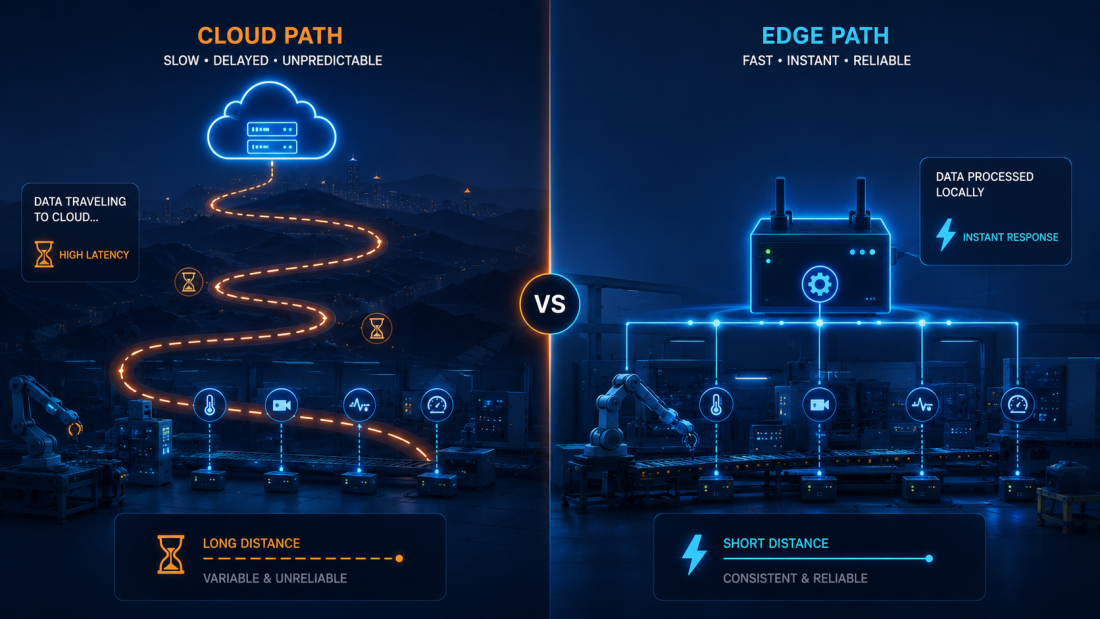
Traditional IIoT sends sensor data to the cloud, processes it, and sends commands back. The round-trip takes 200–400ms depending on network congestion and distance. On a factory floor where a pump failure costs $8,000 per minute in downtime, 400ms is too long. By the time cloud detects an anomaly, the damage spreads. Edge computing flips this.
Sensors feed into local gateways—controllers, edge devices, or industrial PCs—that analyze data immediately. Decisions happen at 10–30ms. A pressure spike triggers a valve closure before the pump cavitates. A temperature anomaly pauses heating before parts warp. That speed differential has a price tag: IoT Analytics’ Smart Manufacturing Report projected the industrial technology market at $176.9 billion in 2024, growing 11% annually. Growth in margins depends on latency, not just throughput.
87% of manufacturers prioritize edge processing over cloud-only, according to Eseye’s 2026 IoT adoption survey.
$440K annually — average cost of undetected machine anomalies per facility, directly addressed through sub-50ms edge response times.
The Procurement Shift: Hybrid Intelligence Architecture
Modern IIoT buyers no longer ask “Should we use edge or cloud?” They ask “How do we architect edge computing AND cloud so edge handles urgent decisions and cloud handles strategic analysis?” This hybrid model eliminates false choices.
The move from reactive to prescriptive operations is the new baseline for industrial leadership. Local intelligence enables both.— IoT Analytics, Top 12 Industrial Technology Trends, Hannover Messe 2026
See our analysis where we explain why legacy equipment integrations require edge processing. Edge devices handle real-time anomaly detection, predictive alerts, and equipment safeguards. Cloud handles historical trend analysis, cross-facility insights, and algorithmic refinement. Neither replaces the other; they complement.
Why Emerging Markets Gain the Advantage
For manufacturers in Nigeria, Southeast Asia, and regions where network connectivity remains variable or expensive, edge computing is transformative. A facility doesn’t need fiber-grade uptime to run predictive maintenance. Edge systems tolerate connection drops without losing operational intelligence. Decisions happen locally; cloud synchronizes when bandwidth is available. See our analysis where we explain device lifecycle management in edge-first architectures.
This architecture advantage compresses automation adoption timelines. You deploy edge intelligence first. Cloud analysis follows. The factory gains industrial competitiveness while network infrastructure matures.
⚠ Fiction — illustrative scenario: A tier-2 food processor in Lagos installs 40 vibration sensors on packaging lines. Cloud-only approach: all data to AWS, analyze, signal PLC. Network hiccup during peak production: decision-making stops. Edge-first approach: local gateway processes vibration patterns, catches bearing wear real-time, alerts operators. When connectivity resumes, cloud analyzes why wear accelerated and updates the predictive model. Factory never stops.
The Real Cost: Bandwidth and Latency as Economics
Manufacturers often underestimate the economics of cloud transmission. A facility with 500 IIoT sensors generating 1 kilobyte samples every second produces 43GB daily. Transmitting to cloud costs money in bandwidth, storage, and compute. Edge computing processes locally once—the edge device capital—then runs perpetually without transmission drag.
That economics flips the procurement calculation. See our analysis where we explain unified namespaces as the foundation for edge-cloud architecture. Vendors building industrial-grade edge platforms are capturing procurement conversations faster than pure cloud providers.
Cybersecurity as a Secondary Win
Edge computing also reduces attack surface. Fewer data transmissions mean fewer interception opportunities. Critical control decisions stay local, not exposed to internet-routable cloud APIs. For manufacturers in regulated environments or regions with data residency requirements, this is a procurement gate. See our analysis where we explain how edge processing unlocks dark data value.
💡 CreedTec Analyst’s Note — Daniel Ikechukwu
Strategic Impact: Edge computing is now table stakes for IIoT procurement. Vendors selling cloud-only architectures are selling yesterday’s economics.
- Stop: Accepting cloud-only IIoT platforms. Require documented sub-50ms latency for time-critical decisions via edge processing.
- Start: Evaluating edge gateway capabilities (processing power, local storage, offline resilience) as your primary procurement criterion.
- Watch: Standardization around edge-cloud communication. Vendors building unified architecture will win 2026 procurement cycles.
ROI Outlook: Edge processing typically pays for itself in 18 months through prevented downtime, reduced bandwidth costs, and faster anomaly response. Facilities with volatile production runs see payback in 8–12 months. Early adopters deploying 50+ edge devices report 60–70% reduction in unplanned downtime costs.
Get CreedTec’s industrial IoT procurement guide. Learn which edge platforms integrate cleanly with your existing systems—and which create silos.
Subscribe to CreedTec
Sources
- N-iX, “Top IIoT Trends Shaping Manufacturing in 2026,” November 2025
- IoT Analytics, “Emerging Industrial Digital Technologies Report,” March 2026
- IoT Analytics, “Top 12 Industrial Technology Trends — Hannover Messe 2026,” June 2026
- RTInsights, “Smart Manufacturing Trends 2026: AI, IoT, and Automation,” April 2026
- Fabrity, “Industrial IoT Trends for 2026,” February 2026