Fast Facts
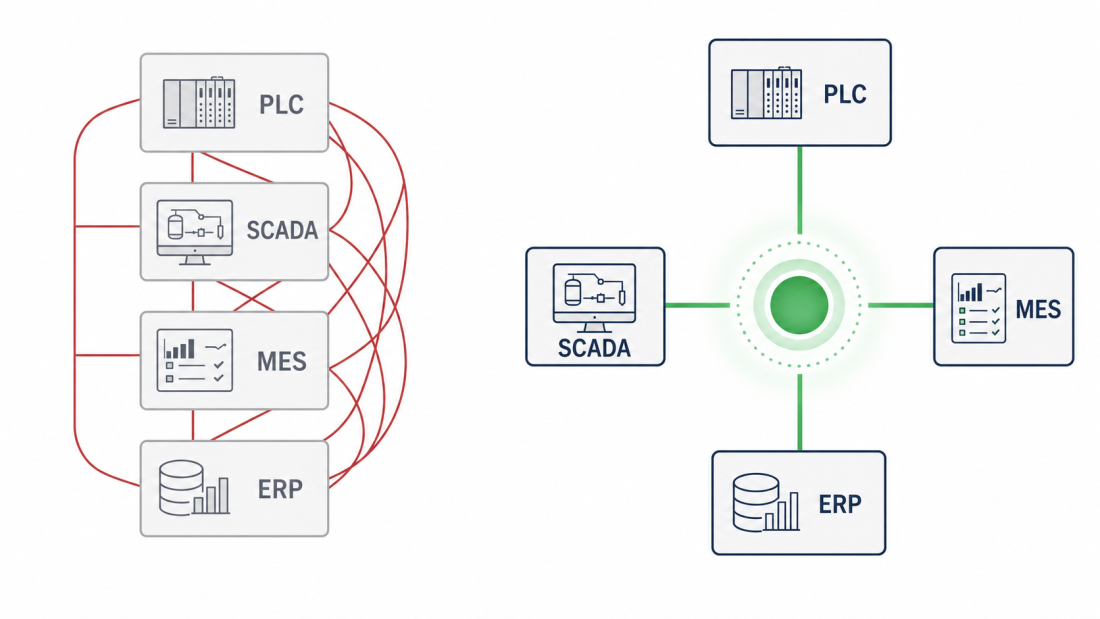
A unified namespace replaces thousands of brittle point-to-point integrations with one real-time data hub. Most manufacturers still don’t have one, which is a core reason most IIoT pilots never scale past year one and most of the sensor data factories already pay to collect goes unanalyzed.
A unified namespace is the reason some factories can plug in a new AI dashboard in an afternoon while others need a six-month IT ticket just to move one sensor feed. McKinsey’s 2025 manufacturing survey found 72% of large manufacturers already have at least one IIoT pilot or production deployment running — so this gap isn’t rare. It’s the default.
Why the ISA-95 Ladder Was Never Built for AI
For decades, industrial automation has organized data using the ISA-95 model: sensors and PLCs at the bottom, SCADA above that, then MES, then ERP at the top, each level passing information upward in stages. It works for control. It was never designed for a machine-learning model that needs live, contextualized data from every layer at once. See our analysis of the audit-driven IIoT adoption crisis, where we explain why this exact gap is now forcing procurement decisions.
A unified namespace replaces that ladder with a single publish-subscribe hub — commonly built on MQTT or OPC UA — where PLC tags, SCADA values, and ERP records all publish to one real-time structure that any authorized system, including an AI model, can subscribe to.
The Stat Nobody Puts on the Automation Budget Line
70% – of IIoT pilots remain pilots after 18 months — never scaling to plant-wide deployment.
Source: McKinsey’s 2025 manufacturing survey, cited by MachineCDN, “The State of IIoT in 2026”
The technology in these pilots is rarely the problem. The absence of a single real-time data hub to plug new tools into usually is.
“The winning pattern is a Unified Namespace: one MQTT publish/subscribe hub that replaces thousands of brittle point-to-point links, so a new dashboard or AI model plugs in within minutes instead of weeks.”— Entrans, industrial IT/OT integration analysis
Why the Real Cost Never Makes the Invoice
Point-to-point integration is the quiet line item nobody budgets for correctly. Every new dashboard, every new predictive-maintenance tool, requires its own custom connection to each data source it needs. A unified namespace turns that recurring cost into a one-time investment: connect a system once, and every future application subscribes to the same live feed. See our coverage of Industrial IoT ROI Frameworks for 2026, where we break down how that math plays out over a three-year budget cycle.
This is also where the “dark data” problem lives, and it is a direct symptom of a missing real-time data layer. Much of the sensor data factories already pay to collect never reaches an application that could use it. See our analysis of dark data sitting unused inside files companies already own, according to HiveMQ’s analysis of AI-ready industrial data architecture.
⚠ Fiction — composite scenario, not a real event: A parts plant’s predictive-maintenance pilot flags a bearing failure three days out. The alert never reaches the maintenance team’s scheduling system, which reads from a different database updated once nightly. The bearing fails on shift two. The model was right. The real-time data hub that would have delivered the alert didn’t exist yet.
Where AI Models Actually Break Without This
Predictive-maintenance and quality-control models are trained on historical sensor time-series data, and their accuracy depends on continuous, correctly time-stamped readings from every connected system — not on the model getting “smarter” on its own. Feed it stale or fragmented data because SCADA, MES, and ERP update on different schedules, and predictions degrade — not because the model failed, but because no unified data layer ever tied the pipeline together. See our analysis of IT-OT data ownership disputes, where we explain why this is the real fault line between the two teams, and our guide to fixing IIoT data latency. Kai Waehner’s analysis of IT/OT convergence patterns frames this same divide as a data-product governance problem, not just a plumbing one.
Global Implications
IT/OT convergence is now a global procurement issue, not a US or European one. Manufacturers in Nigeria, West Africa, and Southeast Asia adopting Industry 4.0 platforms face this problem sharpened by infrastructure gaps: intermittent power and older PLC hardware make retrofitting a real-time data architecture costlier per plant. But it also means these manufacturers can skip the decades of point-to-point legacy integration that older facilities are now paying to unwind — adopting a unified namespace from day one instead of migrating into it, much like regions that leapfrogged landline infrastructure straight to mobile networks.
💡 CreedTec Analyst’s Note — Daniel Ikechukwu
Strategic Impact: Whether a factory’s AI investment compounds or stalls depends on whether a unified namespace exists underneath it. Without one, every new AI pilot inherits the same integration tax as the last.
Stop: Buying point-solution AI dashboards that each require a custom, one-off data connection.
Start: Auditing whether existing OPC UA and MQTT infrastructure can publish to a single real-time namespace before approving another AI pilot.
Watch: Vendors marketing “AI-ready” platforms without disclosing whether their tool requires this kind of unified data layer to function at scale.
ROI Outlook: The upfront cost is real, but it is paid once. Every AI pilot layered on top afterward becomes cheaper and faster to deploy than the one before it.
Manufacturing AI is moving from isolated pilots into plant-wide systems. The next competitive advantage may not be which AI model a factory buys — it may be whether the data underneath it was ever unified in the first place.
Subscribe to CreedTec’s newsletter — it breaks down the data architecture decisions vendors won’t put in their pitch decks.
Sources
- McKinsey & Company — 2025 manufacturing survey data
- MachineCDN — “The State of IIoT in 2026”
- Entrans — IT/OT integration architecture analysis
- Kai Waehner — Unified Namespace vs. Data Product
- HiveMQ — AI-ready industrial data architecture
- ISA — ISA-95 standard
- MQTT.org / OPC Foundation — protocol references
Further reading: The Dark Data IIoT Opportunity · Industrial IoT Architecture ROI Frameworks 2026 · IT-OT Data Ownership Disputes · Fixing IIoT Data Latency · The Audit-Driven IIoT Adoption Crisis