Fast Facts
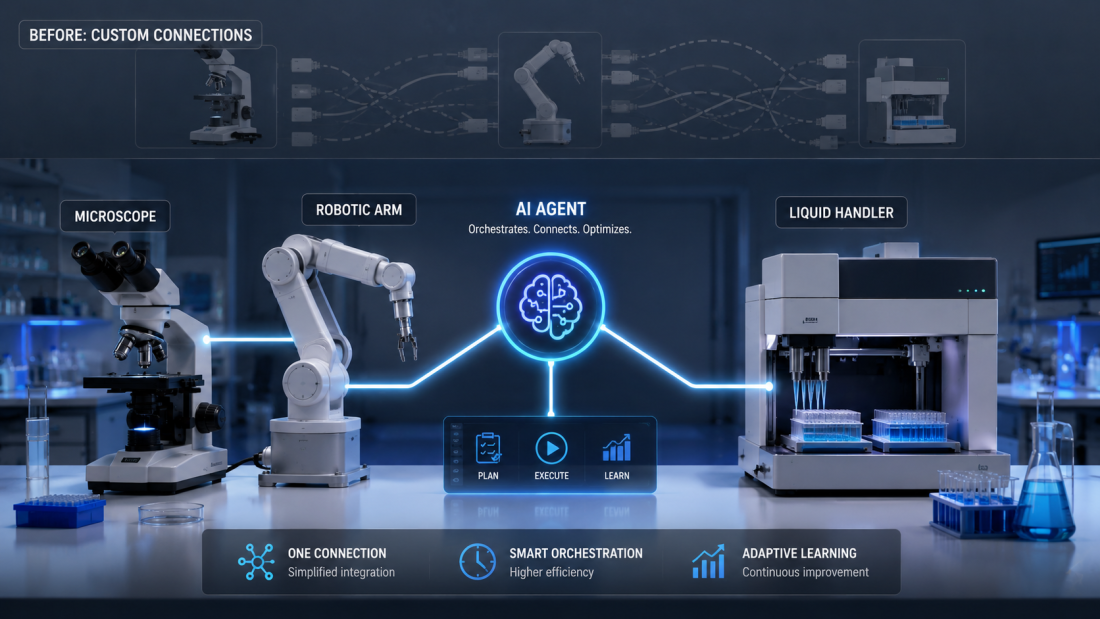
Anthropic opened a research preview of the Model Hardware Standard on August 27, a specification that lets AI agents discover and operate physical equipment, robotic arms, microscopes, liquid handlers, through one shared interface instead of custom integration code per device. Early partners include Genentech, Carnegie Mellon, AWS, Universal Robots, Doosan Robotics, and Hugging Face. QuEra reported a laser-stabilization task going from 58% to 99.3% success with an MHS-connected agent. It is not open-sourced yet, and Anthropic has been explicit that it isn’t a safety certification.
The Model Hardware Standard is Anthropic’s bet that the same playbook behind its Model Context Protocol, now a de facto industry standard for connecting AI to software tools, can work for physical equipment too. Anthropic opened a limited, application-only research preview of MHS on August 27, 2026, developed with HHMI Janelia Research Campus, giving AI agents a standardized way to discover, operate, and troubleshoot programmable hardware, according to Anthropic’s own announcement. The company said integration that used to take weeks or months per device can now take hours or minutes.
The Number That Makes This More Than a Demo
Most new AI infrastructure announcements lead with a capability claim. This one leads with a specific, attributable performance jump: QuEra Computing, which builds quantum computers, used the Model Hardware Standard to let an AI agent recover a laser’s precise operating frequency without human intervention, and reported the task’s success rate rising from 58% to 99.3%, according to AlphaSignal’s coverage of the launch. Carnegie Mellon University researchers ran drug-discovery experiments roughly three times faster using the standard, and Genentech automated a multi-device protein assay procedure that previously required manual coordination across a liquid handler, robotic arm, and plate reader.
58% → 99.3% — QuEra’s reported success rate for autonomous laser recalibration before and after using the Model Hardware Standard.
Weeks to hours — Anthropic’s claimed reduction in device integration time under MHS.
The public evidence does not support a general safety or production certification.— Kingy.ai, independent analysis of the MHS research preview
Why the Partner List Is the Real Signal
A standard is only as useful as who adopts it, and this partner list reads like infrastructure intent rather than a one-off pilot. AWS is adding MHS support through Strands Robots, Tecan is integrating it into its Fluent liquid handling platforms, Universal Robots and Doosan Robotics are testing it with their robotic arms, and Hugging Face is building support into LeRobot, according to the same AlphaSignal report. See our analysis where we explain why ABB and NVIDIA’s 99% sim-to-real accuracy claim needs the same scrutiny as any vendor benchmark. MHS works with any large language model, not just Claude, which is the same open-adoption strategy that helped Anthropic’s Model Context Protocol become a cross-industry standard rather than a proprietary feature.
⚠ Fiction — illustrative scenario: A contract lab’s operations director reads that an AI agent recovered a quantum laser’s calibration 99.3% of the time and assumes the same reliability applies to every device on the bench, greenlighting unattended overnight runs across the full equipment fleet. A camera driver behaves differently than the laser controller did in testing, and a run goes unmonitored for six hours before anyone notices. The standard performed exactly as documented on the device it was tested on. It was the assumption of blanket reliability across untested devices that caused the gap.
What Anthropic Itself Is Not Claiming
Anthropic has been notably restrained about the standard’s readiness: the preview remains application-only, there’s no committed public release date, and the company says it’s using this period specifically to develop safety evaluations and best practices before wider availability, according to Quartz’s reporting on the launch. Safety limits are enforced at the driver level, below the agent itself, which is a deliberate design choice: even if an agent’s reasoning goes wrong, the hardware-level driver is meant to hold the line. See our related coverage of why 272 AI experts rated 18 of 24 catastrophic risk categories above a 10% five-year probability and why proprietary domain data is beating raw compute scale in specialized AI applications.
Global Implications
For manufacturers and research institutions outside the small group of initial Model Hardware Standard partners, the real opportunity sits on the other side of the open-source release Anthropic has promised but not scheduled. A shared hardware interface that any lab or factory could adopt without a bespoke integration budget would matter most in exactly the markets that currently can’t afford weeks of custom engineering per device. See our analysis of why agentic AI governance is losing the identity race entirely.
💡 CreedTec Analyst’s Note — Daniel Ikechukwu
Strategic Impact: The Model Hardware Standard could become the default interface between AI agents and physical equipment the same way Model Context Protocol became the default for software tools, and the partner list already signals that ambition.
- Stop: Treating any single reported success rate, including QuEra’s 99.3% figure, as representative of performance across all device types.
- Start: Watching for the public or open-source release date, since that’s the point this shifts from a controlled pilot to something broadly evaluable.
- Watch: Whether Anthropic’s promised safety evaluations result in published, device-specific certification standards before general availability.
ROI Outlook: Integration-time reduction from weeks to hours is a real, quantifiable cost saving wherever it holds, but buyers should demand device-specific validation data rather than extrapolating from a different partner’s results.
Can any company start using the Model Hardware Standard today?
Not yet. Access is currently limited to an application-only research preview with a small group of partners, and Anthropic has not committed to a specific public or open-source release date.
The Model Hardware Standard is still a preview, not a production system, and Anthropic has been unusually direct about that limitation. But a laser-calibration task jumping from 58% to 99.3% success is the kind of concrete number that turns a standards announcement into something worth watching closely before it ships broadly.
Get CreedTec’s next AI infrastructure briefing before your next automation integration decision.
Subscribe free
Sources
- Anthropic, “Previewing the Model Hardware Standard,” August 2026
- AlphaSignal, “Anthropic’s Model Hardware Standard Lets Claude Control Lab Robots Overnight,” August 2026
- Quartz, “Anthropic Model Hardware Standard connects AI to lab equipment,” August 2026
- Kingy.ai, “Anthropic’s Model Hardware Standard: What MHS Actually Changes,” August 2026
- Fortune, “Anthropic makes first move into physical AI,” August 2026