Fast Facts
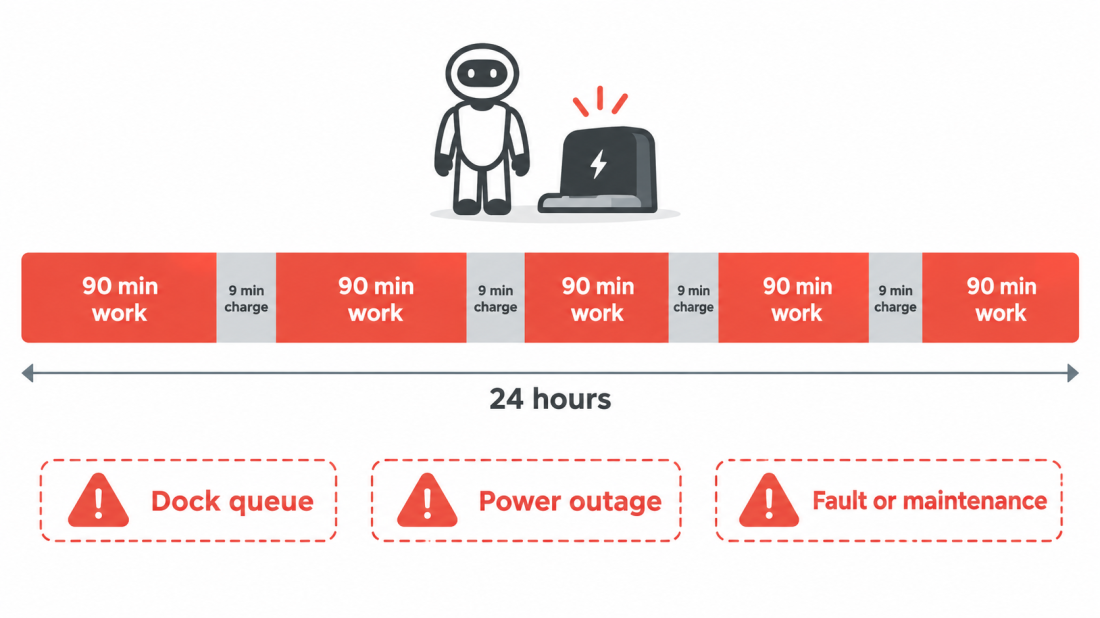
The Digit 5 humanoid from Agility Robotics is billed as able to deliver more than 20 productive hours in a 24-hour day, using a new battery from Nyobolt that runs about 90 minutes and recharges in about nine. Agility says that is a 10-to-1 run-to-charge ratio, up from 2-to-1 on Digit 4. Early customer access is planned for the first half of 2027.
All of these are company figures, not customer-floor results. The 20-hour claim is arithmetic that assumes the robot returns to its dock on schedule, every cycle. For buyers, the real question is not battery chemistry but what happens when the dock, the power or the workflow slips.
Humanoid vendors usually sell capability. Agility is selling uptime. The Robot Report quotes Daniel Diez, Agility’s chief business officer: “For our customers, Digit’s uptime is the business case.” That makes the Digit 5 humanoid a useful test of whether a fast-charging battery can turn a demo robot into a shift-covering one.
The Numbers Behind the Digit 5 Humanoid
Per Silicon Canals, Digit 5 stands 5 ft 11 in, weighs 284 lb, repeatedly lifts up to 50 lb, a 40% increase over Digit 4, and reaches 7.2 ft against about 5.5 ft before. Nyobolt, a Cambridge, U.K. company founded in 2019, supplies the battery. The Robot Report says Nyobolt raised $60 million in May 2026 at a $1 billion valuation with support from Symbotic.
The arithmetic is simple. A 90-minute run plus a 9-minute charge is a 99-minute cycle, which fits about 14.5 times into 24 hours. That yields roughly 21.8 hours running and 2.2 hours charging, the same figure Silicon Canals reports. It is an idealized ceiling before faults, maintenance or queueing for a dock. Interesting Engineering notes the claim holds only if the robot can regularly return to its charging dock.
10:1 | ~21.8 hours | 50 lb
Claimed run-to-charge ratio (Digit 4: 2:1), idealized daily runtime from a 90-minute run and 9-minute charge, and repeatable payload. All are Agility specifications or arithmetic, not measured customer results. Sources: The Robot Report; Silicon Canals; Interesting Engineering.
“For our customers, Digit’s uptime is the business case.”
— Daniel Diez, Chief Business Officer, Agility Robotics (via The Robot Report)
Against Atlas, and Against the Evidence
Silicon Canals compares Digit 5 with Boston Dynamics’ electric Atlas, which it says is rated for up to 66 lb and 7.5 ft reach, with about four hours of runtime on a hot-swappable battery. Atlas leads on payload and reach; Digit 5 bets on charging speed. Boston Dynamics is owned by Hyundai Motor Group (KRX: 005380). See our analysis where we explain why CJ Logistics’ humanoid deployment is the first real test of physical AI economics.
Evidence is thin. The only independently reported field metric Silicon Canals cites is Digit 4 at a GXO facility: 98% tote-sorting accuracy over more than 100,000 units. That measures accuracy, not hours worked. Agility also reports more than $300 million in multi-year commitments, which Silicon Canals and Interesting Engineering both describe as conditional. See our analysis where we explain why a $1.35B humanoid round exposes the robot pre-orders gap.
Safety and Timing Questions
Agility says Digit 5 is built to work near people without cages, using sensors and a separate safety controller that can stop it, back it away or lower it to a seated position. Interesting Engineering reports NVIDIA is the first launch partner for the safety stack, and that safety standards for humanoids are still being developed. See our analysis where we explain how NVIDIA’s Halos humanoid robot safety system works.
Timelines differ. The Robot Report says early access with the Nyobolt battery is expected in the first half of 2027, with broader availability six to nine months later. An August eWeek report had cited December 2026 for early units. That gap is worth a question to any sales rep quoting the Digit 5 humanoid. Lease terms will matter too; see our analysis where we explain why the Agility Robotics and Toyota RaaS deal matters. Maintenance also shapes real uptime. See our analysis where we explain the robot maintenance cost model every procurement team gets wrong.
⚠️ Hypothetical scenario: A Lagos distribution centre plans to cover three shifts with one Digit 5 humanoid. On a day the grid drops, the generator takes four minutes to pick up and the dock lags behind. The robot misses two charge windows and finishes the shift at half the planned output. The contract promised 20 hours; the site delivered 11.
💡 CreedTec Analyst’s Note by Daniel Ikechukwu
Strategic Impact
The Digit 5 humanoid shifts the humanoid contest from what a robot can lift to how often it can work. If the claim holds, one robot could replace shift handovers, which is a labor-cost story, not a technology one. Until customer-floor data exists, it remains a specification.
Stop / Start / Watch
- Stop: pricing a humanoid on theoretical uptime.
- Start: asking for measured hours per day at a named customer site, including dock downtime.
- Watch: the H1 2027 early-access results and whether Agility publishes uptime with faults included.
ROI Outlook
No price is public, so no ROI figure is defensible. What can be modeled is power: dock charging adds load and needs reliable electricity. For buyers in Nigeria and Southeast Asia, backup power belongs in the business case for any Digit 5 humanoid deployment, ahead of the robot’s sticker price.
— Daniel Ikechukwu,
Uptime is only as good as the dock and the grid. Get the weekly robotics briefing on what vendors leave out. Subscribe free