Fast Facts
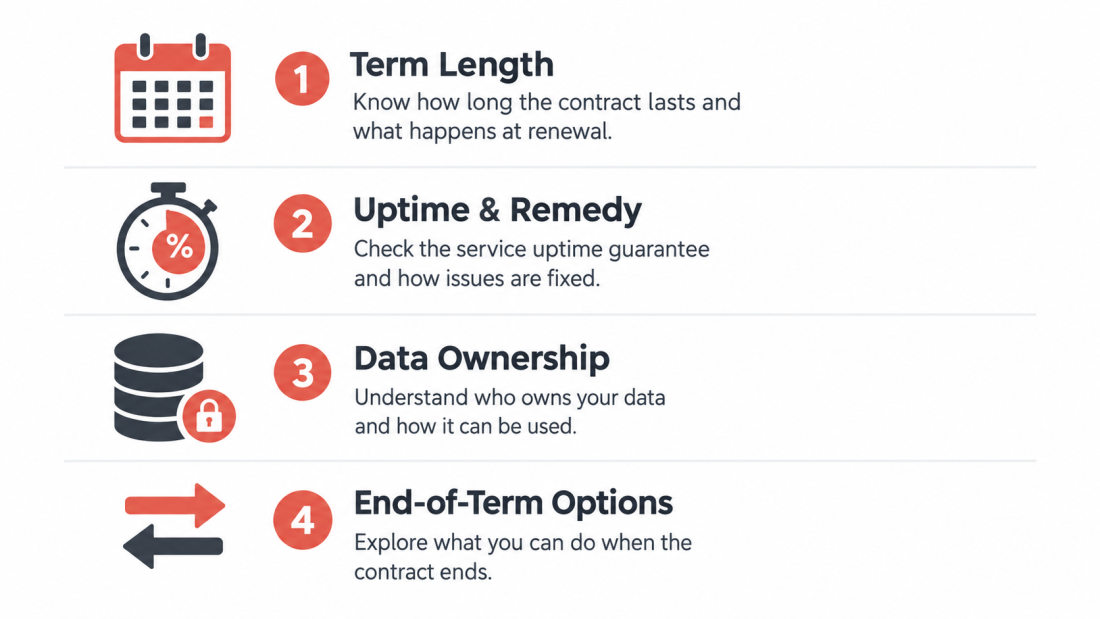
Robotics-as-a-service turns a large robot purchase into a monthly subscription, with the vendor keeping ownership and covering maintenance. That structure only pays off if four specific RaaS contract clauses are negotiated well: minimum term length, uptime with named remedies, data ownership, and end-of-term options. Get those wrong and a low monthly rate with a long lock-in can quietly cost more than buying the robot outright.
Even a strong-sounding 99.5% uptime guarantee still permits close to 44 hours of unscheduled downtime a year, and most contracts measure that uptime on the robot hardware alone, not on whether shipments went out the door.
Robotics-as-a-service (RaaS) exists because the traditional path to automation — a large upfront purchase, a lengthy integration project, an in-house maintenance contract — locks out everyone not already running at scale. Under RaaS, the provider keeps ownership, carries the robot as its own asset, and bundles installation, maintenance, and support into one subscription. That’s why mid-sized manufacturers who could never justify a six-figure purchase are now RaaS customers. But the pitch and the contract are different documents, and the gap lives in the RaaS contract clauses that rarely get the scrutiny the monthly price does.
RaaS Contract Clauses, Starting With Term Length
The whole appeal of RaaS is flexibility — scaling a fleet up or down without a five-year depreciation schedule anchoring the decision. A long minimum term erases that advantage while keeping the subscription’s higher effective cost, since pricing already builds in the vendor’s margin on ownership and risk. Shorter terms protect the exact flexibility the model is supposed to offer. See our analysis where we explain the robot maintenance cost model every procurement team gets wrong.
Clause Two: Uptime That Means Something
Uptime guarantees look reassuring until the math gets checked. A 99.5% SLA still permits roughly 44 hours of unscheduled downtime a year, and most agreements don’t obligate the provider to schedule it around your peak season. The deeper issue: uptime is typically measured on the robot hardware itself, not your warehouse’s throughput, so a provider can hit its number while shipments still miss their window over a software integration failure the SLA never covers. A usable one of these RaaS contract clauses names the remedy — a credit, a response-time commitment — since an uptime promise with no remedy is a marketing line, not a contract term.
Verified numbers
| Stat | Detail |
|---|---|
| ~44 hrs | Downtime still permitted annually under a 99.5% uptime SLA |
| 95–99%+ | Typical uptime range RaaS vendors advertise across current contracts |
| 2023 | Year GXO and Agility Robotics signed the first humanoid robot RaaS contract on record |
Clause Three: Who Owns the Data
Every RaaS robot generates operational data — cycle times, failure logs, picking accuracy, battery health — and by default it often belongs to whoever owns the hardware, which under RaaS is the vendor, not you. A fleet’s performance history is the asset that lets a buyer negotiate better renewal terms or switch providers without starting from zero. Skipping data ownership in the contract hands the vendor a renewal advantage that has nothing to do with service quality. See our analysis where we explain why model deprecation is the contract risk nobody negotiates, which applies just as directly to hardware-as-a-service agreements.
Clause Four: What Happens When the Contract Ends
RaaS providers keep title to the hardware, so the end-of-term clause decides whether a buyer walks away with nothing or has a path to a buyout, a disclosed renewal rate, or a clean transition to a new vendor. Some providers state upfront they’ll own and maintain the equipment with no purchase option; others build in a standard buyout. Neither is wrong, but a buyer who doesn’t know which they signed finds out at the worst moment — when the fleet is suddenly a renewal negotiation with no leverage. See our analysis where we explain why the Agility Robotics-Toyota RaaS deal matters as a working example of this structure in practice.
⚠️ Hypothetical scenario (illustrative only, not a reported case)
A Lagos-based food distributor signs a three-year RaaS contract for warehouse picking robots, drawn in by a 99% uptime guarantee and a rate well below buying outright. Eighteen months in, the robots hit their uptime number every month, but integration failures with the distributor’s own inventory system repeatedly delay shipments during peak demand — failures the SLA never counted. The distributor has no service-credit clause to invoke and no data history to negotiate better terms, because the contract addressed neither.
The One-Line Test
Before signing, a buyer should answer one question in a sentence: if the robots miss a shipment during a defined failure, what credit do I receive, and who owns the data proving it happened? If the honest answer is “it depends,” none of the RaaS contract clauses above have actually been negotiated, no matter how attractive the monthly rate looks. See our analysis where we explain five cost differences between industrial and collaborative robots for the ownership-side comparison this framework complements, and how to boost cobot ROI through warehouse efficiency savings for the usage side of the same decision.
💡 CreedTec Analyst’s Note by Daniel Ikechukwu
Strategic Impact
RaaS removes the capital barrier to automation, but it doesn’t remove the need for contract literacy. The vendor relationship, not the robot’s specs, is what determines whether the subscription actually beats ownership over its term.
Stop / Start / Watch
- Stop: comparing RaaS offers on monthly price alone without pricing in term length and remedy strength.
- Start: demanding uptime definitions tied to your operational throughput, not just the robot’s own hardware status.
- Watch: whether more humanoid RaaS deals, following GXO’s lead with Agility, standardize these four clauses into an industry template buyers can benchmark against.
ROI Outlook
A well-negotiated RaaS contract genuinely beats buying for most mid-sized deployments; a poorly negotiated one erodes that advantage within the first renewal cycle. The four clauses above are where that outcome gets decided, long before the robots ever reach the floor.
— Daniel Ikechukwu
Comparing RaaS vendors for your own fleet?
Get CreedTec’s weekly briefing on robotics procurement, contract economics and deployment risk, written for buyers who sign the agreement. Subscribe free.
Sources
- Layer3Labs: “Robotics as a Service (RaaS): The 2026 Guide to Renting Robots” (2026)
- Warehouse Fieldbook: “RaaS vs Buying Warehouse Robots” — citing Locus Robotics, inVia Robotics and Formic contract terms (Aug 2026)
- iFactory: “Robots as a Service (RaaS) Warehouse Analytics & AI Integration” (2026)
- Wikipedia: “Robot as a service” — ownership and service-contract structure
- Wikipedia: “Agility Robotics” — GXO Logistics first humanoid RaaS contract