Fast Facts
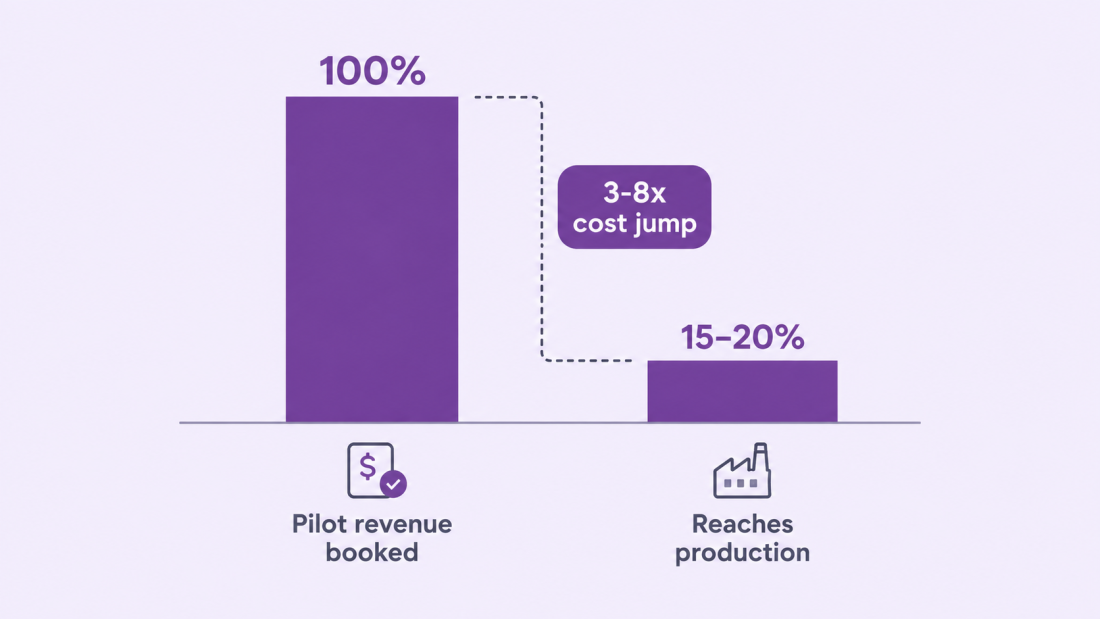
Industrial AI pilot revenue is booked like the start of a platform deal, but most pilots never become one. RAND and MIT’s 2026 analysis puts the failure rate at 80.3%, and multiple 2026 studies converge on 70-88% of AI pilots never reaching production, whatever function they sit in.
The financial risk this creates isn’t the failed pilot itself; it’s a scale-up cost of 3-8x the pilot’s price that the customer discovers only after signing, which is exactly where deals quietly die. Vendors and buyers who price around that jump, not around the pilot fee, are the ones whose revenue survives renewal.
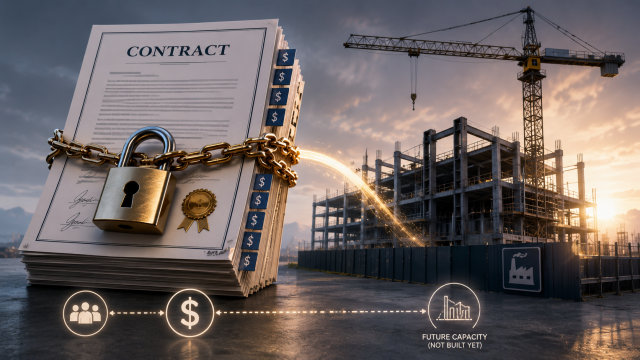
Industrial AI pilot revenue behaves like a down payment on a multi-year platform contract. In practice it is closer to an option the customer can walk away from once the real cost shows up. KPMG has found that while 70-87% of enterprises have launched some AI initiative, only a fraction scale it into a production system that generates measurable value. RAND and MIT’s 2026 review of enterprise AI deployments put the failure rate to deliver measurable business value at 80.3%. Deloitte separately found that 42% of companies abandoned at least one AI initiative in the prior year. None of these numbers describe a fringe problem; they describe the default outcome.
The Jump Nobody Prices Into the Pilot
The gap isn’t mainly technical, it’s financial. Digital Applied’s 2026 budget-planning research, cross-checked against multiple independent analyses, found that moving a successful pilot into production typically costs 250-400% more than the pilot itself, meaning a $100,000 pilot needs $300,000-$800,000 to scale.
Most industrial buyers do not reserve that budget going in, because the pilot’s own pricing gave no signal it was coming. When the real number appears after the fact, the project dies for lack of an approved line item, not for lack of results. See our analysis where we explain why zombie AI projects cost factories more than outright failures.
What This Does to a Vendor’s Books
A vendor that recognizes contract value at signing is booking revenue on a coin flip weighted against it. Gartner’s own 2026 guidance for enterprise AI value points the other way: it expects more than 70% of enterprise AI value to come from AI embedded into operational workflows, not standalone pilots or dashboards, which means revenue tied only to a pilot license is revenue tied to the minority outcome.
A single mid-market manufacturer running eight to twelve simultaneous pilots, a pattern Digital Applied’s 2026 manufacturing survey documents, is not evaluating one vendor against a production incumbent; it is comparing that vendor’s unconverted trial against eleven others. The competitive threat to a vendor’s renewal isn’t the competitor that wins the account — it’s the quiet churn of a pilot that nobody ever formally cancels. See our analysis where we explain why net retention, not new bookings, is the real story behind enterprise software growth.
Verified numbers
| Stat | Detail |
|---|---|
| 80.3% | AI projects failing to deliver measurable value, per RAND/MIT’s 2026 analysis — the core failure rate behind every industrial AI pilot revenue forecast |
| 250–400% | Extra investment a successful pilot needs to reach production (Digital Applied, 2026) — the cost jump that industrial AI pilot revenue rarely prices in |
| 42% | Companies that abandoned at least one AI initiative in the prior year (Deloitte, 2026) — evidence that industrial AI pilot revenue booked at signing is not committed ARR |
⚠️ Hypothetical scenario (illustrative only, not a reported case)
An industrial AI vendor closes a $120,000 predictive-maintenance pilot with a Lagos cement plant and books it as the first year of a three-year platform deal in its board deck. The pilot works on two lines. Scaling to the other fourteen needs a $400,000 data-integration and monitoring build the plant never budgeted. The plant’s ops director goes quiet for two quarters, then declines to renew. The vendor’s churn report calls it a lost account; its finance team had already recognized the contract as multi-year ARR.
The Pricing Test That Separates Survivors
Vendors whose revenue holds up past year one tend to share a structure, not a sales technique: they price the pilot and the scale-up phase as separately negotiated milestones instead of one contract with an implied renewal, and they tie at least part of the scale-up fee to a production usage or output metric rather than a flat license.
See our analysis where we explain why outcome-based pricing is the model that survives the compute cost trap and our breakdown of the asset-based pricing model built for exactly this transition. Buyers, in turn, should ask any vendor for the specific 3-8x figure their own pilots have historically required to scale, not the vendor’s list price for year two. See our analysis where we explain why nobody can agree on the industrial AI market’s real size and how margin intelligence separates real industrial AI revenue from booked optimism.
💡 CreedTec Analyst’s Note by Daniel Ikechukwu
Strategic Impact
Industrial AI pilot revenue is not a leading indicator of platform revenue; the two are separated by a cost jump most contracts never name. Vendors who reveal that jump upfront convert fewer pilots but keep the ones they convert.
Stop / Start / Watch
- Stop: booking pilot contract value as if it were committed multi-year ARR.
- Start: publishing your own historical pilot-to-production cost multiplier and pricing the scale-up phase as its own milestone.
- Watch: the gap between gross bookings and net revenue retention on cohorts twelve months past their pilot date — that gap is the real production conversion rate.
ROI Outlook
The vendors reporting durable growth through 2027 will be the ones whose ARR is backed by production usage, not signed pilots; expect investor and board scrutiny to shift from bookings growth to the ratio of pilot revenue to production revenue on the same set of logos.
— Daniel Ikechukwu, CreedTec (Industrial AI Revenue Analyst)
Structuring your own industrial AI pricing?
Get CreedTec’s weekly briefing on industrial AI revenue models, ARR quality and procurement economics, written for operators and investors who read past the bookings number. Subscribe free.
Sources
- Intelliconnect: “AI Pilot to Production in Manufacturing: Why Operations Lag Behind” — cites RAND/MIT 2026 and Deloitte 2026 (May 12, 2026)
- TechStoriess: “Enterprise AI Adoption in 2026: From Pilot Purgatory to Production-Scale AI Integration” — cites KPMG and Gartner (June 29, 2026)
- Iternal.ai: “AI Implementation Cost: How Much to Budget for AI in 2026” — cites Digital Applied’s 250-400% scale-up finding (July 16, 2026)
- Digital Applied: “AI Agent Scaling Gap March 2026: Pilot to Production”
- Deloitte Switzerland: “AI in Manufacturing 2026” survey