Fast Fcats
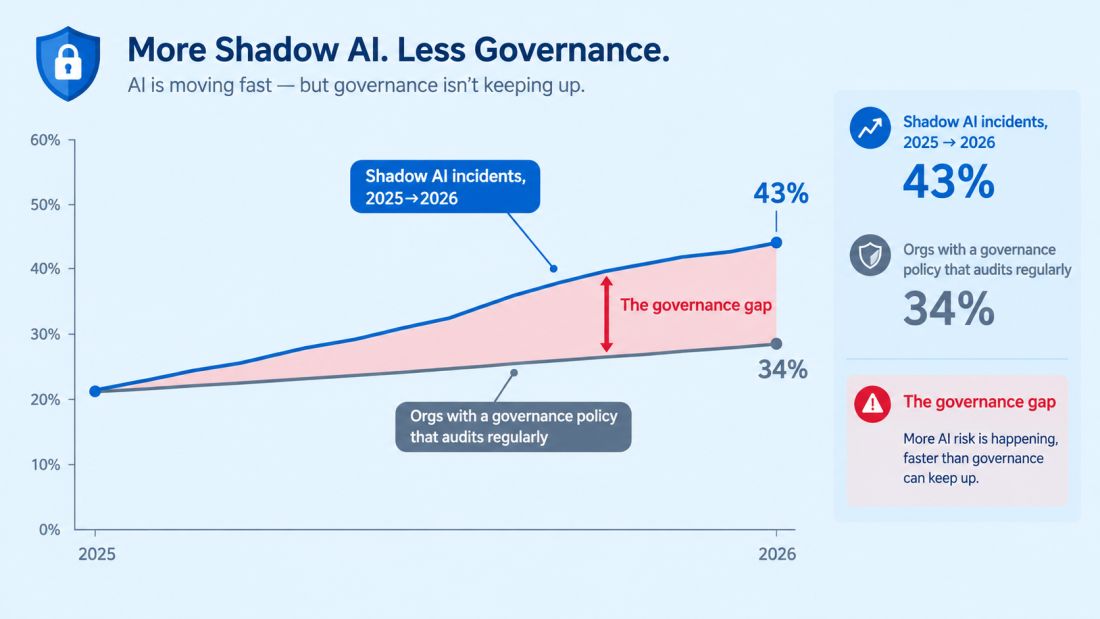
The shadow AI governance gap — employees running AI tools nobody in IT approved or can see — now adds roughly $670,000 to the average cost of a breach, and IBM’s 2026 Cost of a Data Breach research found the share of incidents tied to shadow AI more than doubled year over year to 43%. Most organizations still can’t see the problem: 68% of breached companies had no policy in place to manage or detect it, up from 63% a year earlier.
Banning tools doesn’t close the gap; multiple 2026 studies show usage just moves to personal accounts and phones, outside any log a security team can pull. The gap closes only when a sanctioned tool is fast and good enough that routing around it stops being worth the trouble.
This gap is no longer a future risk analysts warn about — it’s showing up in breach invoices today. IBM’s 2026 Cost of a Data Breach Report, drawn from interviews at 600 breached organizations, found that AI-related incidents involving unsanctioned tools more than doubled as a share of the total, and that breaches linked to shadow AI carry a real, measurable cost premium over the baseline. The number CISOs keep citing is $670,000 extra per incident, a figure IBM has now published across successive editions of the report as the shadow AI premium holds steady even as overall breach costs climb toward $6 million.
Why the Shadow AI Governance Gap Carries a Premium
The extra cost isn’t abstract. Customer PII shows up in a higher share of these breaches, and investigators lose time reconstructing what data went where with no log of which tool was used. IBM’s VP of Security and Runtime Products put the finding plainly.
Shadow AI use “added an extra USD 670,000 to the global average breach cost,” Suja Viswesan, VP of Security and Runtime Products at IBM, said.
The other side of the shadow AI governance gap is just as stark: only about a third of organizations with a policy actually audit their networks for unsanctioned tools regularly. A policy nobody checks against real usage isn’t governance, it’s a document. See our analysis where we explain five costly AI agent security blind spots nobody is fixing in 2026.
Verified numbers
| Stat | Detail |
|---|---|
| 43% | Share of AI-related security incidents tied to shadow AI, more than double the year before (IBM, 2026) |
| $670K | Average extra cost of a shadow-AI-linked breach over baseline (IBM Cost of a Data Breach) |
| 68% | Breached organizations with no policy to manage or detect shadow AI, up from 63% (IBM, 2026) |
Bans Don’t Close the Shadow AI Governance Gap, They Hide It
Blocking unsanctioned tools at the network level is understandable and largely doesn’t work. Separate 2026 research found that when companies banned consumer AI tools outright, employees moved usage onto personal devices and home networks, entirely outside any log a security team could pull later. The gap doesn’t close, it just goes invisible until a breach forces it back open. See our analysis where we explain why agentic AI governance is already failing to keep pace with a 140-to-1 identity problem.
What Actually Closes the Gap
The one intervention with documented results isn’t a ban, it’s a faster sanctioned alternative. One case study found personal-account AI usage inside an enterprise fall from 85% to 11% within a year, once the company provisioned a managed tool good enough that employees stopped routing around it. That single number explains more than any compliance memo: this is a procurement problem, not a discipline problem. See our analysis where we explain who actually gets the best AI under enterprise cybersecurity access tiers and our breakdown of the AI notetaker breach that exposed 181,874 meetings for six silent months.
⚠️ Hypothetical scenario (illustrative only, not a reported case)
A Lagos insurance underwriter’s team starts pasting client risk profiles into a free consumer AI tool to speed up policy summaries, because the company’s approved internal tool is slow and requires three extra login steps. No one flags it, because the underwriting manager doesn’t know the tool exists. Eight months later a routine security audit finds the free tool’s logs contain thousands of policyholder records with no data-processing agreement in place, and the company spends the next two quarters on remediation and regulator notifications it never budgeted for.
The Procurement Checklist This Implies
Three actions separate organizations that close this gap from those that only document it: inventory every AI tool touching company data quarterly, not yearly; require vendor-embedded AI features to log prompts by default, since forensic cost is where the premium concentrates; and time how long sanctioned-tool approval actually takes, since that predicts shadow usage better than any policy. See our analysis where we explain why agentic AI orchestration just became the enterprise deployment gate and why model deprecation is the contract risk nobody negotiates.
💡 CreedTec Analyst’s Note by Daniel Ikechukwu
Strategic Impact
The shadow AI governance gap isn’t a technology gap, it’s a speed gap. Employees route around sanctioned tools that are slower than the free alternative, and no policy memo fixes a product problem.
Stop / Start / Watch
- Stop: treating a published AI usage policy as evidence of AI governance without a regular audit behind it.
- Start: timing how long sanctioned-tool approval actually takes and benchmarking it against the free alternative employees would otherwise reach for.
- Watch: whether the 43% shadow-AI incident share keeps climbing as autonomous agents, not just chat tools, start acting on enterprise data without a human prompting each step.
ROI Outlook
Closing the shadow AI governance gap costs far less than one avoided $670,000 premium; the budget case for a fast, well-provisioned sanctioned tool writes itself once framed against a single incident’s forensic bill.
— Daniel Ikechukwu
Auditing your own AI tool sprawl?
Get CreedTec’s weekly briefing on AI governance, vendor risk and procurement economics, written for security and IT leaders who sign off on the tools. Subscribe free.
Sources
- IBM Newsroom: “One in Four Malicious Breaches are AI-Enabled, Costing Companies $6 Million on Average” (July 29, 2026)
- Cybersecurity Dive: “As data breaches grow costlier, ungoverned AI creates new risks” (July 2026)
- Cinchops: “IBM Cost of a Data Breach Report 2026: The AI Tipping Point” (Aug 2026)
- Shattered.io: “Shadow AI: 20% of Breaches, $670K Cost” — cites IBM VP Suja Viswesan (2026)
- ShadowLock: “State of Shadow AI 2026” research report (June 2026)