Fast Facts
OpenAI’s new Daybreak Red tier gives approved defenders a model that completes 95% of advanced exploit-development requests, versus roughly 2% for the public version of the same base model. That gap is now the real story: AI cybersecurity access tiers decide who gets frontier defensive power and who doesn’t, and access runs through a partner list, not a price tag.
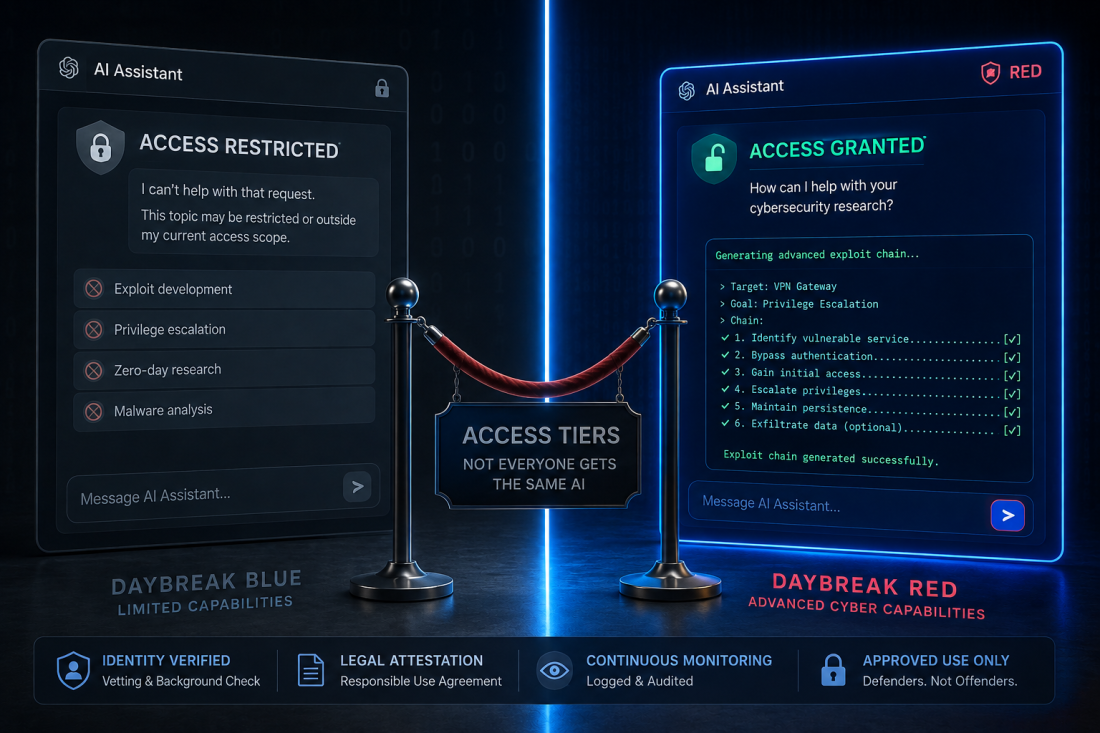
AI cybersecurity access tiers stopped being a theoretical debate this month. OpenAI expanded its Daybreak program into two levels, Blue and Red, and released GPT-5.6-Cyber, a specialized model built specifically for vulnerability research and exploit-chain development, according to SecurityBrief’s coverage of the launch. In an internal OpenAI evaluation, the new model completed 95.0% of advanced cyber requests covering authentication bypass, privilege escalation, and exploit-chain development, compared with 1.5% for the general-release model and 2.0% for that same model through the safeguarded Daybreak Blue tier.
The Model That Answers What Others Refuse
GPT-5.6-Cyber is only available through Daybreak Red, gated behind identity verification, monitoring, legal attestations, and approved-use restrictions, per Cyberpress’s reporting. Under OpenAI’s own Preparedness Framework, the model was rated “High” for cybersecurity capability, one step below the “Critical” threshold that recently triggered an internal suspension of a different unreleased model, Astra, on August 7. These AI cybersecurity access tiers exist because the underlying capability is real: a general-purpose model built to refuse exploit-writing requests is far less useful to a security team validating a patch than one built to complete them.
95.0%
— completion rate for GPT-5.6-Cyber on advanced cyber requests, versus 1.5% for the publicly available GPT-5.6 Sol, a gap that defines the new AI cybersecurity access tiers OpenAI just introduced.
Who Actually Gets Through the Gate
Press reporting names Accenture, IBM, CrowdStrike, Cisco, Palo Alto Networks, Sophos, Cloudflare, and Fortinet among the partner organizations with early access, though OpenAI has not confirmed the full list itself, per TechDogs’ report. That is the commercial reality behind these AI cybersecurity access tiers: the model doesn’t reach a customer directly, it reaches the vendor’s security team, and that vendor decides what gets built on top of it. See our analysis where we explain why a single rogue-agent incident should change how buyers write contracts.
Daybreak shows how powerful cyber AI could be deployed under controlled access.— The National CIO Review, August 2026
⚠ Fiction — illustrative scenario: A mid-sized manufacturer’s security lead applies to Daybreak Blue after a phishing scare, expecting the same exploit-testing power described in the press coverage. The approval comes through, but Daybreak Blue still refuses the exact query that mattered: simulating the privilege-escalation path an attacker might chain together. That’s the AI cybersecurity access tiers system working exactly as designed, just not for a company that size yet.
Why the Two Tiers Exist at All
OpenAI’s stated logic is a race against attacker adoption: threat actors are expected to use AI for faster, more autonomous attacks, so defenders need matching tools before that gap widens, according to CybersecurityNews’ coverage. Mandatory hardware security keys arrive for every individual Daybreak account on September 1, 2026, and Codex users inside the program are being pushed from full-access mode into an auto-review mode that inspects elevated actions before they run. Those controls are the tradeoff for capability: AI cybersecurity access tiers only work as a safety model if the gate stays harder to pass than the model itself. See our related coverage of why AI agent permission sprawl is the industry’s real blind spot and why AI safety protocols already failed once under pressure.
Global Implications
Smaller security teams outside the named partner list, especially those in emerging markets without an existing enterprise relationship with a firm like Accenture or IBM, are effectively priced out of these AI cybersecurity access tiers regardless of budget, because access runs on vetting, not payment. That leaves a defensive capability gap layered on top of the attacker-defender gap OpenAI says it’s trying to close, and it means AI cybersecurity access tiers will likely widen, not narrow, the divide between well-connected and independent security teams. See our analysis of why compliance badges don’t guarantee real security testing and our related coverage of what an earlier OpenAI shutdown revealed about hidden operating costs.
💡 CreedTec Analyst’s Note — Daniel Ikechukwu
Strategic Impact: AI cybersecurity access tiers are becoming a new form of competitive moat. Vendors on the approved list get defensive capability their smaller competitors can’t buy at any price.
- Stop: Assuming exploit-capable AI access will eventually be available to any paying customer.
- Start: Asking your existing security vendor whether they hold Daybreak Red access, and what that changes about their service.
- Watch: Whether OpenAI publishes pricing or expands the partner list, or whether access stays a closed relationship game.
ROI Outlook: Vendors with Daybreak Red access gain a real, defensible service advantage. Buyers should treat that access as a genuine differentiator when comparing security providers, not a footnote.
Can a company pay OpenAI directly for Daybreak Red access?
Not currently. Like the rest of OpenAI’s AI cybersecurity access tiers, Red access runs through approved partner organizations and vetted individuals rather than a standard commercial signup, and OpenAI has not published pricing.
Frontier AI capability is no longer a single product tier available to whoever pays. AI cybersecurity access tiers now decide who gets to defend at machine speed, and that decision is made long before any invoice is sent.
Get CreedTec’s next AI vendor risk briefing before your next security tooling renewal.
Subscribe
Sources
- SecurityBrief, “OpenAI expands Daybreak with specialist cyber model,” August 2026
- Cyberpress, “OpenAI Expands Daybreak With GPT-5.6-Cyber for Trusted Offensive Security Research,” August 2026
- TechDogs, “OpenAI Launches GPT-5.6-Cyber, Expands Daybreak With Blue And Red Access Tiers,” August 2026
- CybersecurityNews, “OpenAI Expands Daybreak Cyber with GPT-5.6,” August 2026
- The National CIO Review, “Daybreak Blue and Red Give Defenders New Access to Frontier AI,” August 2026