Fast Facts
Industrial IoT coverage — how many machines a program can actually reach — decides whether monitoring survives past a demo, not the resolution of any single sensor. UK manufacturing-analytics vendor FourJaw abandoned rich CNC-controller data for an external power sensor that fits any machine, then found the real ceiling was the network, not the hardware.
The lesson for buyers is to price friction before resolution: ask what a rollout costs per site, not what a single pilot machine can report, and treat network access as a procurement line item rather than an engineering afterthought.
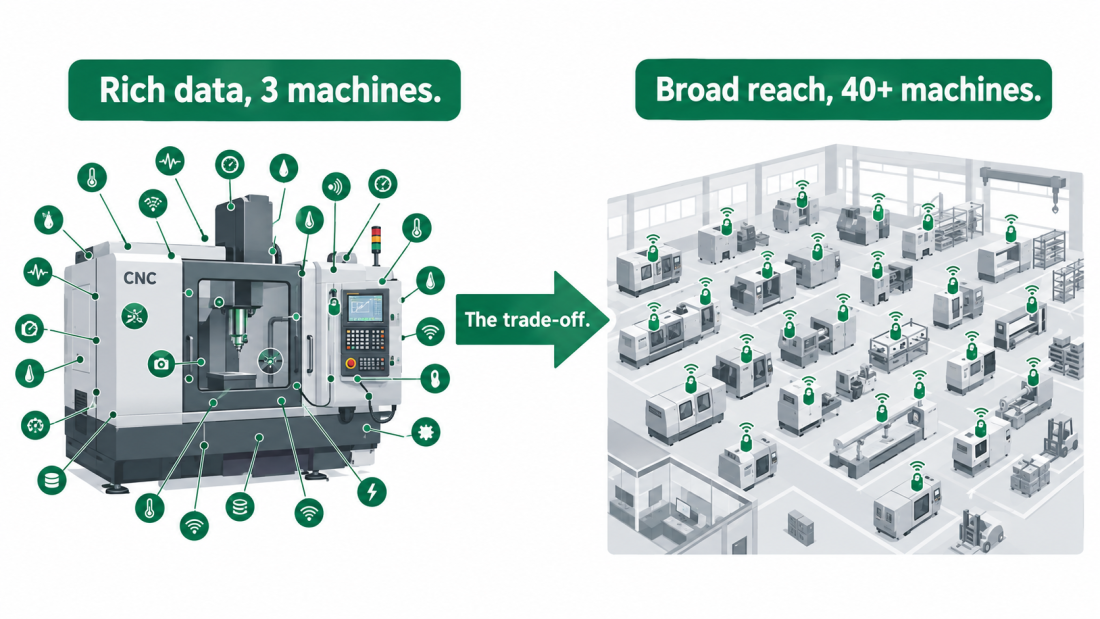
Industrial IoT coverage is the metric the industry keeps underpricing. A September 23 IoT Business News account by Soracom’s Ryan Carlson traces how FourJaw Manufacturing Analytics, a 2020 Sheffield AMRC spinout, rebuilt its product around reach instead of data depth. The company’s founders came out of a research culture that once mounted roughly 1,000 sensors on a single CNC machine in a project literally named “The Full Monty.” Their first product followed that instinct: pull rich data straight from CNC controllers, detailed enough to reverse-engineer a part from its coordinates.
Why Rich Data Died at Machine Four
That approach worked on the first three machines and stopped there. Customers told FourJaw that older machines and unfamiliar brands could not be integrated the same way, turning every new site into its own project. When FourJaw asked what the rich data was actually for, the answer collapsed to one sentence: they wanted to know when a machine was making them money. Resolution and reach pull against each other; most programs pick resolution, which is why pilots look strong on four machines and quietly die around forty.
The Retreat That Became the Product
FourJaw’s fix was to clip a current sensor onto the outside of a machine’s power cable. It cannot report an exact fault code, but it answers whether the machine is earning its floor space, and it works identically on a decades-old Japanese lathe or an office kettle, which was genuinely the first thing the team monitored. No sensor can supply why a stopped machine is idle, so FourJaw pairs the power signal with an operator tablet where a worker taps a reason while it’s fresh. Reach came from giving up fidelity, and the tablet turned out to be the cheapest, highest-value component in the stack. See our analysis where we explain the dark-data opportunity already sitting inside factory files.
Verified numbers
| Stat | Detail |
|---|---|
| ~1,000 | Sensors mounted on one CNC machine in AMRC’s “Full Monty” research project |
| 5–7 Mbps | Bandwidth that carries FourJaw’s entire fleet over cellular, per Soracom |
| 2020 | Year FourJaw was founded as a spinout of Sheffield’s AMRC |
The Layer Nobody Prices: The Network
Integration friction is visible and gets solved first. Install friction is next and never appears on an invoice, since a site visit multiplies labor cost against fleet size. The layer nobody budgets for is the network: FourJaw’s early installs rode customer Wi-Fi, which broke down once IT blocked NTP, defense sites refused any third-party device, or a plant had no Wi-Fi at all. When a deployment stalls there, neither the customer’s IT team nor the vendor can prove fault, and the account is usually lost to a shrug rather than a competitor. See our analysis where we explain how to fix IIoT data latency and reach real-time visibility.
FourJaw’s answer was to stop negotiating for network access and ship cellular routers with a global SIM instead, routing traffic through a private gateway so it never touches the corporate network. The pitch to security shifts from arguing the data is harmless to a configuration change with a monthly price attached — a meeting procurement can close. See our analysis where we explain how hybrid satellite-cellular IoT networks are being built for exactly this gap.
⚠️ Hypothetical scenario (illustrative only, not a reported case)
A Lagos textile plant pilots a monitoring platform on three new looms with full controller access and rich dashboards. Rollout stalls at the older imported machines the plant depends on, and IT refuses to open a port for a foreign vendor’s box. Six months later the pilot is still three machines wide. A rival plant using clip-on power sensors and a cellular router covers all sixty machines that same quarter, with less detail but a real fleet-wide number.
What This Means for a Buyer’s Shortlist
Score any IIoT vendor on three questions before resolution comes up: how many machine brands the sensor supports without controller access, what a new site costs without a vendor visit, and whether connectivity can route around a Wi-Fi refusal. A vendor who answers all three with “it depends” is selling coverage it hasn’t tested outside a lab. See our analysis where we explain why 93% of plants have an MES but only 23% finished the integration, and our breakdown of why legacy-equipment integration’s real cost isn’t the machines themselves.
💡 CreedTec Analyst’s Note by Daniel Ikechukwu
Strategic Impact
FourJaw’s story reframes the IIoT buying decision: the constraint was never sensor accuracy, it was how cheaply a vendor can add machine number four hundred in a plant nobody on the team has visited. Vendors who solve for reach first will out-scale vendors who solve for resolution first.
Stop / Start / Watch
- Stop: judging IIoT pilots by dashboard richness on the two or three machines a vendor chose for the demo.
- Start: pricing per-site rollout cost and network friction into the RFP alongside sensor accuracy.
- Watch: vendors moving from customer Wi-Fi to carrier-agnostic cellular SIMs as enterprise security policy tightens under rules like the EU Cyber Resilience Act.
ROI Outlook
A monitoring program that covers 90% of a fleet at low resolution delivers usable OEE and downtime data faster than one that covers 10% in high fidelity, because the business decision — is this machine earning its floor space — needs coverage, not precision. Expect procurement scorecards to start weighting deployment friction as heavily as feature lists through 2027.
— Daniel Ikechukwu, CreedTec (Industrial IoT Analyst)
Evaluating machine-monitoring vendors?
Get CreedTec’s weekly briefing on IIoT deployment economics, connectivity models and procurement checks, written for plant and IT leaders who sign the contract. Subscribe free.
Sources
- IoT Business News: “The best data point in the factory doesn’t come from a sensor” by Ryan Carlson, Soracom (Sept 23, 2026)
- FourJaw Manufacturing Analytics — company site
- IoT Business News: Onomondo on SGP.32, vendor lock-in and the future of IoT connectivity (Sept 22, 2026)
- IIoT World: Industrial AI Summit 2026 overview
- IoT Now: coverage of the EU Cyber Resilience Act’s first reporting obligations (Sept 2026)