Fast Facts
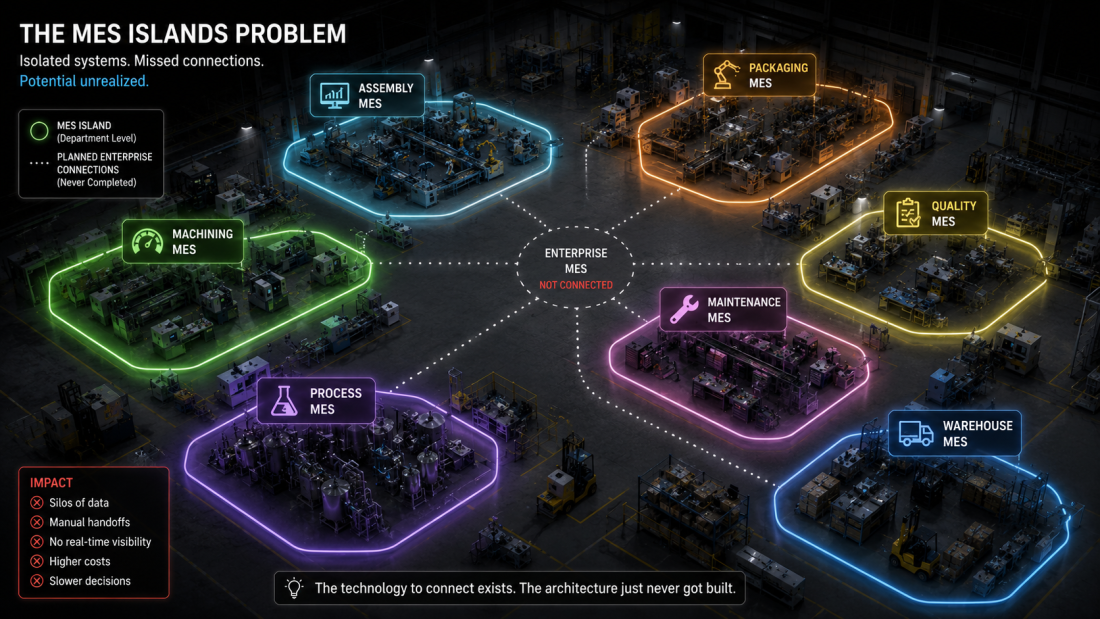
Rockwell Automation surveyed 1,560 manufacturing decision-makers across 17 countries and found that 93% have a Manufacturing Execution System running somewhere, but only 28% deployed it enterprise-wide and just 23% report full integration across ERP, PLM, quality, and operational technology systems. The MES integration gap isn’t a technology shortfall, it’s where most of the return on an already-paid-for investment quietly disappears.
The MES integration gap is the industrial IoT story that doesn’t need a new product launch or a funding round to matter, because it’s hiding inside software most manufacturers already own. Rockwell Automation’s “Scaling MES Across the Enterprise” report, published July 14, 2026 and based on 1,560 manufacturing and industrial operations decision-makers across 17 countries, found that 93% of respondents have a Manufacturing Execution System running in at least one facility, according to the report’s PR Newswire release. Only 28% have deployed it enterprise-wide. Just 23% report full integration across ERP, PLM, quality, and OT systems.
A 70-Point Spread That Isn’t About the Software
The distance between 93% adoption and 23% full integration is a 70-point spread, and that spread is not a technology problem, it’s an integration and change-management problem sitting on the desk of every VP of Operations and plant IT director surveyed, according to MarketScale’s analysis of the findings. The MES integration gap exists because buying and installing the software was always the easier half of the job. Connecting it to ERP, PLM, quality systems, and operational technology across every facility is the harder half, and it’s the half most manufacturers quietly stopped short of finishing.
93% of manufacturers have MES deployed in at least one facility.
23% report full integration across ERP, PLM, quality, and OT systems, the true measure of the MES integration gap.
The gap between deployment and genuine, end-to-end integration is where most manufacturers are stuck.— MarketScale, analysis of Rockwell Automation’s Scaling MES report, July 2026
Why Integration, Not Features, Is Now the Buying Decision
Buyers themselves have already reordered their priorities around this gap: 44% of manufacturers now rank integration as their top MES buying requirement when evaluating new or replacement systems, ahead of feature depth or vendor reputation, according to the same PR Newswire release. That shift reflects a real fear driving procurement decisions, that another MES purchase without a clear integration path just adds a second disconnected island of data rather than closing the MES integration gap already sitting on the shop floor. See our analysis where we explain why Schneider’s $3.1B Cognite bet reveals the real price of IIoT platform consolidation.
⚠ Fiction — illustrative scenario: A plant director proudly reports MES deployment complete after a two-year rollout project closes on schedule and under budget. Eighteen months later, a quality audit reveals that three of the plant’s five production lines still feed data into the MES manually, because the OT integration piece was descoped early to hit the original deadline. The system exists. The enterprise-wide visibility it was funded to deliver never actually arrived.
Where the Value Actually Gets Captured
More than half of survey respondents, 58%, work at organizations with over $1 billion in annual revenue, meaning the MES integration gap is concentrated among companies with the resources to close it, not just smaller manufacturers priced out of full deployment, per Webull’s coverage of the methodology. Real-world examples of what closing the gap looks like exist: Kumi North America, a Tier 1 automotive supplier, first implemented MES software in 2008 and has since expanded to orchestration-level integration across its US and Canadian facilities.
That’s a 17-year runway from initial deployment to enterprise-scale integration, a timeline worth pricing into any manufacturer’s own MES roadmap. See our related coverage of why unified namespace architecture matters for manufacturers and why legacy equipment integration’s real cost isn’t the machines.
Global Implications
For manufacturers in Africa, Southeast Asia, and other emerging markets building out MES capability without the multi-decade runway larger incumbents had, the MES integration gap is both a warning and an opportunity: a newer deployment can be architected for enterprise-wide integration from day one, rather than retrofitting connectivity onto a system built facility by facility over twenty years. See our analysis of the industrial IoT trends that will decide your 2030 ROI and why component lead times are quietly reshaping IIoT procurement timelines.
💡 CreedTec Analyst’s Note — Daniel Ikechukwu
Strategic Impact: The MES integration gap means most manufacturers are sitting on a sunk software investment that never delivered its full return, a fact that should reshape how the next system gets evaluated and funded.
- Stop: Treating MES deployment as complete once the software is running in a single facility, without a funded plan for enterprise-wide integration.
- Start: Making integration scope, not feature checklists, the primary criterion when evaluating a new or replacement MES vendor.
- Watch: Whether Rockwell’s follow-up reporting shows the 23% integration figure improving as more manufacturers reach their second or third MES deployment wave.
ROI Outlook: Closing the MES integration gap on an existing deployment is typically cheaper than a full system replacement, and it recovers value from a purchase most manufacturers have already made.
Should a manufacturer replace its MES if integration has stalled?
Not necessarily. Given that 44% of buyers now rank integration as their top requirement, a manufacturer’s first step should be assessing whether the existing MES can close the integration gap through further connection work before funding a full replacement, since the software itself is rarely the actual bottleneck.
The MES integration gap isn’t a story about manufacturers failing to adopt technology. It’s a story about technology that got adopted and then never finished the job it was purchased to do. Closing that gap, not buying another system, is where the next real return sits.
Get CreedTec’s next industrial IoT integration briefing before your next MES budget cycle.
Subscribe free
Sources
- PR Newswire, “93% of Manufacturers Have MES, But Only 23% Have Fully Integrated It,” July 2026
- MarketScale, “93% of manufacturers have MES, but only 23% have fully integrated it,” July 2026
- Webull, “93% of Manufacturers Have MES, But Only 23% Have Fully Integrated It,” July 2026
- Investing News Network, “New Rockwell Automation Report Finds,” July 2026