Fast Facts
Industrial IoT lead times for advanced microcontrollers and sensor fusion chips are stretching to 24-52 weeks in 2026, even as the general narrative says the chip shortage ended. Foundries are prioritizing high-margin AI chips over the mature-node parts that IIoT sensors and gateways depend on, and procurement teams still budgeting on old lead-time assumptions are about to get caught out.
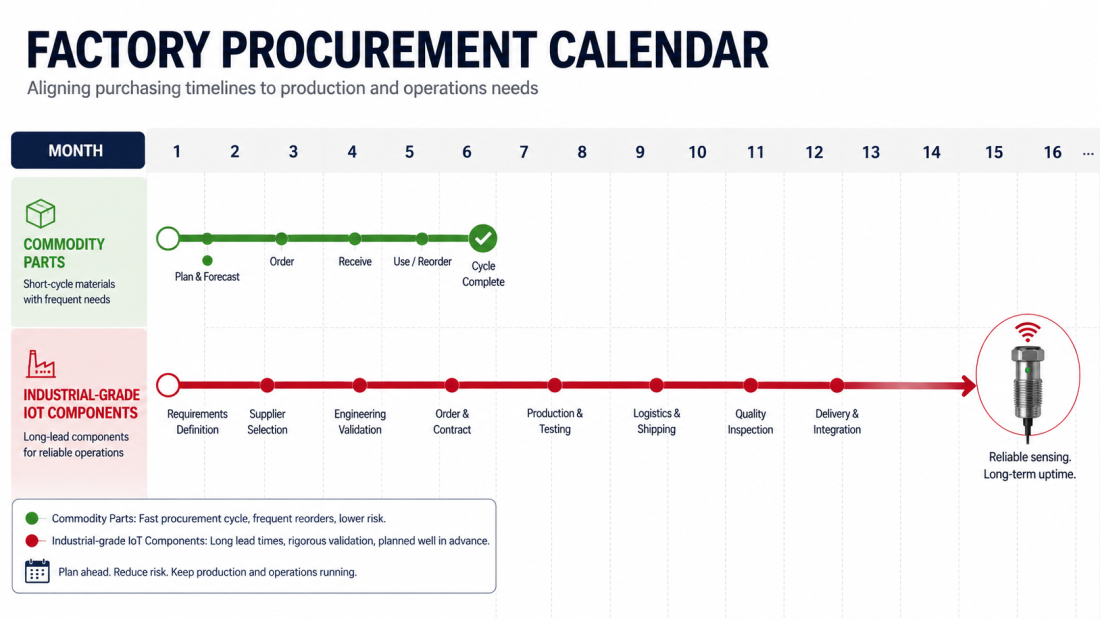
Industrial IoT lead times are quietly becoming a two-tier problem, and most procurement calendars haven’t caught up. Advanced 32-bit microcontrollers and high-current power management chips now carry lead times of up to 52 weeks, while industrial-grade IoT components broadly run 24 to 36 weeks, according to Utmel’s 2026 semiconductor availability forecast. Meanwhile, commodity 8-bit MCUs have fallen back to a manageable 9 to 10 weeks. The gap between those two numbers is the real story.
The Shortage Never Ended, It Moved
Many industry observers claim the chip shortage is completely over, which is a common misconception, per Utmel’s analysis. What actually happened is a split: mature 8-bit architectures stabilized while advanced-node, AI-capable, and high-performance industrial families stayed tight. IoT chips and sensor fusion processors specifically carry lead times of 18 to 30 weeks depending on foundry node and packaging complexity, and ruggedized, high-reliability components face even tighter supply. Industrial IoT lead times didn’t shrink alongside the broader semiconductor recovery narrative; they diverged from it.
52 weeks
— maximum reported industrial IoT lead times for advanced 32-bit MCUs and high-current PMICs, versus 9-10 weeks for commodity 8-bit MCUs, per Utmel’s 2026 forecast.
Why AI Demand Is the Hidden Driver
The mechanism behind stretched industrial IoT lead times traces back to where foundries put their capacity. Foundries have prioritized high-margin, advanced-node AI chips, leaving mature nodes between 28nm and 180nm, the range most IIoT sensors and gateways depend on, fighting for what’s left, according to PC Tech Magazine’s procurement analysis. AI datacenter demand for high-bandwidth memory alone pushed DRAM contract prices up 55% in the same period, pulling fab investment and priority further away from the parts an industrial buyer actually needs. See our analysis where we explain why the industrial IoT hardware layer keeps carrying risk nobody budgets for.
Acute shortages will linger at least through mid-2027, with automotive and industrial IoT hit hardest.— PC Tech Magazine, supply-chain analyst commentary, 2026
⚠ Fiction — illustrative scenario: A logistics operator plans a fleet-wide sensor upgrade for Q1, using last year’s eight-week lead time as the budget anchor. The purchase order comes back with a 40-week delivery window on the exact sensor fusion chip the design calls for. The rollout doesn’t slip by a few weeks. It slips by a full operating year, because the part that changed wasn’t listed as a risk on anyone’s procurement sheet.
The Commercial Question Buyers Aren’t Asking
Segment-specific pressure means two buyers ordering what looks like the same category of part can face completely different industrial IoT lead times depending on the exact family and node, according to 773 Group’s 2026 MCU market analysis. NXP’s automotive-grade S32 platform, widely used in connected industrial and gateway designs, is reporting 20 to 28 week lead times for customers without existing allocation agreements. That’s the commercial question worth asking a supplier directly: is your quoted lead time based on an existing allocation agreement, or a cold order placed today. The two answers can differ by months. See our related coverage of why device lifecycle management is IIoT’s coming bill and industrial IoT ROI heading into 2026.
Global Implications
Buyers in Nigeria, Southeast Asia, and other emerging markets without existing framework agreements with major distributors are structurally last in line when industrial IoT lead times stretch, since allocation priority tends to follow order volume and prior relationship, not urgency. Component engineers who flag sole-source parts before a design freezes, and procurement teams who shift from just-in-time ordering to strategic buffering, are the ones absorbing this shift with the least disruption. See our analysis of why legacy equipment integration’s real cost isn’t the machines and 5G RedCap’s role in industrial IoT deployments this year.
💡 CreedTec Analyst’s Note — Daniel Ikechukwu
Strategic Impact: Industrial IoT lead times have quietly decoupled from the general chip-shortage recovery story, and procurement teams still budgeting off 2024-era assumptions are exposed.
- Stop: Treating “the chip shortage is over” as true for every component category on your bill of materials.
- Start: Auditing your BOM at the part-family level to separate genuine allocation risk from commodity parts that have already recovered.
- Watch: Whether foundries shift mature-node capacity back toward industrial parts once AI-driven advanced-node demand plateaus.
ROI Outlook: Multi-source footprints and early allocation agreements cost more upfront than single-source, just-in-time ordering, but they cost far less than a 40-week deployment delay on a signed contract.
Should procurement teams sign allocation agreements even without a confirmed order?
For parts flagged as advanced-node or industrial-grade, yes. Suppliers are reporting materially shorter industrial IoT lead times for customers with existing agreements versus cold orders, and that gap is unlikely to close before 2027.
Are all industrial IoT components affected by the shortage equally?
No. Commodity 8-bit MCUs have largely stabilized to 9-10 week lead times. The pressure behind longer industrial IoT lead times is concentrated in advanced 32-bit MCUs, PMICs, and sensor fusion chips, so a part-by-part BOM review matters more than a category-wide assumption.
The chip shortage headlines moved on before the actual shortage did. Industrial IoT lead times are the part of the supply chain still absorbing the pressure, and the buyers treating that as old news are the ones most likely to get a surprise purchase order back.
Get CreedTec’s next industrial IoT procurement briefing before your next component order goes out.
Subscribe free
Sources