
Fast Facts: UK startup Humanoid raised $152 million at a $1.35 billion valuation this week, becoming Europe’s first pure-play humanoid robotics unicorn. The headline is the valuation. The number worth checking is the robot pre-orders book: 34,000 units worth roughly $2.4 billion, against nine completed industrial deployments. That gap between booked and delivered is the real story for anyone pricing risk into the humanoid robotics boom.
Humanoid, a London-based robotics company, announced a $152 million Series A on July 21 at a $1.35 billion post-money valuation, led by Prime Movers Lab with Schaeffler, Bosch, Fubon Financial Holding Venture Capital, and Aglaé Ventures participating, according to Reuters. It’s a genuinely fast climb — the company launched two years ago and has now raised $270 million total. It also lands inside a much bigger wave: roughly $56 billion has flowed into robotics companies in 2026 so far, nearly double the prior year’s pace, according to Forbes.
But the number that should get a procurement analyst’s attention isn’t the valuation. It’s the robot pre-orders backlog behind it.
Why the Robot Pre-Orders Number Matters More Than the Valuation
34,000 vs. 9
Humanoid’s commercial pipeline includes 34,000 robot pre-orders valued at roughly $2.4 billion — against nine completed industrial deployments with Fortune 500 partners to date.
Source: TechStartups, July 2026
A pre-order isn’t revenue. It’s a signed intent, usually with deposit terms and delivery windows that can slip, get renegotiated, or fall through entirely if manufacturing capacity doesn’t scale on schedule. Humanoid’s beta rollout is targeted for Q4 2026 — a few months from now — and Bosch has committed production capacity for 100,000 units as both manufacturing partner and investor. That’s a serious industrial commitment. It’s also exactly the kind of structural bet CreedTec has flagged before in its analysis of top robotics companies in 2026, where the gap between order-book size and shipped-unit count separates durable platforms from funding-round headlines.
“Gone from an idea to becoming Europe’s first pure-play humanoid robotics unicorn.”— Artem Sokolov, Founder and CEO, Humanoid
Sokolov’s framing is fair — the growth is real. Nine live deployments, a Schaeffler order for 1,000 units (the largest publicly announced commercial agreement in the sector), and named partnerships with SAP, NVIDIA, and Siemens aren’t nothing. But 34,000 pre-orders against nine deployments is roughly a 3,800-to-1 ratio of promised to proven. Buyers evaluating a vendor at that ratio should be asking for delivery-schedule guarantees, not just case studies.
The Wheeled-Robot Bet Nobody’s Talking About
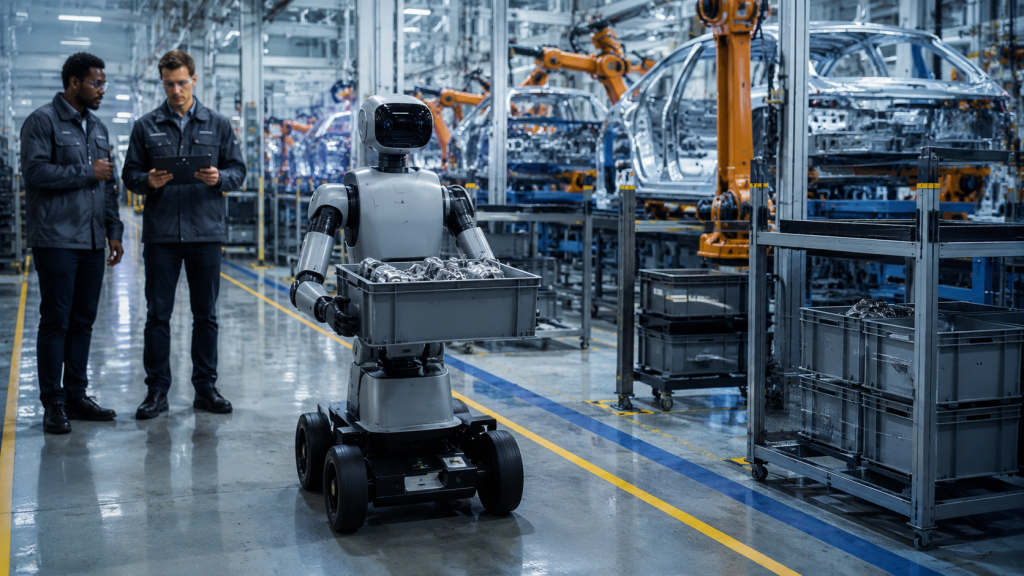
Humanoid’s HMND 01 is wheeled, not bipedal — a deliberate choice that reportedly speeds up European safety certification compared to walking humanoids. That’s a financial decision disguised as an engineering one: certification timelines directly determine how fast robot pre-orders convert into installed, revenue-generating units. Schaeffler’s CEO framed the broader shift plainly.
“Humanoid robotics is rapidly moving from a visionary concept to an industrial reality.”— Klaus Rosenfeld, CEO, Schaeffler (via Forbes)
Rosenfeld isn’t wrong about the trajectory. He’s also the CEO of a company that just invested in Humanoid — the quote is directionally true and also a stakeholder statement, which is worth holding in the same hand.
⚠ Fiction — composite scenario, not a real event: A logistics operator places a 200-unit order with a humanoid robotics vendor after seeing a strong funding headline. Eighteen months later, only 12 units have shipped — the vendor’s certification process ran long, and the pre-order was never contractually binding on delivery timing. The operator’s headcount plan, built around the original 200-unit date, is now a year behind.
Global Implications
Humanoid’s raise sits inside a genuinely crowded field. Germany’s NEURA Robotics has drawn up to roughly $1.4 billion in funding, Austin-based Apptronik extended its Series A to $935 million, and Figure AI’s valuation in the US has reached $39 billion. In China, Unitree shipped more than 5,500 robots last year and is now pursuing a public listing, while AgiBot and LimX continue raising nine-figure rounds. Capital is chasing the category from three continents at once, and pre-order backlogs are becoming the default way companies signal demand before they can prove supply.
For manufacturers in Nigeria, West Africa, and Southeast Asia watching this space, the practical takeaway isn’t “buy now” — it’s patience with a purpose. None of these vendors are shipping at meaningful volume outside their home certification zones yet. See our analysis of Europe’s AI robotics opportunity and China’s humanoid robot mass-production race for how the regional supply picture is likely to unfold before any of these robot pre-orders reach emerging-market buyers.
💡 CreedTec Analyst’s Note — Daniel Ikechukwu
Strategic Impact: Robot pre-orders are becoming the industry’s preferred growth metric precisely because they’re easier to generate than deployments. Treat pre-order totals as a demand signal, not a revenue forecast.
Stop: Evaluating humanoid robotics vendors primarily on valuation or pre-order book size.
Start: Asking any vendor what percentage of its pre-orders carry binding delivery dates and penalty clauses for delay.
Watch: Whether Humanoid’s Q4 2026 beta rollout closes the gap between booked and delivered units, or whether the ratio widens as more capital chases the category.
ROI Outlook: Early movers who sign now may get preferential pricing and pilot slots. But budgeting around a robot pre-orders date, rather than a contractually guaranteed delivery date, is the same mistake procurement teams have made with every hyped hardware category before this one.
Humanoid robotics is no longer a lab experiment — the capital and the deployments are both real. But until robot pre-orders and delivery counts move closer together, the honest read on any funding headline in this sector is: promising, not proven.
Subscribe to CreedTec’s newsletter — it tracks which robotics funding rounds are converting into real factory floor deployments, and which are still just pipeline.
Sources
- Reuters — original funding report
- Forbes — sector funding context and Schaeffler quote
- Tech Startups — pre-order and deployment figures
- EU-Startups — European funding landscape comparison
- SiliconANGLE — CEO commentary
Further reading: Top Robotics Companies in 2026 · Europe’s AI Robotics Opportunity · China’s Humanoid Robot Mass-Production Race · AgiBot’s Hong Kong IPO Bet · 3 Physical AI Investment Opportunities in 2026



1 comment on “Humanoid’s $1.35B Round Exposes the Robot Pre-Orders Gap”
Great read