Fast Facts
Connecticut’s manufacturing output is at an all‑time high, but 82% of its manufacturers can’t find skilled workers. Since 2024 the state has poured over $6 million into youth robotics programs to solve the engineering shortage from the ground up. The bet isn’t just on kids with controllers – it’s on keeping a $42.9 billion industry from stalling.
$6 million for robotics talent – not machines – is Connecticut’s real industrial bet
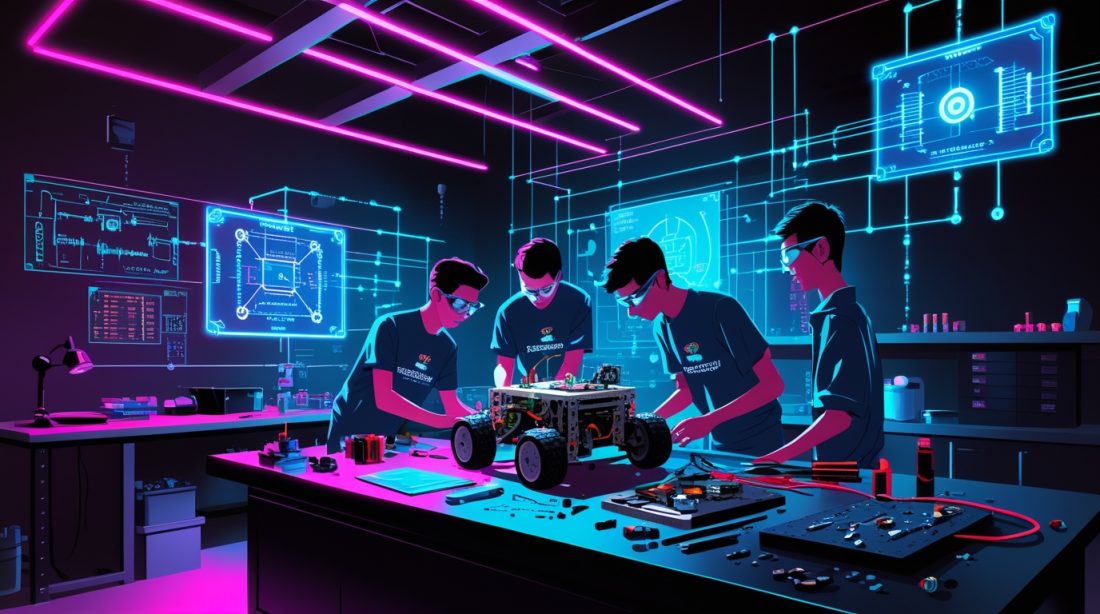
Connecticut has invested more than $6 million in statewide robotics programming since 2024. The money isn’t buying robot arms or factory automation; it’s funding FIRST Robotics teams, after‑school competitions and summer camps. The goal is to build a pipeline of future engineers for an advanced manufacturing sector that already accounts for more than a tenth of the state’s GDP.
82% of Connecticut manufacturers report difficulty finding and retaining skilled workers, with skills gaps as the greatest challenge.
That’s the problem. Connecticut’s manufacturing output hit a record $34.2 billion in 2024, nearly 12% of the state’s economy. Growth slowed to 0.5% in late 2025, and the reason isn’t demand – it’s bodies. “We desperately need a steady pipeline of people that are interested in engineering,” says Michelle Hall, director of the Connecticut Office of Manufacturing. Hall adds: “When it comes to developing that pipeline, I always feel like the earlier the better”.
Why throwing money at adult retraining won’t work
Traditional workforce programs target workers already in the labor market. That fixes the gap in years. Connecticut’s bet – FIRST Robotics, VEX Robotics, and rookie team grants – starts with kids who haven’t even chosen a major. A 2024 study by ReadyCT and CONNSTEP confirmed that manufacturing’s hidden constraint isn’t capital; it’s the absence of middle‑skilled technicians who can program, maintain and troubleshoot automated production lines. The $6 million is designed to intercept that shortage before it reaches the factory floor.
⚠ Fiction – The opportunity most states are missing
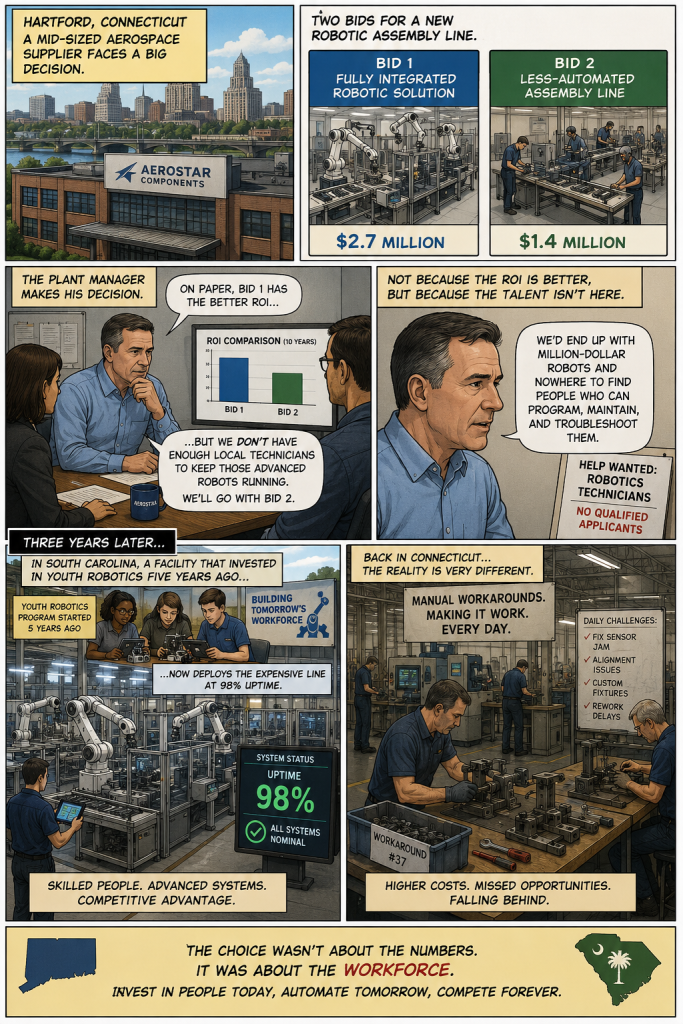
A mid‑sized aerospace supplier in Hartford receives two bids for a new robotic assembly line: a fully integrated solution for $2.7 million, and a less‑automated line for $1.4 million. The plant manager chooses the cheaper option – not because the ROI is better, but because there aren’t enough local technicians to keep the high‑end robots running. Three years later, a facility in South Carolina that invested in youth robotics five years ago deploys the expensive line at 98% uptime. Connecticut’s manufacturer is still relying on manual workarounds.
The shortage of robotics‑savvy workers isn’t theoretical. CBIA’s 2025 Manufacturing Report put the number at 82% of manufacturers struggling to find and retain workers, with skills gaps as the biggest hurdle. Connecticut’s approach tackles the supply‑side lag by building competence from middle school up.
How the $6 million breaks down (and what it buys)
| Investment Area | Amount | Purpose |
|---|---|---|
| FIRST Robotics expansion | ~$2.27 M | New teams, rookie grants, hardship assistance |
| Statewide robotics programming | remaining | VEX Robotics, competition fees, teacher training |
| Target | 20+ new K‑12 teams | Added to existing 250 FIRST teams in CT |
The Manufacturing Innovation Fund allocated $2.27 million specifically to expand FIRST Robotics in Connecticut’s public schools. That funding supports roughly 20 new teams, covering registration fees, student camps and equipment. When you add VEX Robotics and other league support, the total crosses the $6 million mark. The state also made $4.8 million available over two years to expand robotics and advanced manufacturing education broadly.
Global implications – talent is the new tariff
Other manufacturing hubs – Germany, South Korea, Michigan – are investing in hardware subsidies and tax breaks. Connecticut’s pivot to pre‑career robotics training is different. It accepts that advanced manufacturing’s next decade will be defined by who has the engineers, not who has the cheapest robot. Without that pipeline, automation becomes a liability: machines that can’t be serviced and software that can’t be optimized.
For manufacturers in emerging markets like Nigeria and Vietnam, the warning is clear. Skills gaps kill automation ROI faster than currency volatility or power outages. If you can’t keep the robot running, the payback period becomes infinite.
Procurement takeaway – what buyers should ask
When you evaluate automation investments, don’t just calculate hardware payback. Ask your integrator or vendor:
- What is the local technician availability for this system?
- Does your training package include long‑term maintenance education for our staff?
- What is your track record for post‑installation support in regions with thin engineering talent?
The $6 million that Connecticut is spending on 15‑year‑olds isn’t philanthropy. It’s a hedge against the day when even the most advanced robot is worthless because nobody knows how to fix it.
💡 CreedTec Analyst’s Note – Daniel Ikechukwu
Strategic Impact – Connecticut’s investment sends a signal: automation without local talent is stranded capital. Manufacturers should treat youth robotics funding as a leading indicator of where the future workforce will (or won’t) be available.
Stop / Start / Watch
- Stop assuming automation vendors will supply long‑term engineering support. Most won’t, or will charge punitive rates for it.
- Start mapping the talent pipeline in your region before signing a large robotics contract.
- Watch other states and countries copy Connecticut’s model. The next competitive advantage will be engineering density, not tax incentives.
ROI Outlook – A single unfilled automation technician role can cost a facility $150,000–$250,000 annually in lost uptime and delayed maintenance. The $6 million state investment prevents roughly 60‑80 such vacancies over a decade. For a manufacturer, co‑investing in local robotics education (through sponsorships or apprenticeship programs) can deliver a 5–10x return by shrinking post‑installation support costs.
Frequently Asked Questions
Why is Connecticut investing in youth robotics rather than direct factory equipment?
Because 82% of its manufacturers already report severe skills gaps. New machines won’t run themselves; trained engineers are the bottleneck.
Does the $6 million cover hardware for the teams?
Partially. The funds cover registration fees, rookie team startup costs, competition kits, teacher training, and hardship grants for high‑need districts.
How does FIRST Robotics connect to actual manufacturing jobs?
FIRST participants learn CAD, electrical wiring, pneumatics, programming and real‑time troubleshooting – the same skills needed to commission and maintain industrial robots.
What’s the procurement question for manufacturers in states without this investment?
Ask automation vendors directly: “What is your post‑installation training model for our region?” If they can’t provide a clear, local answer, build a contingency budget for external support.
Is this money enough to move the needle?
It’s seed capital. The goal is to build a self‑sustaining pipeline, not fund every team forever. Early results show 20 new FIRST teams added to the existing 250, with more students pursuing engineering pathways.
What should a factory buyer in an emerging market learn from this?
Don’t commit to advanced automation until you have verified local or regional maintenance and programming support. The robot is only as good as the human who can debug it on a Thursday afternoon.
Further Reading (CreedTec archive)
- China Humanoid Robot Mass Production Race in 2026
- Humanoid Robots Nonstop in Package Testing – The Labor Model Is Already Broken
- 5 Reasons Humanoid Robot ROI Drives the 2026 Cost‑Saving Shift
- Industrial AI Strategy Analysis – How Robots, Tariffs and Human Skills Define 2026’s Competition
- Why Every Industry Needs a Secure IoT Satellite Constellation by 2030
Newsletter CTA – Your factory’s automation ROI depends on the technicians you can hire tomorrow. Subscribe to CreedTec for weekly analysis on industrial AI, robotics economics and the hard‑nosed data behind smart manufacturing decisions.



2 comments on “$6 million for robotics talent – not machines – is Connecticut’s real industrial bet”
$6M in talent, not hardware? Connecticut gets it. Skills first, automation follows. That’s exactly how it should be
Exactly. Hardware is the visible cost. Talent is the invisible one—and the one that determines whether the hardware actually works. Connecticut understood that tradeoff.