Fast Facts
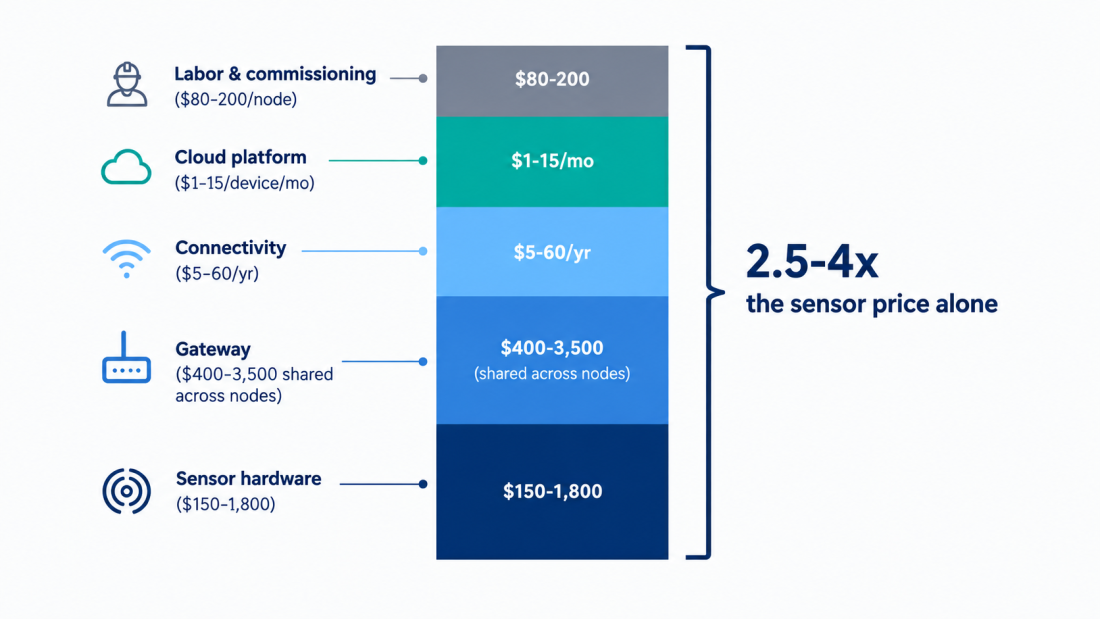
- Industrial IoT sensor cost breaks into four layers — hardware, connectivity, cloud, and labor — and buyers who price only the first layer routinely underbudget the real deployment by 2.5 to 4 times.
- Sensor hardware alone runs $120–$1,800 per point depending on type, but connectivity pricing varies up to 40x by protocol: LoRaWAN costs $5–$15 per sensor per year, cellular LTE-M/NB-IoT runs $20–$60 per year, and satellite starts around $200 per year.
- Industrial gateways cost $400–$3,500 for LoRaWAN or wired protocols, and a full cellular site build — including labor, permits, and mounting — can reach $10,700–$21,400 in urban environments versus roughly $1,100 per site for LoRaWAN.
- A $500 sensor probe can quietly become a $4,500 deployed node once the gateway, connectivity, cloud platform, and commissioning labor are added — the gap most vendor quotes never show upfront.
Every industrial IoT sensor cost estimate that stops at the per-unit hardware price is wrong by design, not by accident — vendors quote the number that looks smallest. A defensible 2026 budget has to account for four separate cost layers that stack on top of each other: the sensor itself, the gateway and connectivity that gets its data out, the cloud platform that stores and processes it, and the labor to commission and maintain the whole system.
Layer One: Sensor Hardware
Basic industrial sensors — simple temperature or contact points — run $150–$350 per unit. Mid-range vibration sensors with FFT analysis cost $400–$800, and industrial-rated units certified for hazardous locations (ATEX/Class 1 Div 2) run $900–$1,800. Wireless temperature transmitters land at $120–$450 per point, and combining vibration and temperature into a single node typically cuts per-point cost by 15–25% versus separate devices on the same asset. This layer is what most vendor pricing pages show — and it’s typically only 30–50% of total industrial IoT sensor cost once the rest of the system is added.
Layer Two: Gateways and Connectivity
Industrial gateways from vendors like Phoenix Contact, Advantech, or Siemens run $400–$3,500, with LoRaWAN, WirelessHART, or Bluetooth mesh gateways covering 50–500 sensor nodes per unit. Connectivity is where the real variation shows up: LoRaWAN costs $5–$15 per sensor per year, cellular LTE-M or NB-IoT runs $20–$60 per year (plus $30–$80 per month for a cellular gateway’s data plan), Wi-Fi is effectively free if the infrastructure already exists, and satellite connectivity starts around $200 per year for remote sites with no other option. A LoRaWAN module itself costs $8–$10, versus $3,200–$10,700 in full equipment cost for a comparable cellular site.
📊 The Numbers That Matter
- $120–$1,800 — sensor hardware cost per point, depending on type and rating
- $5–$15/year — LoRaWAN connectivity cost per sensor, the cheapest wireless option
- $20–$60/year — cellular LTE-M/NB-IoT connectivity cost per sensor
- $400–$3,500 — industrial gateway hardware, covering 50–500 nodes
- 2.5x–4x — how much total deployed system cost exceeds raw sensor hardware price
Layer Three: Cloud Platform and Software
The cloud layer is the part of industrial IoT sensor cost most buyers forget to budget for entirely. Managed IoT platforms like AWS IoT, Azure IoT, Losant, or Ubidots typically charge $1–$5 per device per month, or $3–$15 per asset per month for a cloud CMMS with IoT integration built in. Self-hosting an open-source stack (Grafana plus InfluxDB, for example) costs nothing in licensing but requires $1,000–$5,000 in server infrastructure and someone to maintain it. Standalone edge analytics software runs $8,000–$40,000 as a one-time license, while integrating existing sensor data into an already-owned CMMS typically costs $2,000–$12,000 in implementation work rather than new hardware.
Layer Four: Installation and Labor
Mounting, baseline measurement, and threshold configuration run $80–$200 per node in labor, and a typical 50-node site gets commissioned in three to five days by a two-person team. Site preparation is where urban cellular deployments get expensive: a complete cellular site build, including rooftop access, mounting structures, and permits, can reach $10,700–$21,400 in dense urban areas, against roughly $1,100 per site for a comparable LoRaWAN deployment. At scale, the math shifts again — a utility deploying 20,000 smart meters needs to hold monthly connectivity cost under $0.30 per meter to keep the rollout financially viable, which is why LoRaWAN and NB-IoT dominate high-volume metering while cellular stays reserved for lower-density, higher-bandwidth applications.
Why the Sticker Price Always Undersells Industrial IoT Sensor Cost
None of this is unique to sensors — it’s the same integration-cost blind spot that shows up everywhere in industrial technology procurement. See our analysis where we explain why legacy equipment integration’s real cost isn’t the machines, and why device lifecycle management is IIoT’s coming bill long after the initial deployment invoice is paid.
Connectivity choice compounds the problem: see our analysis of the 16-point satellite connectivity performance gap buyers are ignoring and our comparison of hybrid satellite-cellular IoT modules for sites where no single connectivity type covers the whole deployment. Even the supply side affects the final number — see our analysis of why industrial IoT lead times hit 52 weeks while everyone calls the shortage over, since a longer lead time often means paying a premium for expedited stock or redesigning around whatever hardware is actually available.
Quick Questions
What’s the cheapest way to connect industrial IoT sensors?
LoRaWAN, at $5–$15 per sensor per year plus roughly $1,100 in per-site equipment cost, is the lowest-cost wireless option for most industrial sensor deployments — provided the application only needs small, infrequent data messages rather than continuous high-bandwidth streaming.
Why is my quoted industrial IoT sensor cost so much higher than the sensor price I saw online?
Because the sensor is typically 30–50% of total deployed cost. Gateways, connectivity, a cloud platform, and installation labor make up the rest, which is why a $500 sensor can become a $4,500 line item once fully deployed.
Does industrial IoT sensor cost scale down significantly at volume?
Yes — most manufacturers offer project pricing above 100 units, and per-unit hardware and connectivity costs both drop meaningfully at scale for industrial IoT sensor cost overall, though gateway and cloud platform costs scale more slowly since one gateway typically covers 50–500 nodes.
💡 CreedTec Analyst’s Note by Daniel Ikechukwu
Strategic Impact: Industrial IoT sensor cost estimates that stop at hardware pricing are the single most common reason IIoT pilots blow their budget before scaling — the connectivity, cloud, and labor layers hiding underneath the quoted industrial IoT sensor cost are where the real money and the real planning risk both live.
Stop
- Budgeting an IIoT pilot off the per-sensor hardware price alone without modeling the connectivity, cloud, and labor layers on top of it.
Start
- Requesting a fully loaded per-node cost from any vendor — hardware, gateway allocation, annual connectivity, and cloud subscription combined — before comparing quotes.
Watch
- Whether 5G RedCap and falling LoRaWAN module prices narrow the cost gap with cellular enough to change default connectivity choices in 2027 deployments.
ROI Outlook: Getting the connectivity layer right is the single highest-leverage decision in any industrial IoT sensor cost model — choosing LoRaWAN over cellular for a large, low-bandwidth sensor network can cut total connectivity spend by 60–75% with no loss of functionality, while choosing cellular for a genuinely mobile or high-bandwidth application avoids a costly mid-project re-architecture later.
— Daniel Ikechukwu, CreedTec
Sources
- Oxmaint — Wireless Predictive Maintenance Cost, Pricing & ROI Calculator 2026
- Zhongsheng Environmental — IoT Sensor Cost in 2026: Industrial Pricing, Specs & Buyer’s Guide
- Choovio — LoRaWAN vs. Traditional Systems: Cost Comparison
- LoRaWAN-Consulting.com — LoRaWAN Total Cost of Ownership: What 5 Years of IoT Really Costs
- ManThink — The Last Mile of Industrial IoT: LPWAN Selection Analysis (2026 Guide)