Fast Facts
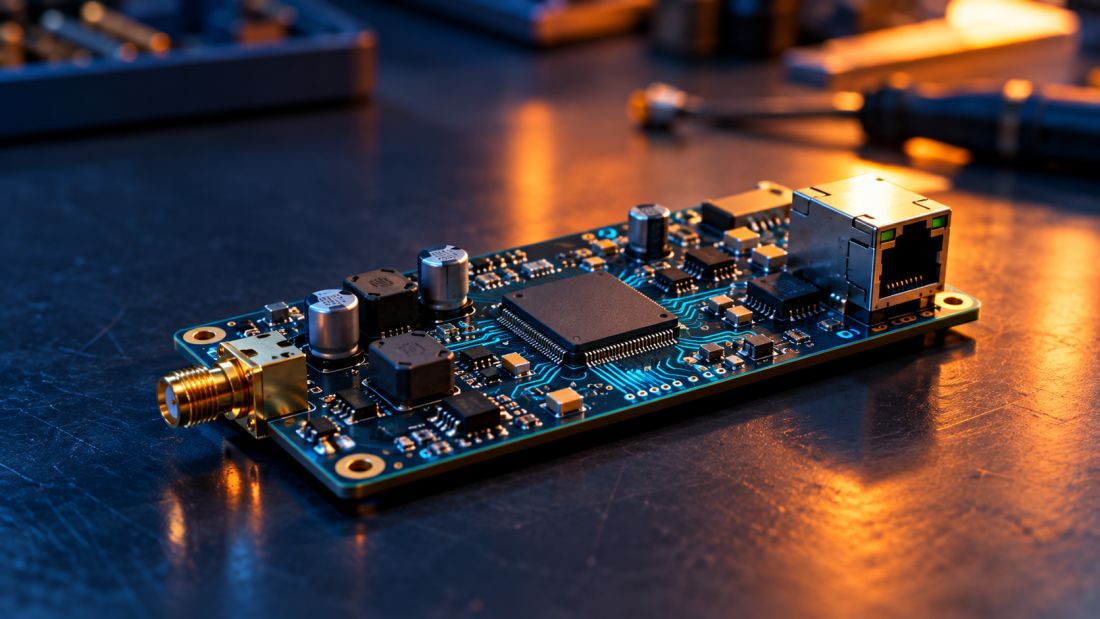
Teltonika introduced Oxa on September 14, 2026—its first embedded industrial IoT gateway engineered for OEMs and device manufacturers. The case-free device packs a 1.3 GHz ARM Cortex-A7 processor, 128 MB DDR2 RAM, LTE Cat 4 connectivity, Gigabit Ethernet, and full RutOS support into a 70 × 18.2 × 67.7 mm package weighing 36 grams. The procurement implication is structural: OEMs can now build cellular connectivity into their own equipment instead of adding a separate networking device alongside it.
Embedded industrial IoT gateway design just became a component decision instead of an enclosure decision. Teltonika announced Oxa on September 14, 2026, describing it as its first embedded industrial IoT gateway engineered specifically for OEMs and device manufacturers. The device is case-free, meaning it is designed to be built inside another product rather than mounted next to it.
That distinction is the whole story. “OEMs increasingly want industrial connectivity to become part of their own product rather than adding a separate networking device alongside it,” said Paulius Ruginis, Embedded Product Owner at Teltonika. An embedded industrial IoT gateway changes what an equipment manufacturer sells. It is no longer a machine plus a gateway box. It is a machine with connectivity built in.
What Oxa Actually Is
| Spec | Value |
|---|---|
| Processor | 1.3 GHz ARM Cortex-A7 |
| RAM | 128 MB DDR2 |
| Storage | 512 MB SPI flash |
| Connectivity | LTE Cat 4 (150 Mbps down / 50 Mbps up), Gigabit Ethernet |
| Dimensions | 70 × 18.2 × 67.7 mm |
| Weight | 36 g |
| Operating temperature | -40°C to 75°C |
| Power | 9-30 VDC, under 5 W |
| Protocols | Modbus TCP, OPC UA, DNP3, BACnet/IP, DLMS/COSEM, MQTT |
| VPN | OpenVPN, IPsec, WireGuard, ZeroTier |
| OS | RutOS with SDK and Package Manager |
The embedded industrial IoT gateway runs the same RutOS that Teltonika’s enclosed gateways use, and it integrates the full set of industrial communication protocols. That means OEM engineers get a ready-to-integrate platform with cellular connectivity, industrial protocols, and remote management without starting at the cellular module level.
Why the Case-Free Design Matters for Procurement
A traditional gateway is an enclosure. It has mounting holes, a power connector, and a warranty. An embedded industrial IoT gateway is a board. It gets designed into someone else’s product. The OEM owns the integration. Teltonika provides the connectivity stack.
For equipment manufacturers, that changes the bill of materials. The gateway stops being a separate line item that a customer buys and installs. It becomes a component inside the machine. The OEM controls the user experience, the firmware, and the branding. Teltonika provides the radio, the protocols, and the remote management system.
For buyers, the implication is that the connectivity layer becomes invisible. A pump, a compressor, or a CNC machine with an embedded industrial IoT gateway arrives connected. There is no separate box to install, no extra cabling, and no integration project. The procurement question shifts from “which gateway should we buy?” to “does this equipment come with connectivity built in?”
Teltonika says a possible application is connected access control equipment, especially at gates, barriers, and other locations where extending wired internet infrastructure would be unreasonable or expensive. That is a small use case that points to a larger pattern: any equipment deployed where running a cable is hard is a candidate for an embedded industrial IoT gateway.
⚠ Fiction—composite scenario, not a real event: A manufacturer of agricultural irrigation controllers sells a product that customers install in remote fields. Previously, each controller required a separate cellular gateway mounted in a weatherproof enclosure next to the control panel. The enclosure cost $180, the installation took two hours, and the gateway occasionally failed because of heat or moisture. The manufacturer redesigns the controller around an embedded gateway board. The bill of materials drops by $60 per unit, installation drops to zero, and field failures drop because the electronics are protected inside the controller’s own enclosure.
Global Implications
For equipment manufacturers outside the US and Europe, the embedded industrial IoT gateway model lowers the barrier to selling connected products. A manufacturer in Nigeria or Southeast Asia can build connectivity into a pump, a generator, or a solar inverter without developing cellular expertise in-house. Teltonika provides the stack. The OEM provides the product.
The operating temperature range of -40°C to 75°C matters in these markets. Equipment deployed in hot, dusty, or humid environments needs components rated for the conditions. An embedded industrial IoT gateway that survives those conditions removes a failure point that separate enclosures often introduce.
What to Watch
The gateway market has been shifting from standalone boxes toward embedded components for several years. Teltonika’s Oxa is a signal that the shift is accelerating. OEMs that build connectivity into their products control the customer relationship and the data pipeline. OEMs that bolt on a third-party gateway hand both to the gateway vendor.
For procurement teams evaluating connected equipment, the question to ask is simple: is the connectivity embedded or added on? An embedded industrial IoT gateway is not a feature. It is a design decision that determines who owns the data, who supports the connection, and how long the product stays connected.
💡 CreedTec Analyst’s Note — Daniel Ikechukwu
Strategic Impact: The embedded industrial IoT gateway shifts connectivity from a separate purchase to a design component. Equipment manufacturers that embed connectivity control the user experience and the data pipeline. Buyers should treat embedded connectivity as a procurement criterion, not a bonus.
Stop: Evaluating connected equipment without asking whether the connectivity is embedded or added on.
Start: Requiring equipment vendors to disclose whether the gateway is a component inside the product or a separate device mounted alongside it.
Watch: Whether other gateway vendors follow Teltonika with embedded form factors aimed at OEMs, which would confirm the market is moving from boxes to boards.
ROI Outlook: Embedded connectivity reduces installation cost, field failure rates, and support complexity. The savings show up in the total cost of ownership, not the unit price.
Sources:
- Embedded Computing Design, “Teltonika Introduces Oxa, an ARM Cortex-A7 Powered Embedded Industrial IoT Gateway,” September 14, 2026
- Teltonika Networks, Oxa product page
Further Reading:
- Qualcomm Dragonwing IoT Day Proves the Industrial IoT Market Has a New Kingmaker
- Industrial Edge AI Networking: Why Rajant-Nokia Just Collapsed the IIoT Stack
- Legacy Equipment Integration’s Real Cost Isn’t the Machines
- Device Lifecycle Management Is IIoT’s Coming Bill
- Why the Industrial Edge Processor Supply Commitment Matters More Than Qualcomm’s Specs
Subscribe to CreedTec’s weekly briefing—industrial IoT connectivity economics, embedded gateway design, and the procurement signals behind the hardware headlines.