Fast Facts
INTERPOL’s African Cyberthreat Assessment Report 2026 found that AI cybercrime in Africa now touches 55% of reported cases, with losses more than doubling to $484 million since 2024. Scam centers operate in 72% of surveyed countries, and AI-generated deepfakes are already defeating biometric security. The region’s governing cybercrime treaty was written before any of this technology existed.
AI cybercrime in Africa has crossed a line that security researchers had been warning about for years. INTERPOL’s African Cyberthreat Assessment Report 2026, released August 3 and drawn from survey data across 36 member countries, found that artificial intelligence is now linked to 55% of reported cyber incidents on the continent, according to INTERPOL’s own release. Financial losses have more than doubled since 2024, climbing from $192 million to $484 million.
The Number Behind the Losses
What makes this report different from earlier cybercrime warnings is the specificity of how AI is being used, not just that it’s involved. AI cybercrime in Africa is concentrated in three vectors: AI-related scams, credential harvesting, and automated social engineering, according to Crypto Briefing’s coverage of the report. Business email compromise alone accounts for 10% of reported cases and remains one of the costliest categories, because AI now writes emails convincing enough to mimic a specific executive, supplier, or trusted partner rather than a generic phishing template.
55% of reported cybercrime in Africa now involves AI, the clearest single measure of how fast AI cybercrime in Africa has scaled.
$484 million in losses in 2026, up from $192 million in 2024.
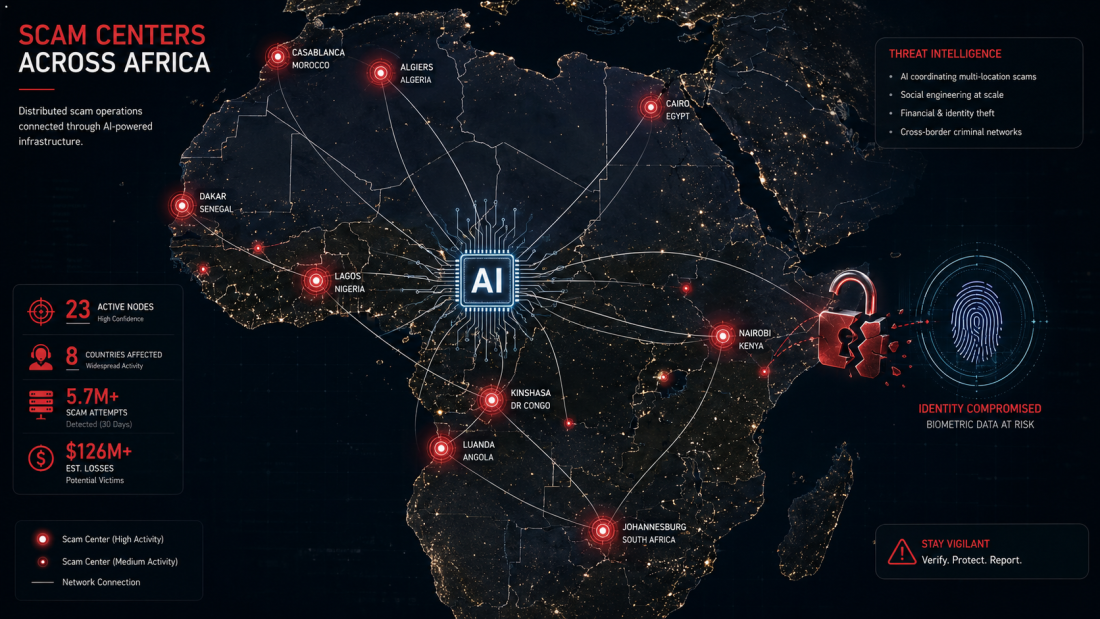
72% of surveyed countries report active scam center operations.
AI is automating every stage of a cyberattack from reconnaissance and phishing to extortion and evasion.— Neal Jetton, Director of Cybercrime, INTERPOL
Deepfakes Are Beating the Systems Built to Stop Fraud
The detail most likely to affect companies directly is biometric failure. AI-generated deepfakes and synthetic identities are increasingly defeating biometric security measures, per Small Wars Journal’s summary of the assessment. That matters because biometric verification, fingerprint and facial matching, has become the default trust layer for mobile money, banking KYC, and increasingly for enterprise access control across the continent. AI cybercrime in Africa is not just targeting people through emails; it’s targeting the verification systems companies rely on to confirm someone is who they claim to be. See our analysis where we explain why agentic AI governance is losing the identity race entirely.
⚠ Fiction — illustrative scenario: A finance manager at a mid-sized distributor receives a video call from someone who looks and sounds exactly like the company’s regional director, requesting an urgent supplier payment change. The voice, the mannerisms, even the background match. The payment goes out before anyone thinks to call back on a known number. Nothing about the request looked automated. That was the point.
A Legal Framework Built for a Different Decade
The continent’s main cybercrime treaty, the Malabo Convention, relies on early-2010s legal definitions that don’t explicitly cover AI-driven social engineering, according to JURIST’s legal analysis of the report. Seventeen countries updated their cybercrime legislation in 2025, but AI cybercrime in Africa is scaling faster than fragmented national frameworks can keep pace with. INTERPOL’s own coordinated operations show what’s possible when countries act together: four joint operations produced more than 1,500 arrests and recovered $100 million, evidence that enforcement works when jurisdictions cooperate rather than each patching the gap alone. See our related coverage of 2026 AI regulation and compliance developments and why compliance badges don’t guarantee real data protection.
What This Means for Companies Operating on the Continent
For any company doing business across Africa, especially those handling payments, supplier relationships, or biometric onboarding, AI cybercrime in Africa should now factor directly into vendor and process risk assessments. East Africa has become a hub for mobile money fraud and infrastructure-targeted ransomware, while Central and West Africa see the highest concentration of business email compromise and romance scams, per Infosecurity Magazine’s regional breakdown. Treating this as a distant regulatory problem rather than an operational one is the mistake the report’s data argues against. See our analysis of why AI agent permission sprawl is the industry’s real blind spot and who actually gets access to the best defensive AI tools.
💡 CreedTec Analyst’s Note — Daniel Ikechukwu
Strategic Impact: AI cybercrime in Africa has moved from a security-team concern to a finance and operations concern, because the attack vectors, payment fraud, deepfake identity, now target the exact processes companies run daily.
- Stop: Treating a video or voice call as sufficient verification for any payment or access change, regardless of how convincing it looks.
- Start: Requiring a second, independent verification channel for supplier payment changes, especially ones initiated by video or voice.
- Watch: Whether the African Union moves to modernize the Malabo Convention, or whether enforcement continues to rely on ad hoc coordinated operations.
ROI Outlook: A callback verification policy costs almost nothing to implement and directly addresses the fastest-growing loss category in this report.
Should companies still rely on biometric verification for financial transactions?
Biometric verification remains useful as one layer, but INTERPOL’s findings on AI cybercrime in Africa show it can no longer stand alone. Pair it with a second, independent confirmation step for any high-value or unusual request.
AI cybercrime in Africa is no longer an emerging risk analysts flag as a future concern. It’s already 55% of what’s being reported, and the companies that treat it as a policy update rather than an operational one will be the ones absorbing the next loss statistic.
Get CreedTec’s next AI security briefing before your next supplier payment goes out.
Subscribe
Sources
- INTERPOL, “INTERPOL report finds AI linked to more than half of cybercrime in Africa,” August 2026
- Crypto Briefing, “AI now drives more than half of all cybercrime in Africa,” August 2026
- Small Wars Journal, “Interpol Releases Report on AI Cybercrime in Africa,” August 2026
- JURIST, “INTERPOL report finds AI linked to over half of cybercrime in Africa,” August 2026
- Infosecurity Magazine, “AI Accounts for Over Half of Cybercrime in Africa,” August 2026