TL;DR
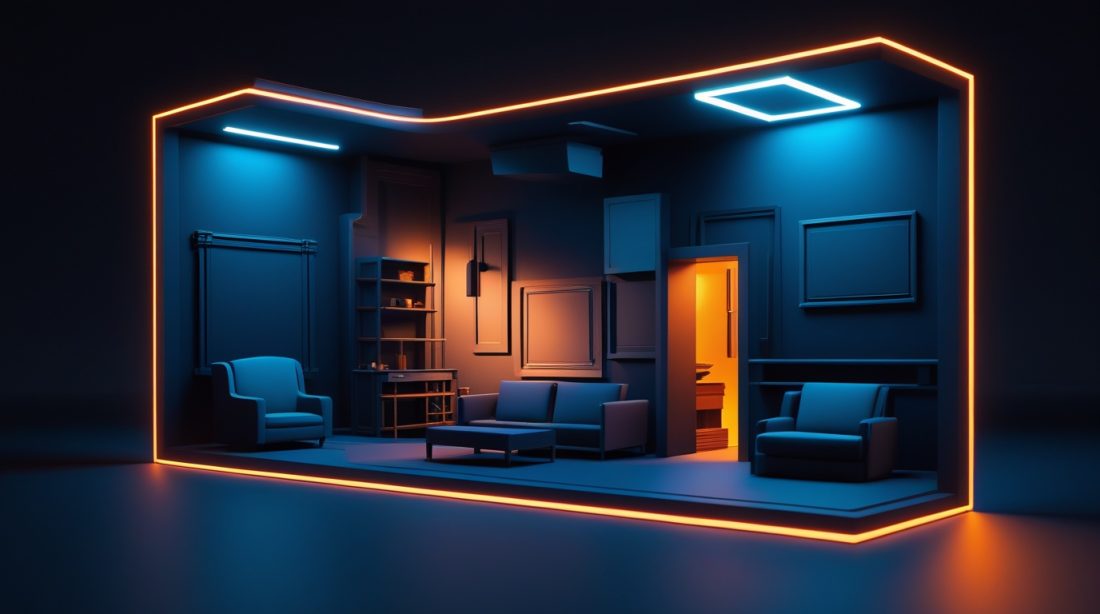
MIT SceneSmith attacks the cost nobody talks about in robot training. MIT CSAIL and Toyota Research Institute built SceneSmith, where three collaborative AI agents generate realistic 3D training environments — kitchens, garages, living rooms — with up to six times more objects than prior scene-generation methods. The real story isn’t graphics quality. It’s that hand-building diverse training environments has been a hidden, expensive bottleneck in robot learning, and SceneSmith is the first serious attempt to automate it away.
- 3 — collaborative VLM-based AI agents that build each SceneSmith environment
- 6x — more objects per scene compared to prior scene-generation methods
- 100 — unique 3D spaces generated during testing
- July 13, 2026 — MIT News publication date for the SceneSmith research
The Bottleneck Was Never the Physics Engine
Robotics simulators have gotten genuinely good at simulating physics — objects fall, collide, and interact realistically. The remaining challenge has been creating sufficiently rich and diverse simulation content to match the complexity of the real world, according to Russ Tedrake, the MIT professor leading the research. A physics engine that can simulate one perfect kitchen is far less useful than one that can generate a thousand different, cluttered, realistic kitchens — because a robot trained on one clean scene fails the moment it meets a messy one.
“One natural idea is to use simulation as a training ground… one of the remaining challenges has been creating sufficiently rich and diverse simulation content to capture the complexity of the real world.” — Russ Tedrake, MIT CSAIL / Toyota Research Institute
Why Manual Scene-Building Was the Real Cost Driver
Before SceneSmith, building a single realistic training environment meant a human artist or engineer placing objects and tuning clutter by hand — a cost that scales linearly with every new environment a robot needs to learn in. SceneSmith’s AI agents can be asked directly to “generate a garage with a car, a workbench, tires stacked in the corner, and a ladder against the wall,” producing a usable scene without that manual labor. That shift — from hand-built to agent-generated environments — is what collapses the cost of environment diversity, not any improvement to the underlying physics.
Proof It Isn’t Just Prettier Graphics
The MIT team validated realism by dropping a pretrained robot policy — trained entirely on real-world data and never exposed to a SceneSmith scene — into the generated environments. Told to take an apple from a bowl and place it on a cutting board, the robot completed the task correctly. If the generated scenes hadn’t closely resembled the real settings the policy learned from, that transfer simply wouldn’t have worked — a more meaningful validation than a benchmark score, since it tests generalization to genuinely novel content.
⚠ Illustrative scenario (fictional): A warehouse automation vendor needs to train a picking robot for a client’s unusually laid-out storage racks, but hand-building a custom simulation environment would take weeks a small project can’t afford. An agent-generated scene system like SceneSmith could produce dozens of layout variations overnight, turning a bespoke, budget-breaking task into a same-day request.
Global Implications: Cheaper Diversity Changes Who Can Afford Simulation
Manual environment design has favored well-funded labs that can staff dedicated simulation artists. If agent-generated scenes prove reliable at scale, that cost advantage narrows — smaller robotics teams and operators in resource-constrained markets could generate the environment diversity their use case needs, rather than training on generic simulation content built for someone else’s factory floor.
💡 CreedTec Analyst’s Note — Daniel Ikechukwu
Strategic Impact: Environment diversity, not physics fidelity, has been the quiet cost bottleneck limiting how well simulation-trained robots generalize to real-world conditions.
Stop: Assuming simulation training quality mainly reflects physics engine sophistication.
Start: Evaluating simulation vendors on how cheaply and diversely they generate environments matching your deployment conditions.
Watch: Whether agent-generated scenes hold up across a wider range of validation tests beyond the initial MIT/Toyota experiments.
ROI Outlook: Promising for teams currently priced out of custom simulation environments; still early-stage for mission-critical deployment decisions.
Generic training scenes won’t prepare a robot for your specific factory floor. Subscribe to CreedTec’s newsletter for the simulation economics vendors don’t lead with.
Further reading on CreedTec:
NVIDIA Isaac GR00T’s Headline Number Isn’t the Number That Matters · Robot Simulation Training Scene Assets · The Physics Simulation Bottleneck · Why Photorealistic Digital Twins Cut Robotics Training Costs · Embodied World Models for Robotics Training