Fast Facts:
Apollo 2 humanoid robot training just moved out of the lab — and the bill moved with it. Apptronik opened a 90,000-sq-ft “Robot Park” in Austin and unveiled Apollo 2, its production humanoid, on June 30, 2026 — a machine quietly running as a live data-collection platform for over a year. Backed by $935M in Series A funding and a Google DeepMind partnership, the real story isn’t the robot’s specs. It’s the cost of the factory that trains it, and who can afford to build one.
- $935M — Apptronik’s Series A, pushing valuation past $5B
- 90,000 sq ft — size of the expanded Austin Robot Park
- 1+ year — how long Apollo 2 has run as a working data platform
- 350+ employees, built on 15 prior robots, including NASA’s Valkyrie
- $2.92B → $15.26B — global humanoid robot market, 2025–2030 (39.2% CAGR, MarketsandMarkets)
- $0.27B → $0.37B — Middle East & Africa humanoid market, 2025–2026 (Fortune Business Insights)
The Announcement Behind the Announcement
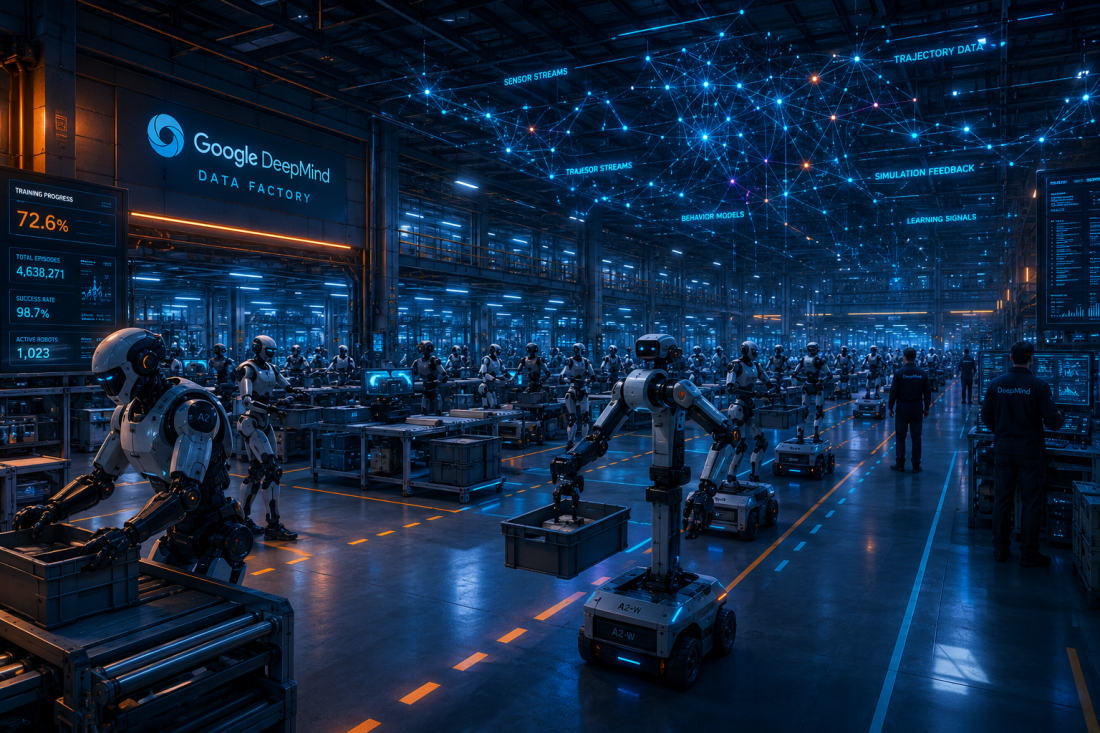
On June 30, Apptronik unveiled its expanded Robot Park in Austin, built with Google DeepMind to push humanoids from pilots into production. Inside, fleets of Apollo 2 — bipedal and wheeled — run logistics, manufacturing, and retail tasks purely to generate training data. The robot isn’t new; it’s been Apptronik’s quiet workhorse for over a year, with 90%+ energy-efficient actuators and target use cases spanning six sectors, from kitting to machine tending.
Why a Building Matters More Than a Robot
Apptronik CEO Jeff Cardenas calls Robot Park the company’s “data factory” — the counterpart to the hardware factory that builds the robots. That matters for buyers: a humanoid without a pipeline that constantly retrains it isn’t a finished product. It’s a body waiting on a brain still being assembled elsewhere, on someone else’s payroll and timeline.
“For truly useful humanoid robots, safety and reliability have to advance alongside capability.” — Barry Phillips, Chief Commercial Officer, Apptronik
The Procurement Math Nobody’s Advertising
Apptronik has raised close to $1 billion and still calls Apollo 2 a prototype for “scaled pilots,” with Apollo 3 — its first true commercial product — not due until next year. The global humanoid market is still small: about $2.92 billion in 2025, scaling to $15.26 billion by 2030 at a 39.2% CAGR (MarketsandMarkets). For any operator buying today, that gap between hype and shipped product is the real risk line — not the sticker price.
⚠ Illustrative scenario (fictional): A mid-size contract-packaging plant outside Lagos gets a quote for an early-generation humanoid unit. The hardware looks affordable against rising labor costs. Missing from the quote: the equivalent of Robot Park — months of task-specific data collection the vendor needs before the robot performs reliably on this line. The plant pays for that infrastructure anyway, in delayed output.
Global Implications: Where the Data-Factory Model Travels
Training infrastructure at Robot Park’s scale concentrates near capital, talent, and AI lab partnerships — Austin, not Lagos or Accra. Middle East & Africa’s humanoid market sat near $0.27 billion in 2025, edging toward $0.37 billion in 2026, a fraction of North America’s. The lesson for emerging-market operators isn’t that humanoids are far off — it’s that the training-data advantage Apptronik just built will stay concentrated in a few hubs unless local pilots or regional data-collection partnerships close that gap deliberately.
💡 CreedTec Analyst’s Note — Daniel Ikechukwu
Strategic Impact: Robot Park confirms data infrastructure, not robot design, is now the binding constraint on humanoid commercialization.
Stop: Evaluating humanoid vendors purely on hardware specs or demo videos.
Start: Asking how much task-specific data your use case needs before deployment, and who pays for it.
Watch: Apollo 3’s 2027 launch as the real test of whether Robot Park’s data translates to ROI.
ROI Outlook: Neutral-to-cautious for 2026 buyers; Apollo 2-class machines remain data-collection tools wearing a product’s price tag.
Hidden integration costs don’t show up in the quote — they show up in your first quarter of downtime. Subscribe to CreedTec’s newsletter for the financial gap analysis vendors won’t send you.