TL;DR
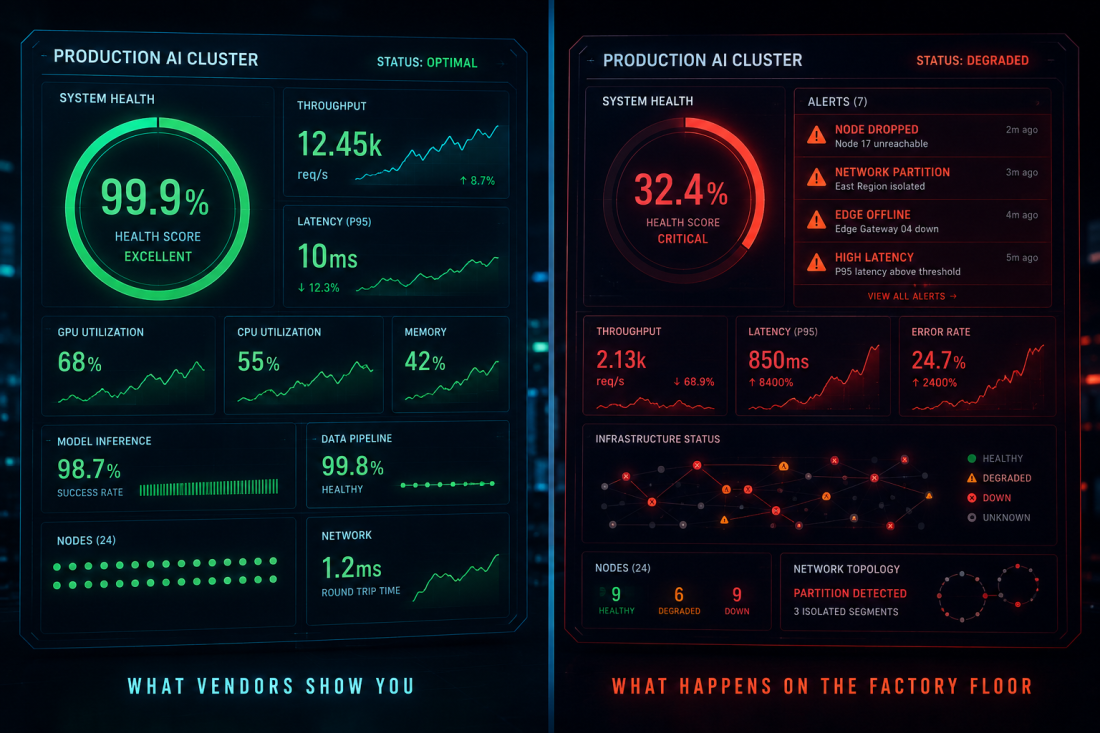
Distributed AI infrastructure reliability, not raw performance, now decides industrial deployment success. Enterprise AI keeps failing after the pilot stage — RAND’s 2025 meta-analysis found 80.3% of enterprise AI projects deliver no measurable business value, a figure Gartner corroborated in April 2026. The common thread isn’t model capability. It’s what happens when distributed AI infrastructure meets the unpredictability of a live factory floor: dropped nodes, network partitions, and edge devices that go dark mid-inference. Throughput benchmarks don’t capture any of that.
- 80.3% — enterprise AI projects that fail to deliver promised business value, per RAND’s late-2025 meta-analysis of 65 documented projects
- 28% success / 57% failure — rate reported by IT & Operations managers in Gartner’s April 2026 infrastructure projects report
- 70%+ — predictive maintenance initiatives that fail to reach full-scale deployment, per the Society for Maintenance & Reliability Professionals
The Benchmark That Doesn’t Matter on the Factory Floor
Vendors sell distributed AI systems on throughput and latency numbers measured in clean lab conditions. Those numbers rarely survive contact with a real plant network, where edge nodes drop offline, sensor feeds arrive out of order, and a single unreconciled node can silently poison a fleet-wide model update. RAND’s research and Gartner’s confirming figures point to the same underlying pattern: AI systems that pass evaluation still collapse in production because reliability — not raw compute — was never engineered in from the start.
“As AI moves into industrial environments, reliability becomes the foundation everything else depends on. High throughput and low latency are valuable, but consistent uptime, predictable behavior, fault tolerance, and recoverability are what determine whether AI systems can be trusted in production.” — Adedamola Maxwell, Principal Systems Engineer building reliable distributed and decentralized infrastructure
What “Reliable” Actually Means at the Infrastructure Layer
Reliability in distributed AI isn’t a single dial to turn — it’s a stack of specific engineering mechanisms. Fault tolerance means the system detects a failed node through health-check heartbeats and re-routes inference requests before a factory controller notices a gap. Recoverability means state checkpointing, so a model serving a robotic arm can resume from its last known-good configuration instead of restarting cold after a network partition. Predictable behavior means bounded response times enforced through request timeouts and circuit breakers, not best-effort scheduling that degrades silently under load. None of this shows up in a throughput chart, and all of it is what separates a system that survives a bad Tuesday on the plant floor from one that takes the line down.
⚠ Illustrative scenario (fictional): A mid-sized parts manufacturer deploys a distributed AI quality-inspection system across twelve edge nodes on the assembly line. During a routine network switch failure, three nodes drop offline simultaneously. A system built for raw throughput keeps pushing inference requests to the dead nodes, queuing silently, until a supervisor notices defective parts passing unflagged forty minutes later. A system built for fault tolerance detects the dropped heartbeats within seconds, reroutes to healthy nodes, and flags the gap for review — the difference isn’t model accuracy, it’s infrastructure design.
Why This Matters More in Emerging Manufacturing Markets
The reliability gap bites hardest where network infrastructure is least forgiving — including Nigerian and West African manufacturing operations navigating intermittent power and inconsistent connectivity alongside their AI rollouts. A distributed AI system engineered only for benchmark throughput assumes a stable network it won’t always get. One engineered for fault tolerance and graceful degradation is built for the network conditions that actually exist, not the ones in a vendor’s demo environment.
💡 CreedTec Analyst’s Note — Daniel Ikechukwu
Strategic Impact: Procurement teams evaluating industrial AI vendors are still asking “how fast” before they ask “how does it fail” — and that ordering is costing them post-pilot collapses at nearly the same rate RAND and Gartner are both now documenting.
Stop: Selecting distributed AI infrastructure primarily on throughput and latency benchmarks measured in controlled lab conditions.
Start: Requiring vendors to demonstrate specific failure-recovery mechanisms — heartbeat-based node detection, state checkpointing, circuit breakers — not just uptime percentages.
Watch: Whether reliability engineering becomes a standard RFP requirement for industrial AI procurement, the way cybersecurity certifications already have.
ROI Outlook: Positive for buyers who weight fault tolerance and recoverability in vendor selection; still exposed for buyers optimizing purely for benchmark performance.
The AI system that wins your pilot isn’t always the one that survives your network. Subscribe to CreedTec’s newsletter for the procurement signals vendors don’t put in their demos.
Further reading on CreedTec:
Top Robotics Companies Transforming the Industry in 2026 · Predictive Maintenance Lags in Nigerian SMEs · China’s Humanoid Robot Mass Production Race · Robot Grasping Simulation in 2026