Fast Facts
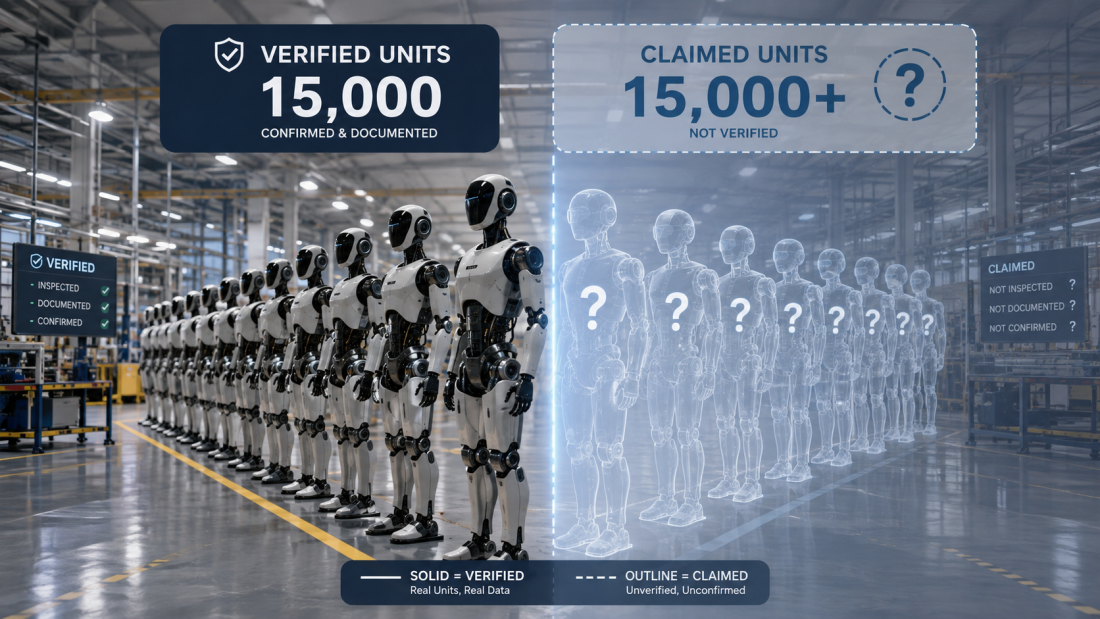
Widely repeated humanoid robot production numbers, Tesla past 50,000 Optimus units, Figure AI past 10,000 deployments, don’t come from the companies themselves. Tesla’s own 2025 target was 5,000 units for internal use; actual output was a few hundred. The gap between claimed and audited numbers is now the story investors and buyers should be pricing in.
Humanoid robot production numbers have become the least reliable statistic in industrial AI. Search for how many humanoid robots are actually working today and you’ll find confident figures everywhere: Tesla past 50,000 cumulative Optimus units, Figure AI past 10,000 deployments across partner warehouses. None of those figures come from the companies they describe, according to a July 2026 investigation by Technology.org. Tesla has never published an audited Optimus production count.
The Gap Between the Target and the Count
The clearest example sits in Tesla’s own record. The company targeted 5,000 Optimus units for internal factory use in 2025. Actual output, per mid-2025 reporting from The Information cited by Technology.org, was a few hundred units, under ten percent of the goal. Contributing factors included China’s April 2025 export restrictions on rare earth magnets and a longer-than-planned Gen 3 design finalization, particularly on the dexterous hand system.
Optimus Gen 3 production only began at Fremont in late July or August 2026, four months after the last Model S and Model X units rolled off that same line. These humanoid robot production numbers matter because they’re the exact figures investors and industrial buyers use to size a market that hasn’t been independently measured.
Under 10%
— the share of Tesla’s own 2025 Optimus production target it actually hit, based on reporting cited in Technology.org’s July 2026 deployment review.
None of these figures come from the companies they describe.— Technology.org, “Humanoid Robots in 2026: What Is Actually Deployed,” July 2026
Where the Verified Numbers Actually Point
The strongest deployment evidence belongs to companies with less market attention than Tesla. Figure AI’s Figure 02 robots completed an eleven-month deployment at BMW’s Spartanburg plant, contributing to production of more than 30,000 BMW X3 vehicles and loading more than 90,000 sheet metal parts before the company retired that generation, according to TechTimes’ coverage of IEEE Humanoids 2026.
Figure AI’s newer BotQ factory runs at one robot per hour and passed 1,000 cumulative units in July. Unitree ships more humanoid units than any Western competitor at roughly a tenth of the price, yet its own Q1 2026 profit still fell by half, a detail that rarely makes it into the humanoid robot production numbers repeated in funding pitches. See our analysis where we explain why Unitree’s magazine cover hides a real industrial deployment problem.
⚠ Fiction — illustrative scenario: An industrial buyer builds a three-year automation budget around a widely cited “50,000 units deployed” headline, assuming that scale means the supply chain and support network are mature. The vendor quote comes back at double the expected lead time, because the real installed base, the audited one, is a fraction of the number the budget was built on.
Why the Inflated Numbers Persist
Unverified humanoid robot production numbers serve a real purpose for the companies behind them: bigger claimed deployment counts support higher valuations, attract supplier partnerships, and pressure competitors into matching a pace that may not exist. Buyers and investors have every incentive to want the numbers to be true, since the humanoid labor story is genuinely compelling. That desire is exactly what makes unaudited humanoid robot production numbers so durable in press coverage. See our related coverage of why a $1.35B funding round exposed the gap between robot pre-orders and deliveries and why most industrial robot cost guides assume US wages.
Global Implications
For manufacturers in emerging markets evaluating humanoid platforms, treating headline humanoid robot production numbers as proof of supply chain maturity is a costly assumption. China recorded roughly 295,000 new industrial robot installations in 2024 alone, a figure that comes from national statistics rather than company press releases, which makes it a far more reliable benchmark for where real manufacturing capacity sits. See our analysis of China’s humanoid mass-production race in 2026 and our earlier coverage of Figure AI’s 200-hour Helix 02 run.
💡 CreedTec Analyst’s Note — Daniel Ikechukwu
Strategic Impact: Humanoid robot production numbers reported without a third-party audit should be treated as marketing, not market sizing, when they inform procurement or investment decisions.
- Stop: Building deployment timelines or budgets around cumulative unit claims that trace back to press coverage rather than audited filings.
- Start: Asking vendors for reference customers and site visits instead of accepting headline production figures at face value.
- Watch: Whether Tesla or Unitree publish an audited production count before their next funding or earnings cycle.
ROI Outlook: Buyers who verify deployment claims before signing avoid the lead-time and support-network surprises that come from budgeting against an inflated installed base.
The humanoid robotics industry is real, and parts of it are scaling fast. But humanoid robot production numbers, as reported today, are mostly a trust exercise dressed up as a market metric. Until companies publish audited counts, the safest number in any deployment claim is the one a buyer can verify in person.
Get CreedTec’s next robotics procurement briefing before your next automation budget cycle.
Subscribe free
Sources



1 comment on “Humanoid Robot Production Numbers: The 50,000-Unit Claim Nobody Can Verify”
The robotics industry faces a critical reality check, with a significant gap emerging between public relations hype and verified manufacturing output. This analysis underscores the need for greater transparency regarding operational capabilities.