Fast Facts
Unitree founder Wang Xingxing just landed on TIME’s cover with the company’s 9-foot mecha robot GD01, and Unitree filed for a $6 billion IPO in March. But buried in TIME’s own reporting is the number that matters for buyers: only 9% of Unitree’s humanoid sales go into actual industrial deployment. The other 91% goes to commercial venues, universities, and developers — meaning most of the world’s best-selling humanoid robot is still selling to people trying to build better robots, not to factories running them.
Wang Xingxing, founder and CEO of Chinese robotics firm Unitree, appeared on TIME’s July 23 cover alongside the company’s GD01 — a 9-foot, half-ton, human-piloted mecha robot the magazine calls the world’s first mass-produced transformable robot — under the headline “The Robots Cometh,” according to TIME. It’s the first time in eight years a Chinese entrepreneur has made the cover.
The valuation story is real: Unitree filed for an IPO in March that would value the firm at $6 billion, and it shipped more than 5,500 units in 2025 — more than a quarter of the entire global humanoid market. But the industrial deployment number tells a different, more useful story for anyone evaluating whether this technology is ready for a factory floor.
Why the Industrial Deployment Number Matters More Than the Cover
9% vs. 74%
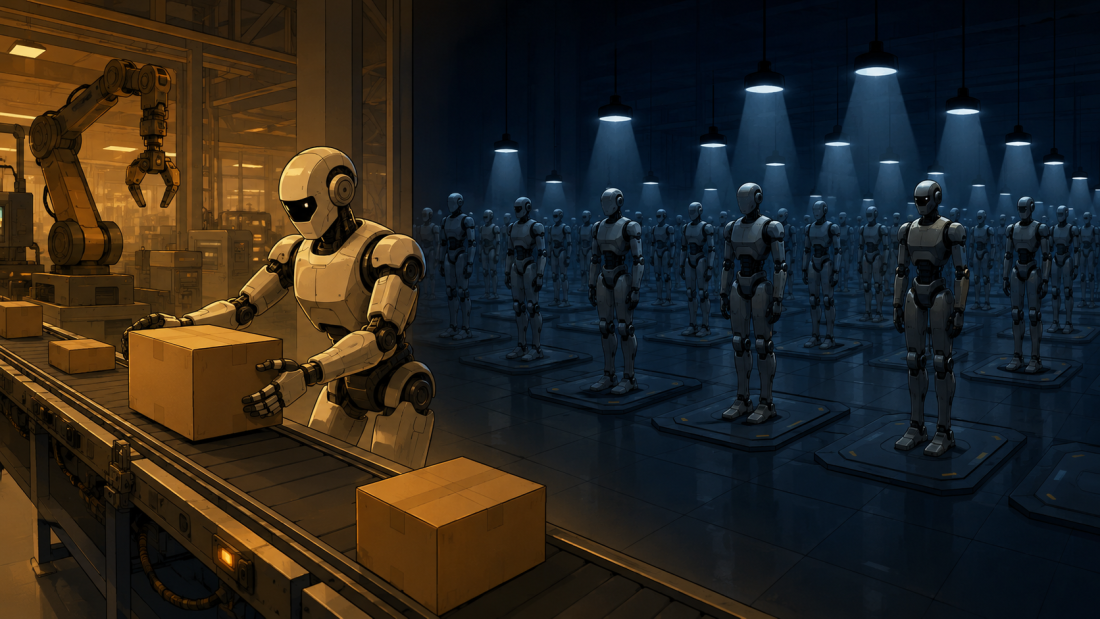
Only 9% of Unitree’s humanoid sales go directly into industrial applications. 17% go to commercial venues like tourist sites and retail stores. The remaining 74% go to universities, research institutions, and individual developers.
Source: TIME, “The Robots Cometh,” July 23, 2026
That 74% figure is the real headline. As Grace Shao, publisher of the AI Proem newsletter, put it in TIME’s reporting: today’s humanoids are “just not ready for the mass market.” The entire modern humanoid industry, TIME notes, is essentially selling robots to people trying to build better robots. For a procurement team, that reframes Unitree less as an industrial vendor and more as a very well-funded R&D platform that happens to also sell a small number of working units. See our earlier analysis of the robot pre-orders gap behind Humanoid’s $1.35B round, where the same booked-versus-delivered pattern shows up in a different company entirely.
“Humanoid robot technology is still in its relatively early stages.”— Wang Xingxing, Founder and CEO, Unitree
The Efficiency Gap Behind the Hype
Wang isn’t being falsely modest. TIME reports today’s humanoids operate at roughly 30% to 50% of human efficiency on basic factory and warehouse tasks like stacking and carrying boxes. Unitree’s flagship G1 can carry 5-kilogram payloads for only 10 to 15 minutes before it needs to cool down. That’s real progress from a lab demo — but it’s a long way from replacing a shift worker, and it’s the practical reason the industrial-deployment share sits at single digits while the hype cycle races ahead of it.
The generalization gap is the industry’s real bottleneck. Wang calls it “the biggest headache for the entire global scientific community” — the challenge of getting a robot to execute an unfamiliar command in an unfamiliar environment, rather than a rigidly pre-programmed motion. He estimates the industry is two to 10 years from a “ChatGPT moment” where robots can reliably generalize. See our coverage of AI agent governance risks in 2026 for how that same generalization problem shows up in software-only AI agents, not just hardware.
⚠ Fiction — composite scenario, not a real event: A logistics firm orders 50 humanoid units after watching a viral robot-dancing clip, expecting to automate its warehouse floor within the quarter. Six months later, only 4 units are running live shifts — the rest are still in a testing bay while engineers retrain motion models for the facility’s specific shelf layout. The viral video sold the order. The industrial deployment reality set the actual timeline.
Global Implications
Unitree’s rise is inseparable from state backing. Chinese cities have assembled investment funds worth more than $26 billion for robotics and AI since late 2024, and Unitree benefits from Hangzhou’s $14 billion Sci-Tech Fund as one of the city’s “Six Little Dragons” startups. That’s fueled a geopolitical response: three US lawmakers introduced the bipartisan Guard Act in June, seeking to restrict Chinese robots deemed a national-security risk, with Unitree named directly. Elon Musk, notably, told a Tesla earnings call that Tesla sees “no significant competitors outside of China” in humanoids.
For manufacturers in Nigeria, West Africa, and Southeast Asia, the practical read is patience: with industrial deployment still under 10% of sales even for the market leader, and price still dropping — Unitree’s G1 fell from $16,000 to $13,500 in 18 months — waiting a generation cycle before ordering will likely mean lower prices and better generalization than buying into today’s R&D-stage hardware. See our analysis of China’s humanoid robot mass-production race for how that pricing curve is likely to continue.
💡 CreedTec Analyst’s Note — Daniel Ikechukwu
Strategic Impact: The TIME cover is a brand event, not a deployment milestone. Buyers should separate Unitree’s cultural and financial momentum from its actual readiness for industrial deployment, which TIME’s own reporting puts at single-digit percentages of sales.
Stop: Treating viral robot demonstrations or magazine covers as evidence of factory-floor readiness.
Start: Asking any humanoid vendor what percentage of their sales are industrial deployments versus R&D, research, or developer units — Unitree’s own 9% figure is now a public benchmark to compare against.
Watch: Whether Unitree’s IPO filing and revenue growth (up 68% year-on-year in Q1, even as adjusted profit halved) shifts R&D spending toward closing the generalization gap faster than competitors.
ROI Outlook: Early industrial buyers get engineering influence and negotiating leverage, but should budget for pilot-stage reliability, not production-line uptime. The efficiency and price curves both favor waiting, unless first-mover data access is worth the premium.
A magazine cover proves a company matters. It doesn’t prove a robot is ready to run your shift. Until industrial deployment numbers catch up to the headlines, the honest read on humanoid robotics is still: impressive, not yet operational.
Subscribe to CreedTec’s newsletter — it tracks which humanoid robotics vendors are actually shipping into factories, and which ones are still mostly shipping into labs.
Sources
- TIME — “The Robots Cometh,” original reporting and interview with Wang Xingxing
- Wikipedia — Wang Xingxing background and career timeline
- Wikipedia — Unitree Robotics company profile
- Morgan Stanley — humanoid market sizing forecasts
- South China Morning Post — Wang Xingxing background coverage
Further reading: Humanoid’s $1.35B Round Exposes the Robot Pre-Orders Gap · China’s Humanoid Robot Mass-Production Race · AI Agent Governance Risks in 2026 · Top Robotics Companies in 2026 · Europe’s AI Robotics Opportunity