Fast Facts
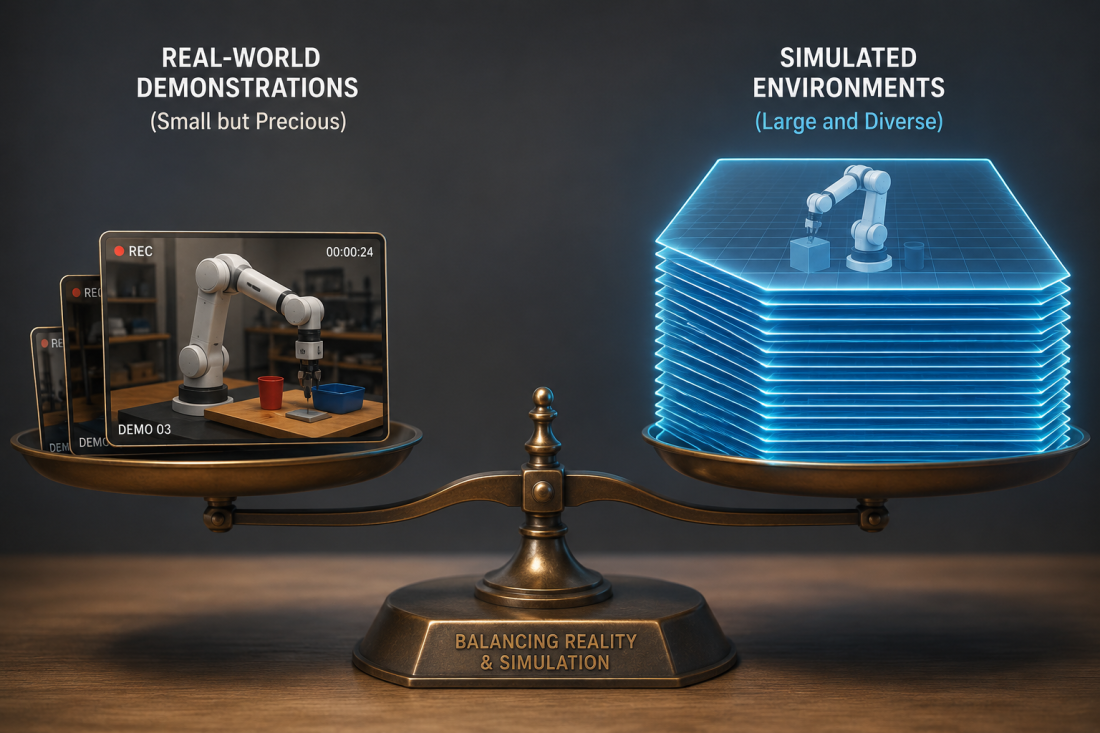
Research teams at Carnegie Mellon and Stanford independently found that vision-language-action robot policies trained on just 40% synthetic data matched the performance of policies trained on 100% real-world demonstrations. That result undercuts the assumption behind billions in robotics funding: that owning a massive real-world data collection fleet is the primary competitive moat.
Synthetic robot training data just cleared a bar that changes how robotics companies should be valued. Robots face a real data shortage: the physical world has produced only about 500,000 hours of high-quality robotic interaction data, while achieving baseline generalization in embodied AI is estimated to require between 1 billion and 10 billion hours, according to a 2026 industry analysis published via ANTARA. That gap is exactly why the CMU and Stanford finding matters.
A Result That Undercuts the Data Collection Race
Teams at CMU and Stanford independently reported 2026 results where vision-language-action models trained on 40% synthetic data matched policies trained on 100% real data on held-out tasks, according to the State of Robotics 2026 report from the Robotics Center of Silicon Valley. That finding runs against the scaling narrative borrowed from language models, where bigger and more real data has generally meant better performance. In robotics, synthetic robot training data closed most of that gap at less than half the real-world volume.
500,000 hours — total high-quality real-world robotic interaction data collected industry-wide as of 2026.
1-10 billion hours — estimated data needed for baseline embodied AI generalization, a gap synthetic robot training data is now closing faster than raw collection ever could.
Why Efficiency Is Beating Scale
The robotics field’s 2026 empirical consensus is that efficiency matters more than scale beyond roughly 7 billion parameters, and a well-curated 500-demonstration fine-tune of a 7B model outperforms a poorly curated fine-tune of a 70B model on most manipulation benchmarks, per the same State of Robotics report. That finding runs directly against how most robotics funding pitches are still framed, where bigger models and bigger data fleets are presented as the obvious moat.
Photorealistic rendering through platforms like NVIDIA Cosmos and Isaac Lab has narrowed the visual gap between simulated and real environments enough that the substitution now holds up on held-out tasks, not just training metrics. See our analysis where we explain why MIT’s SceneSmith attacks the cost nobody talks about in robot training.
Achieving baseline generalization in embodied AI demands between 1 billion and 10 billion hours.— ANTARA News, industry analysis, June 2026
⚠ Fiction — illustrative scenario: A robotics startup raises a Series B partly on the strength of its proprietary fleet collecting real-world pick-and-place footage around the clock. A smaller competitor with no fleet at all, using a well-curated synthetic robot training data pipeline and a fraction of the real data, matches its benchmark scores within a quarter. The fundraising deck that emphasized fleet size never mentioned curation quality at all.
What This Means for How Robotics Data Gets Valued
Global spending on robot simulation software has grown into a $7.58 billion market in 2026, on a trajectory toward $13.9 billion, according to a Research and Markets estimate cited in ANTARA’s coverage. Synthetic robot training data is no longer a supplementary tool bolted onto real-world collection; for many manipulation tasks, it’s now a credible substitute.
That reframes the investment thesis behind companies whose primary pitch is data-collection scale rather than simulation and curation infrastructure. It also changes what due diligence should look like: a fleet of data-collecting robots is an easy number to put on a slide, while a simulation pipeline’s actual sim-to-real transfer rate takes real technical scrutiny to verify, which is exactly why it’s been underweighted in most funding narratives so far. See our related coverage of why robot simulation scene assets are becoming the industry’s missing link and the physics simulation bottleneck holding robotics back.
Global Implications
For manufacturers and robotics buyers in emerging markets who can’t fund a proprietary real-world data collection fleet the way well-capitalized US and Chinese competitors can, synthetic robot training data narrows a gap that used to be closed only by capital. A strong synthetic robot training data pipeline is a far cheaper entry point than a warehouse full of demonstration robots. See our analysis of the world models and robot training crossover happening in 2026 and how generative AI is self-generating robot training data.
💡 CreedTec Analyst’s Note — Daniel Ikechukwu
Strategic Impact: Synthetic robot training data changes what counts as a defensible moat in robotics. Fleet size alone no longer guarantees a performance advantage if a competitor’s simulation pipeline is well curated.
- Stop: Valuing robotics companies primarily on the size of their real-world data collection fleet.
- Start: Asking robotics vendors what share of their training pipeline is synthetic, and how they validate sim-to-real transfer on held-out tasks.
- Watch: Whether the 40% threshold holds up across more task categories beyond the manipulation benchmarks tested so far.
ROI Outlook: A strong simulation pipeline built on synthetic robot training data costs a fraction of a real-world data collection fleet and, per this research, can deliver comparable results on the tasks tested.
Should buyers still ask vendors about their real-world data collection scale?
Ask instead about the balance of synthetic robot training data versus real data and the curation quality behind it, and request evidence of sim-to-real transfer on tasks similar to your use case. Fleet size alone is no longer a reliable proxy for performance.
The robotics industry spent years treating real-world data collection as the unavoidable cost of entry. Synthetic robot training data just gave smaller, better-curated teams a credible way to compete without matching that spend dollar for dollar.
Get CreedTec’s next robotics procurement briefing before your next simulation platform decision.
Subscribe
Sources