Fast Facts
Teleoperated robots are usually marketed as a human-in-the-loop safety measure — a person supervising the machine until it’s ready to work alone. That framing undersells what’s actually driving adoption. The real reason 42% of large manufacturers will run at least one teleoperated system by 2026 is that teleoperation has become the cheapest way to buy proprietary training data, with per-hour collection costs dropping 60% since 2024. The human isn’t a safety net. The human is generating the dataset the robot will eventually replace them with.
Teleoperated robots are booming for a reason most coverage gets backwards. Roughly 42% of large manufacturing enterprises will operate at least one teleoperated robotic system by 2026, up from 28% in 2024, according to MarketIntelo’s market research, which values the category at $12.4 billion in 2025. The standard explanation is that certain tasks still need a human’s judgment. The more accurate explanation is economic: teleoperation has quietly become the cheapest, highest-quality way to generate the data that trains full autonomy.
Why Teleoperated Robots Are Really a Data Collection Play
$340 → $118 per Hour
The cost of collecting teleoperation training data fell 60% between 2024 and 2026, putting a $50,000-$150,000 enterprise pilot data budget within reach for companies that couldn’t previously justify the expense.
Source: Robotics Center of Silicon Valley, “State of Robotics 2026”
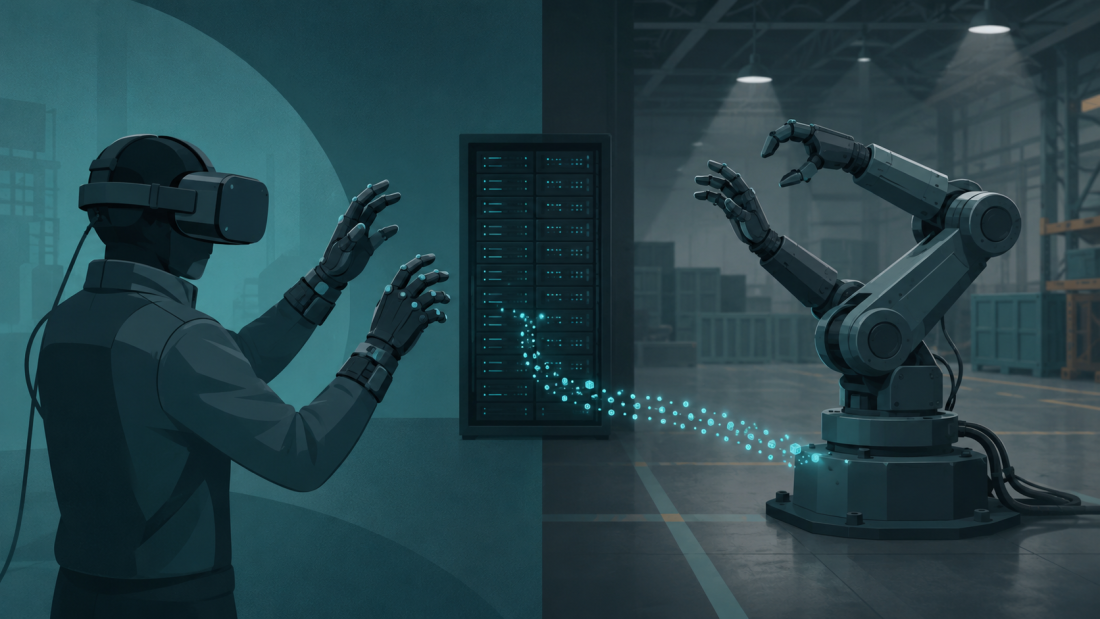
Every teleoperated episode a human runs generates action-paired sensorimotor data — synchronized joint angles, gripper forces, camera frames, task context — that doesn’t exist anywhere else at scale. Language models can train on text already sitting on the internet. Embodied AI can’t; someone has to physically generate that data first, and teleoperation is how.
Figure AI operates a proprietary teleoperation fleet feeding its BMW manufacturing deployment, and the same “data flywheel” model — where every deployed robot’s supervised episodes feed back into training — sits at the center of Tesla Optimus’s development strategy too. See our earlier coverage of World Labs’ sim-to-real leap letting robots run an hour alone, where a different lab attacks the same data bottleneck from the simulation side instead of the teleoperation side.
“Teleoperation is not a stop-gap. It is how robots learn to be autonomous.”— Labellerr, “Top Teleoperation Service Providers for Robotics in 2026”
The Demo Gap Nobody’s Pricing Into the Hype
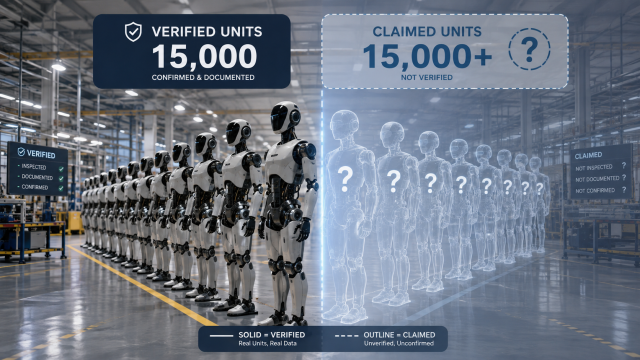
Teleoperated robots have also become the quiet asterisk on some of the industry’s most impressive demo footage. Bloomberg, Electrek, TechCrunch, and The Verge have separately documented patterns suggesting some of Tesla’s most prominent Optimus public demonstrations involved teleoperation rather than autonomous operation, according to Axis Intelligence’s 2026 humanoid robot statistics report. That’s not disqualifying — every manufacturer uses teleoperation during development — but it’s directly relevant context for interpreting any demo video before a procurement decision gets made. See our earlier analysis of Unitree’s TIME cover hiding a 9% industrial deployment problem, where the same gap between demo footage and deployed autonomy shows up in a different company entirely.
The commercial infrastructure has caught up to this reality fast. Data collection cost benchmarks for 2026 now range from roughly $15 an hour for simple single-arm teleoperation programs to $150-plus an hour for full humanoid, multi-sensor programs, according to DataX Power’s 2026 data collection cost benchmarks. Companies like Figure, 1X, and Fourier have built internal data collection infrastructure specifically because the economics favor owning that pipeline once a program scales past a certain threshold.
⚠ Fiction — composite scenario, not a real event: A warehouse operator signs a contract for “AI-powered” robotic picking, drawn in by demo footage showing smooth, apparently autonomous handling of irregular objects. Three months into deployment, the actual system still requires a human operator remotely correcting roughly a third of picks — not a defect, but the intended data-collection phase the vendor never clearly explained was still underway. The operator budgeted for a finished product and received a training program instead.
Global Implications
Teleoperated robots deployed for defense, security, and hazardous-material handling represent 16.2% of the current market, and space exploration applications for NASA and ESA missions account for a further 4.6% — categories where human oversight is a genuine operational requirement, not a data-collection cover story. Manufacturing remains the largest single category at 28.6% of market revenue, which is exactly where the data-flywheel economics matter most.
For manufacturers evaluating teleoperated robots in Nigeria, West Africa, and Southeast Asia, the practical question to ask any vendor is which category their proposed teleoperated robots fall into: a genuine oversight requirement, or a data-collection phase being billed as a finished deployment. Falling data-collection costs make teleoperated pilots more accessible globally. Still, that accessibility cuts both ways — it also makes it cheaper for vendors to run an extended data-gathering phase disguised as production deployment. See our coverage of Humanoid’s $1.35B round exposing the robot pre-orders gap for how that same gap between funding-stage promises and delivered capability shows up in a different part of the robotics market.
💡 CreedTec Analyst’s Note — Daniel Ikechukwu
Strategic Impact: Teleoperated robots are as much a data-acquisition strategy as a deployment strategy. Buyers who understand which mode they’re actually purchasing can negotiate accordingly — a data-collection pilot should cost less than a finished autonomous deployment, not the same.
Stop: Assuming demo footage of smooth robotic task completion reflects fully autonomous operation without asking directly what percentage of the task involved a remote human operator.
Start: Asking any robotics vendor to disclose their current teleoperation-to-autonomy ratio for the specific task being purchased, and to price data-collection phases separately from finished autonomous deployment.
Watch: Whether falling data-collection costs accelerate the transition from teleoperated to fully autonomous operation across the industry faster than vendor marketing claims currently suggest.
ROI Outlook: Teleoperated deployment costs less upfront than fully autonomous systems but requires ongoing operator labor. Buyers should model the total cost of that labor across the expected data-collection period, not just the headline hardware or software price.
The industry sells teleoperated robots as a bridge to full autonomy. In reality, teleoperated robots are the product as much as the bridge—every supervised task generates the proprietary data that makes the next generation of autonomous systems more valuable.
Subscribe to CreedTec’s newsletter — it tracks which robotics vendors are honest about their teleoperation ratio, and which ones let demo footage do the talking instead.
Sources
- MarketIntelo — market sizing and sector breakdown
- Robotics Center of Silicon Valley — “State of Robotics 2026” data economics figures
- Axis Intelligence — humanoid robot statistics and Tesla Optimus demo reporting
- DataX Power — 2026 data collection cost benchmarks by program type
- Labellerr — teleoperation service provider landscape
Further reading: World Labs’ Sim-to-Real Leap Let Robots Run an Hour Alone · Unitree’s TIME Cover Hides a 9% Industrial Deployment Problem · Humanoid’s $1.35B Round Exposes the Robot Pre-Orders Gap · Nvidia’s Digital Shipyard Bet Is a Simulation Sales Pitch · MIT SceneSmith Attacks the Cost Nobody Talks About in Robot Training