Fast Facts
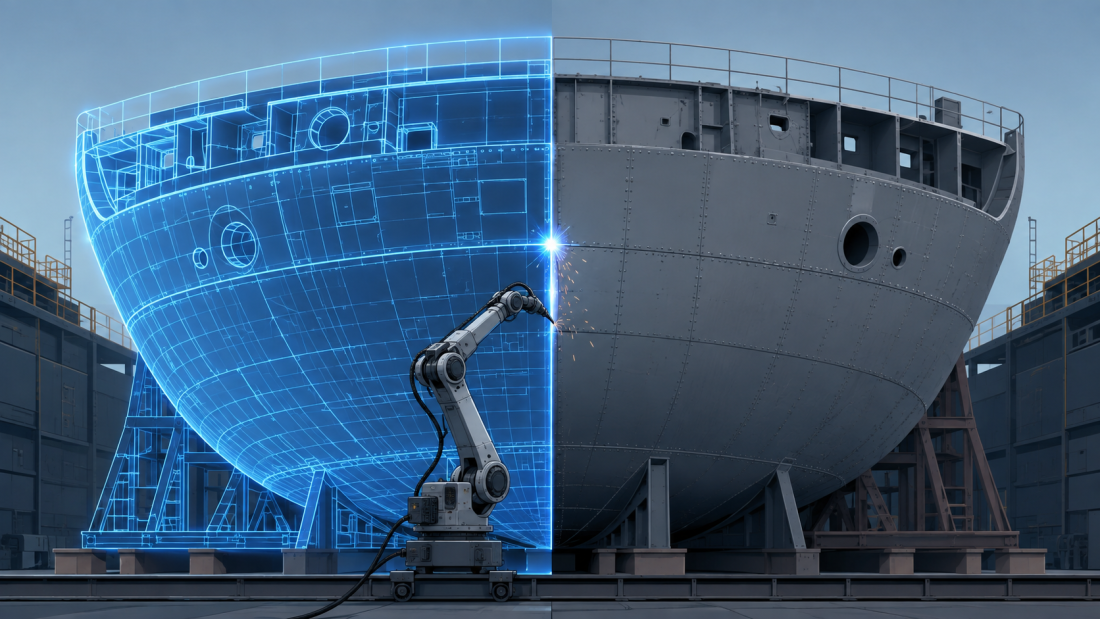
Nvidia and Kawasaki Heavy Industries began building a next-generation digital shipyard at Kawasaki’s Sakaide Works on July 16, using physical AI and digital twin technology to co-develop robots for welding, painting, inspection, and material handling. Coverage frames this as a robotics story. It’s really a simulation story — Nvidia is betting that whoever owns the virtual proving ground for shipbuilding tasks, not whoever sells the robot arm, captures the durable value in an industry where a mistake can sink a multi-million-dollar hull.
The digital shipyard Nvidia and Kawasaki are building isn’t primarily about robots — it’s about where those robots get trained before anyone lets them near a real vessel. Kawasaki Heavy Industries began collaborating with Nvidia on the project at its Sakaide Works in Kagawa Prefecture, part of a government-supported R&D initiative aimed at connecting commercial vessel design and construction into a single production flow, according to PortNews. The partnership pairs Kawasaki’s decades of shipbuilding data and robotics know-how with Nvidia’s Omniverse and Isaac platforms.
Why the Digital Shipyard Model Beats Selling Robots Directly
Welding, Painting, Inspection, Material Handling
The four task categories Nvidia and Kawasaki are targeting first for AI-powered robotics — each one a process where a physical mistake is expensive to reverse on a vessel already under construction.
Source: FreightWaves, July 2026
Shipbuilding is about as unforgiving a domain as simulation technology can be tested in. A warehouse robot that mishandles a box costs a broken package. A shipyard robot that mis-welds a seam on a hull section can compromise structural integrity on a vessel worth tens of millions of dollars, discovered only much later.
That asymmetry is exactly why training in a digital shipyard first, rather than iterating directly on physical steel, isn’t a nice-to-have — it’s the only economically sane way to deploy autonomous robotics in this industry at all. See our earlier coverage of World Labs’ sim-to-real leap letting robots run an hour alone, where the same logic of proving performance in simulation before touching hardware shows up in a very different robotics category.
“Our collaboration with NVIDIA marks an important step in advancing the use of AI in shipbuilding to a new stage.”— Yasuhiko Hashimoto, President, Representative Director and CEO, Kawasaki Heavy Industries
The Business Model Hiding Inside a Hardware Announcement
Nvidia’s stake here is bigger than one shipyard. The Kawasaki deal extends Nvidia beyond data-center chips into AI-powered robotics, digital twins, and industrial automation — a category where AMD, Intel, and ABB are also competing, and where Nvidia’s platform becomes embedded in a customer’s physical operations rather than just its IT budget, according to Yahoo Finance. Kawasaki brings the shipbuilding domain expertise; Nvidia brings the compute and, critically, the simulation software that both trains the robots and validates whether a proposed process change is safe to try on a real hull before anyone commits steel and labor to it.
“NVIDIA will continue to support this challenge as a partner through our Omniverse and Isaac platforms.”— Deepu Talla, Vice President of Robotics and Edge AI, Nvidia
That framing matters commercially: Nvidia isn’t primarily selling Kawasaki a fleet of welding robots. It’s selling the virtual proving ground itself — the reusable simulation environment that can, in principle, be resold or re-licensed to other shipbuilders facing the same labor shortage and the same rising demand for low- and zero-carbon vessels. See our analysis of Gemini Robotics 2’s whole-body control hiding the real bet, where a similar tiered-access strategy — sell the reasoning layer broadly, keep the physical execution layer scarce — shows up at a different robotics lab entirely.
⚠ Fiction — composite scenario, not a real event: A mid-sized shipyard invests in welding robots trained only on physical trial-and-error, skipping digital-twin validation to save on software licensing. Eighteen months in, a batch of welds passes visual inspection but fails a structural stress test months later, after the hull sections are already assembled — a defect a properly simulated training process would have caught before a single physical weld was made, at a fraction of the rework cost now required.
Global Implications
Japan’s motivation here is explicit and structural: the digital shipyard project is meant to offset shortages of skilled workers and broader labor constraints in Japan’s shipbuilding industry, while expanding capacity to meet rising demand for low- and zero-carbon vessels. That’s a demographic problem with an automation solution, and it’s one shared by manufacturing economies well beyond Japan.
For manufacturers in Nigeria, West Africa, and Southeast Asia building out heavy industry capacity without decades of existing automation infrastructure, this simulation-first model offers a genuine template: it lowers the cost of getting complex, high-stakes robotics right the first time, rather than paying for physical trial-and-error on expensive materials. See our coverage of MIT SceneSmith attacking the cost nobody talks about in robot training for how that same simulation-first economics plays out in a different manufacturing context.
💡 CreedTec Analyst’s Note — Daniel Ikechukwu
Strategic Impact: Nvidia’s digital shipyard partnership is a simulation-platform sale disguised as a robotics-hardware announcement. The company that owns the training environment, not the one that owns the robot arm, captures the durable value in high-stakes manufacturing domains.
Stop: Evaluating this partnership purely as a hardware deployment story about welding and painting robots.
Start: Asking any heavy-industry automation vendor whether their robots are trained and validated in a reusable digital twin environment before touching physical materials, and who owns that environment afterward.
Watch: Whether Nvidia and Kawasaki extend the digital shipyard concept to other shipbuilders as a licensable platform, which would confirm the simulation-as-product thesis over a one-off partnership.
ROI Outlook: Simulation-first deployment costs more upfront in software and platform licensing, but avoids the catastrophic downside of a physical defect discovered after assembly — a trade that gets more favorable the higher the cost of getting a manufacturing mistake wrong.
Everyone covering this deal is counting robots. The digital shipyard that trains them, and who ends up owning that virtual proving ground, is where the actual money in this partnership will be made.
Subscribe to CreedTec’s newsletter — it tracks which robotics partnerships are really simulation-platform plays wearing a hardware announcement.
Sources
- PortNews — original project announcement and Sakaide Works details
- Yahoo Finance — Nvidia investor and competitive positioning analysis
- Smart Maritime Network — executive quotes and platform details
- FreightWaves — task categories and deal structure
- Konsulteer — digital twin technology breakdown
Further reading: World Labs’ Sim-to-Real Leap Let Robots Run an Hour Alone · Gemini Robotics 2’s Whole-Body Control Hides the Real Bet · MIT SceneSmith Attacks the Cost Nobody Talks About in Robot Training · The Physics Simulation Bottleneck · Top Robotics Companies in 2026