Fast Facts
Samsung’s chip division posted a 250-fold profit surge in Q2 2026, driven by an AI memory shortage that pushed DRAM prices up 44% and NAND prices up 53% in a single quarter. The windfall belongs to the suppliers. Every other industrial buyer competing for the same memory now sits behind AI hyperscalers in the allocation queue.
The AI memory shortage just produced one of the largest single-quarter profit swings in semiconductor history. Samsung’s Device Solutions division posted operating income of roughly $62 billion in Q2 2026, a more than 250-fold increase year over year, as AI data centers competed for High Bandwidth Memory the company could not produce fast enough, according to The National. Total company revenue hit an all-time quarterly record of 171.5 trillion won.
Where the Windfall Actually Lands
This isn’t a story about AI software revenue. It’s a story about who owns the physical bottleneck underneath it. Citi Research found that average DRAM selling prices rose 44% quarter-on-quarter in Q2 2026, while NAND prices rose 53% over the same period, per Gadget Hacks’ reporting on Samsung’s earnings preview. The AI memory shortage rewards whoever controls the fabs, not whoever builds the smartest model, and that distinction matters enormously for anyone budgeting around “the AI boom” as a single, evenly distributed opportunity.
44% — quarter-on-quarter rise in average DRAM prices, Q2 2026.
53% — quarter-on-quarter rise in average NAND prices, same period, per Citi Research.
The supply constraints are expected to become even more severe in 2027.— Park, Samsung memory executive, Q2 2026 earnings call
What the Shortage Costs Everyone Else
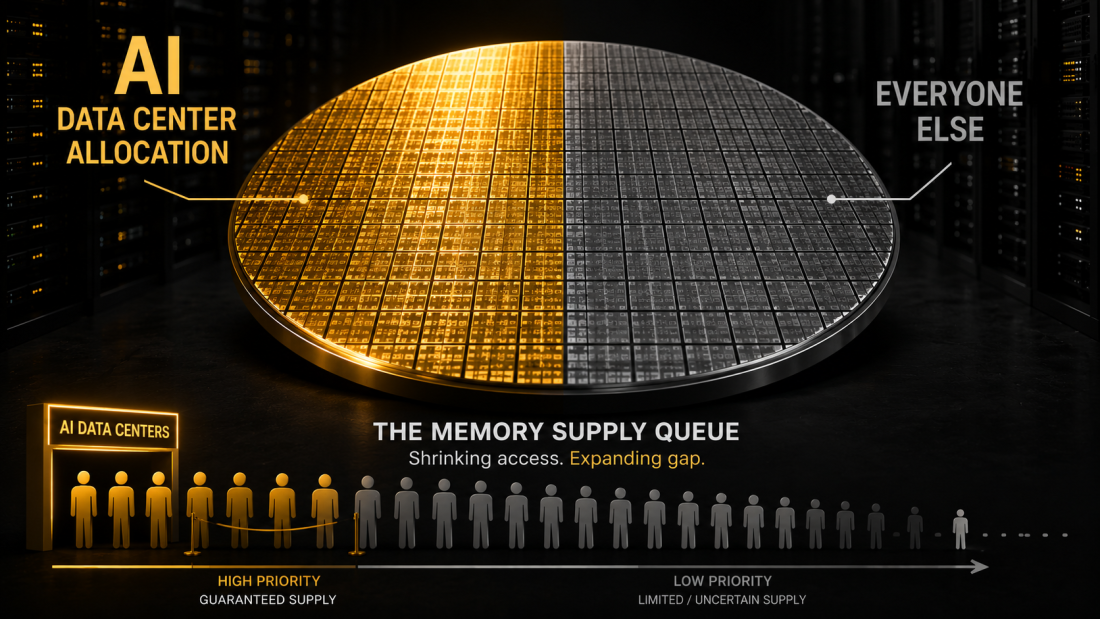
Samsung is now allocating 60% to 70% of its memory capacity to multi-year contracts with major data center customers, according to the company’s own Q2 earnings call transcript, and it has signed a $200 billion supply deal with Broadcom running through 2030. Every ton of capacity locked into those agreements is capacity that never reaches the open market where mid-market manufacturers, IIoT device makers, and industrial buyers place standard orders. The AI memory shortage doesn’t show up as a line-item price increase for those buyers first; it shows up as a phone call from a distributor explaining why the order slipped. See our analysis where we explain why nobody can agree on the actual size of the industrial AI market.
⚠ Fiction — illustrative scenario: A regional IIoT sensor manufacturer places a routine reorder for embedded flash storage, the same part number it has bought for three years. The distributor calls back apologetic: allocation now favors framework agreements with data center customers, and the lead time has tripled. Nothing about the sensor changed. The memory market underneath it did.
Why Fear Drives the Next Round of Contracts
Samsung itself doesn’t expect relief. Management said the industry’s supply shortage is likely to persist through 2028, with conditions tightening further in 2027. That forecast changes buyer behavior in a predictable way: scarcity pushes companies toward long-term take-or-pay agreements out of fear of being locked out entirely, which further concentrates supply with whoever signs first and signs biggest. The AI memory shortage is, in that sense, self-reinforcing. Buyers who can’t commit to multi-year volume become permanently disadvantaged, regardless of how strong their actual demand is. See our related coverage of why Siemens’ record industrial profit isn’t just an AI story and why Google’s TPU push is chasing inference money, not Nvidia’s crown.
Global Implications
For manufacturers in Nigeria, Southeast Asia, and other emerging markets, the AI memory shortage compounds an existing disadvantage: smaller order volumes and weaker distributor relationships already put these buyers last in line during any allocation squeeze. Budgeting for flat component costs in 2026 and 2027 is no longer a safe assumption anywhere in the supply chain. See our analysis of Oracle’s warning on industrial AI investment ROI challenges.
💡 CreedTec Analyst’s Note — Daniel Ikechukwu
Strategic Impact: The AI memory shortage is a revenue story for suppliers and a procurement risk story for everyone else. Both are true simultaneously, and most coverage only tells the first half.
- Stop: Assuming memory and storage component pricing will normalize alongside broader chip-shortage narratives.
- Start: Locking in longer-term supply agreements now, even at a price premium, before allocation tightens further into 2027.
- Watch: Whether Samsung, SK Hynix, and Micron expand capacity fast enough to loosen allocation before 2028, as currently forecast.
ROI Outlook: Suppliers are capturing historic margin. Buyers who secure allocation early will pay more per unit but avoid the compounding cost of production delays later.
Should industrial buyers sign multi-year memory contracts now?
Given Samsung’s own forecast that the shortage persists through 2028, locking in volume even at a premium is generally safer than betting on short-term price relief that current supply data doesn’t support.
Is the AI memory shortage only affecting high-end HBM chips?
No. Citi Research’s Q2 2026 data shows conventional DRAM and NAND prices rising alongside HBM, meaning standard components used in industrial and IIoT hardware are affected too, not just AI server memory.
The AI memory shortage will continue to produce headline profits for the companies that manufacture the chips. For everyone downstream, the real number to watch isn’t Samsung’s quarterly earnings, it’s their own next quote from a distributor.
Get CreedTec’s next industrial procurement briefing before your next component order goes out.
Subscribe free
Sources
- The National, “Samsung’s chip Q2 profit surges 250-fold as AI memory shortages fuel demand,” July 2026
- Gadget Hacks, “Samsung AI Memory Chip Profit Surge Explained,” July 2026
- Investing.com, Samsung Electronics Q2 2026 Earnings Call Transcript
- MyBusinessFuture, “Samsung Q2: Memory Remains Scarcer Than Expected,” August 2026