Fast Facts
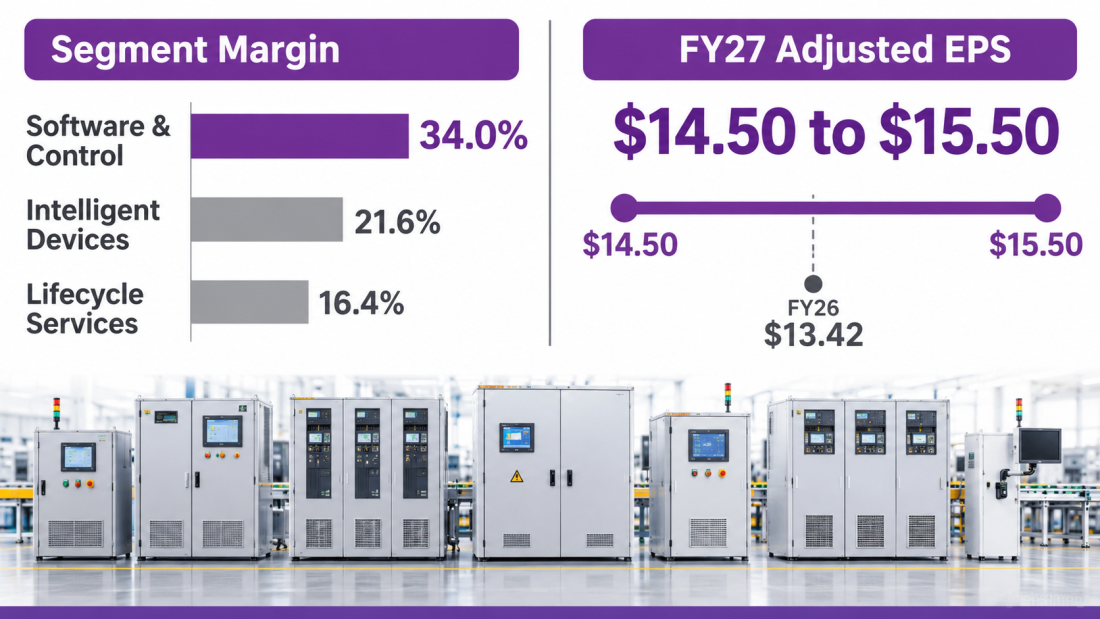
Rockwell Automation (NYSE: ROK) reported fiscal fourth-quarter sales of $2,332 million on November 5, about 3% below the $2.41 billion analysts expected, per 24/7 Wall St. The Rockwell Automation fiscal 2027 guidance still calls for 6% to 9% organic growth and adjusted EPS of $14.50 to $15.50, up from $13.42 in fiscal 2026.
The profit engine is Software and Control, which earned a 34.0% segment margin. By our arithmetic from reported margins, it produced about 44% of segment earnings on 32% of Q4 sales. Recurring revenue grew only 5%, so software sales are outrunning the subscription base.
Industrial automation vendors now sell an AI story on top of a controller business. The Rockwell Automation fiscal 2027 guidance shows which half pays. Q4 sales rose 1% reported and 3% organic, while adjusted EPS grew 16% to $3.88 against $3.69 expected, so the earnings quality is better than the headline revenue line.
A Miss Wrapped in a Tariff Adjustment
Rockwell booked an $85 million customer tariff refund accrual as a reduction of sales, which it says cut about four points from Q4 growth. It also received $103 million of IEEPA tariff refunds plus $5 million of interest, a net gain of $0.11 per share. Fiscal 2026 sales reached $8,989 million, up 8% both reported and organic, and free cash flow hit $1,701 million.
The fiscal 2027 range carries a roughly one-point benefit from that same refund program, according to the company’s release. Strip it out and the underlying organic range is about 5% to 8%, by our arithmetic. Reported growth guidance is 4.5% to 7.5%, after about a 1.5-point drag from the Sensia dissolution. See our analysis where we explain why a flat guide can sit beside an industrial peak.
| Metric | Value |
|---|---|
| Q4 Sales | $2,332M (+1%) |
| Software & Control Margin | 34.0% |
| S&C Organic Growth | +15% |
| EPS Guide Midpoint | $15.00 |
Sources: Rockwell Automation release (Nov 5, 2026); consensus per 24/7 Wall St. Midpoint is the average of $14.50 and $15.50.
Where the Rockwell Automation Fiscal 2027 Guidance Gets Its Profit
Software and Control sold $754 million at a 34.0% margin, versus 31.2% a year earlier, with organic growth of 15%. Intelligent Devices sold $1,144 million at 21.6%, and Lifecycle Services sold $519 million at 16.4%, down 110 basis points. Weighting each segment’s reported margin, Software and Control earns about $256 million of roughly $589 million in combined segment profit. That is our estimate, not a company figure.
The fiscal 2027 midpoint implies adjusted EPS growth of about 11.8% on $13.42, our calculation. See our analysis where we explain how Honeywell’s data center orders doubled while automation lagged, and why Siemens’ record industrial profit isn’t just an AI story.
Recurring Revenue Is the Soft Spot
Organic ARR grew 5% in fiscal 2026, with software at a high-single-digit rate. An automated transcript summary of the call says the Rockwell Automation fiscal 2027 guidance assumes ARR growth of 7%, and that project delays and smaller rollouts held ARR back. It cites a customer that might halve a planned managed-services rollout, while renewals stayed strong. Verify those figures against the replay. See our analysis where we explain why net retention is the real story behind IFS’s growth.
CEO Blake Moret said, We enter fiscal 2027 from a position of strength.
On AI, the transcript summary quotes him on customers wanting to orchestrate people, AI agents, workflows, and industrial systems in real time
. That is an opportunity statement, not a revenue line: the release gives no AI revenue and no orders or backlog figure. See our analysis where we explain how industrial AI revenue really gets made.
⚠️ Hypothetical scenario: A Lagos beverage bottler is renewing a three-year support and managed-services agreement for its controller fleet. The vendor cites inflation and proposes a roughly 3% annual escalator, close to the price assumption described on Rockwell’s call. The plant engineer asks to cap the escalator at a published index and to phase the rollout, as one customer reportedly planned to do. The vendor accepts the cap but resists phasing, so the bottler signs a shorter term to preserve leverage.
💡 CreedTec Analyst’s Note by Daniel Ikechukwu
Strategic Impact
The Rockwell Automation fiscal 2027 guidance rests on one segment. If Software and Control holds a mid-30s margin, the 6% to 9% range is reachable even with weak services and about a point of one-off tariff help.
Stop / Start / Watch
- Stop: reading AI orchestration talk as AI revenue before a disclosed line item exists.
- Start: comparing vendors on segment margin and ARR growth, not headline sales.
- Watch: the Q1 print, where management reportedly expects a sequential decline, and the ARR trajectory toward 7%.
ROI Outlook
For buyers, pricing near 3% a year plus software-heavy mix means support costs rise faster than hardware. Lock escalators to an index, and size managed-services scope to a pilot before committing to the full rollout.
— Daniel Ikechukwu
Reading vendor earnings for contract leverage?
The CreedTec Industrial AI Revenue Brief turns quarterly results into the price and term questions procurement teams need.
Subscribe to the Revenue Brief