Fast Facts
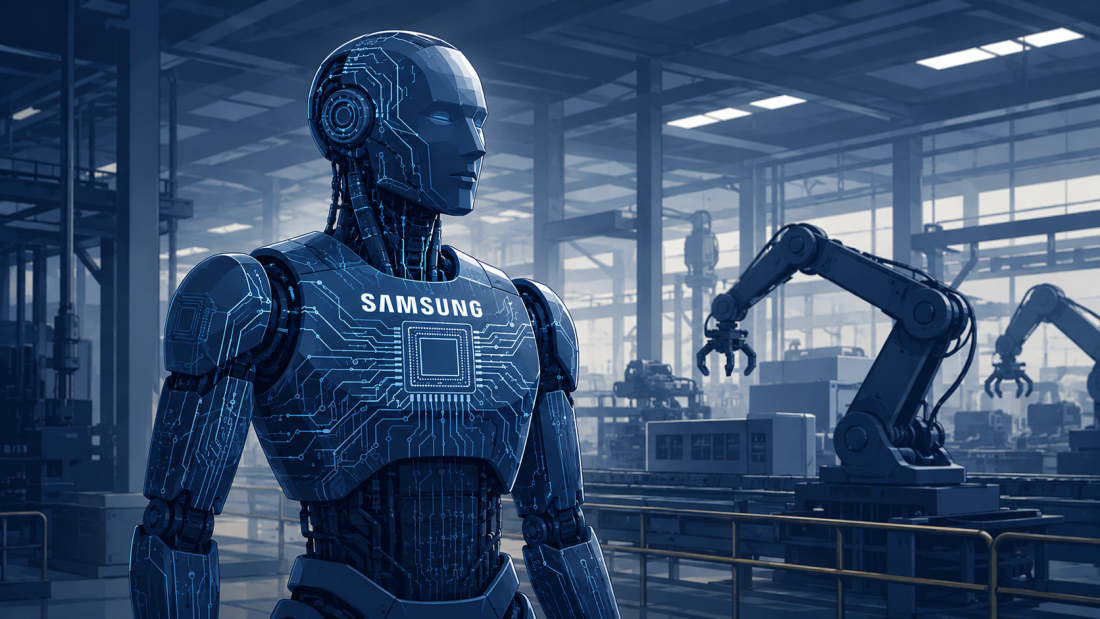
Samsung’s new RX robotics division, launched July 21 with a $13 billion factory investment, is building in-house robots for its own production lines. Coverage frames this as Samsung entering the humanoid robot race against Tesla and Unitree. The more useful read is different: Samsung is already the chip supplier behind Tesla’s Optimus and Nvidia’s robot AI stack. This effort functions as a proof-of-concept and demand-generation vehicle for its foundry business — the far larger and more durable opportunity than selling finished humanoids ever could be.
In-house robots are how Samsung plans to prove its own chips work before selling that same silicon to everyone else building humanoids. Samsung Electronics officially launched its RX robotics division on July 21, 2026, reporting directly to CEO TM Roh, backed by a $13 billion investment in manufacturing facilities in Gumi, South Korea, according to Dataconomy. The division plans to deploy humanoid robots on Samsung’s own production lines starting in the second half of 2026 to gather real-world manufacturing data.
Why In-House Robots Make More Sense as a Chip Strategy
$16.5 Billion
The value of Samsung’s contract to supply Tesla with next-generation AI6 chips for Optimus and autonomous vehicles, produced at Samsung’s Taylor, Texas plant — a deal signed before Samsung’s own in-house robots division even existed.
Source: Grand Pinnacle Tribune, citing the July 2025 Samsung-Tesla chip agreement
Samsung’s foundry is already manufacturing Nvidia’s Groq3 language processing unit at 4-nanometer scale for humanoid robot AI stacks, and fabricating the AI5 and AI6 chips destined for Tesla’s own Optimus program, according to reporting confirmed by Elon Musk. That means Samsung was already the picks-and-shovels supplier to the humanoid robot race before it decided to build robots of its own.
In-house robots give Samsung something a chip supplier alone can’t get: a live, internal reference deployment that proves its silicon actually performs the sensorimotor and cognitive workloads it’s being sold to do. See our earlier analysis of Nvidia’s digital shipyard bet being a simulation sales pitch, where a different chip and platform giant used the same logic — sell the infrastructure, let the flagship deployment prove it works.
“We are building capabilities to develop customized key robot components in-house that are optimized for our own robots.”— Samsung Electronics, Q1 2026 earnings conference call
The Talent Hire That Reveals the Real Priority
Samsung didn’t promote from within to lead RX’s strategy — it hired Executive Vice President Lee Dongkun, who previously directed robotics strategy at Hyundai Motor Group, the parent of Boston Dynamics, and who oversaw development of the electric Atlas humanoid and Spot quadruped during Hyundai’s push to commercialize both. That hire, paired with Samsung’s Rainbow Robotics subsidiary already commercializing the RBY1 wheeled dual-arm platform and developing HUBO bipedal prototypes, signals a company assembling deployment expertise, not just research capability. See our coverage of Unitree’s TIME cover hiding a 9% industrial deployment problem for how deployment expertise, not funding or hype, is the scarce resource across this entire sector right now.
Samsung’s in-house robots strategy also extends to components most competitors buy from third parties: the company is developing its own actuators using motor technologies adapted from home appliances, an unusual but financially logical move for a company that already runs enormous consumer-electronics manufacturing lines. Owning that layer reduces both cost and dependency on the same small set of actuator suppliers every other humanoid maker competes for.
⚠ Fiction — composite scenario, not a real event: A robotics analyst covers Samsung’s RX division purely as a Tesla and Unitree competitor, publishing a forecast comparing unit shipment targets. Two years later, Samsung has shipped fewer finished humanoids than expected — but its foundry chip revenue from robotics customers across five different manufacturers has quietly become a bigger business line than the humanoid unit itself, exactly the outcome the shipment-focused forecast never modeled.
Global Implications
South Korea’s national strategy treats this as bigger than one company’s product line. President Lee Jae-myung’s “Three Super Projects” initiative, unveiled in June with roughly $1.3 trillion in total planned investment through 2036, positions physical AI and robotics as a core pillar alongside Samsung and SK Group’s participation — meaning Samsung’s in-house robots effort is partly a national industrial-policy vehicle, not a purely commercial bet. More than 300 humanoid robot companies now operate globally, with Chinese manufacturers like Unitree shipping units at roughly $16,000 each, a price point Samsung’s foundry-subsidized strategy may be better positioned to match than pure-play robotics startups without a chip business underneath them.
For manufacturers in Nigeria, West Africa, and Southeast Asia watching this space, the practical signal is which companies are building durable, multi-revenue-stream robotics businesses versus single-product bets. See our analysis of China’s humanoid robot mass-production race for how a similar scale-and-subsidize strategy is playing out from a different national base entirely.
💡 CreedTec Analyst’s Note — Daniel Ikechukwu
Strategic Impact: Samsung’s in-house robots aren’t really competing for humanoid market share — they’re a reference deployment validating a chip and component business that already sells to Samsung’s own robotics competitors. That’s a structurally different, and more durable, bet than a standalone robotics product line.
Stop: Evaluating Samsung’s robotics ambitions purely against Tesla, Unitree, or Figure AI unit-shipment forecasts.
Start: Tracking Samsung’s foundry contracts with other humanoid makers as the leading indicator of whether this strategy is working, not headline robot deployment numbers.
Watch: Whether Samsung’s factory deployment data translates into measurable chip or actuator design wins with third-party robotics customers within the next 18 months.
ROI Outlook: A chip-and-component strategy diversified across every major robotics maker carries lower risk than betting on Samsung’s own humanoid becoming a market leader — the foundry revenue arrives regardless of which robotics company ultimately wins the category.
Everyone covering Samsung’s robotics push is counting future humanoid units. The company itself is counting foundry customers — and it already has some of the biggest names in robotics on that list, months before its own robot ever left a factory floor.
Subscribe to CreedTec’s newsletter — it tracks which robotics announcements are actually product launches, and which ones are infrastructure plays wearing a robot costume.
Sources
- Dataconomy — RX division launch and $13 billion investment details
- Tech Times — Lee Dongkun hire and competitive landscape
- Korea JoongAng Daily — Samsung spokesperson quote and organizational structure
- 36Kr — Rainbow Robotics and in-house actuator development
- Quasa — deployment timeline and manufacturing-first sequencing
Further reading: Nvidia’s Digital Shipyard Bet Is a Simulation Sales Pitch · Unitree’s TIME Cover Hides a 9% Industrial Deployment Problem · China’s Humanoid Robot Mass-Production Race · Humanoid’s $1.35B Round Exposes the Robot Pre-Orders Gap · Teleoperated Robots Are a Data Strategy, Not a Stopgap