Fast Facts
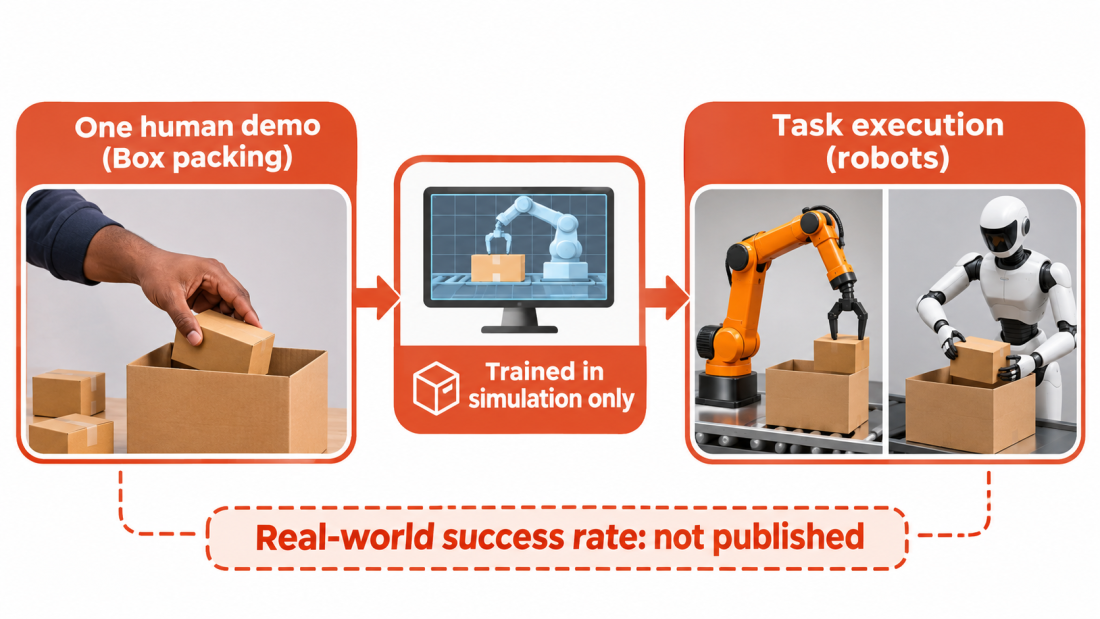
Machenta robot learning is the pitch behind a $40 million seed round announced on October 27: an AI model, trained entirely in simulation, that teaches a robot a new task from a single human demonstration. Creandum and Union Square Ventures co-led, per The Next Web, and Imperial College London calls it the largest seed round for a UK robotics startup.
The company, spun out of Imperial’s Robot Learning Lab, has published no success rates, customers or deployments, and says it has no near-term plans to sell. The idea is credible and the evidence is not yet public, which is the right frame for any buyer.
Most robot training either needs many demonstrations or large volumes of real-world data. Machenta robot learning argues for the opposite: generate the practice in a simulator, then let the robot copy a task after seeing it once. If it holds, that would shift cost from data collection to simulation quality.
What Machenta Robot Learning Claims
CEO Edward Johns, a robot learning professor, and PhD student Vitalis Vosylius founded the company in late 2025 after about six years of lab work. Johns says the model uses no “single pixel of real-world data.” Instead, it relies on in-context learning, where the demonstration acts like a prompt rather than a retraining job, a comparison Johns draws to language models. Earlier lab versions needed roughly 30 minutes of extra data collection per task, which the company says it set out to remove.
$40M seed | 11 staff | 0 published success rates
Funding and headcount per The Next Web; Forbes and tech.eu describe a team of roughly a dozen. Valuation is undisclosed. The “0” reflects that no benchmarks or deployments appear in the coverage we reviewed.
Why Machenta Robot Learning Faces a Hard Test
Simulation-trained policies often look strong until they meet friction, lighting and object behavior. Forbes noted that gap, and recalled that in March Johns described capability limited to picking, placing and opening doors and drawers at about half a centimeter of precision, with moving objects a year or more away. The Next Web adds that precise tasks and complex movements remain difficult. See our analysis where we explain the physics simulation bottleneck, and how a World Labs sim-to-real leap let robots run an hour alone.
“Very few teams in robotics can point to a body of work like this.”
— Kathi Wilhelm, Creandum
That is an investor’s endorsement of a research record, and the research is real. The research behind it won a best paper award at the ICLR 2025 Robot Learning Workshop, per Forbes, but that award went to the paper, not to a product. For Machenta robot learning, the open question is whether paper results survive a customer’s factory.
How It Fits the Training Data Race
Rivals mostly buy real-world data or mix it with simulation. The Next Web lists competitors valued between roughly $10 billion and $14 billion or more, including Skild AI, Physical Intelligence and FieldAI. See our analysis where we explain how FieldAI’s robot brain hit a $10 billion valuation. Data-heavy approaches also carry human cost: see why egocentric robot training data is recorded by $2.60-an-hour workers. A pure-simulation route would avoid that cost, if it works, and so the synthetic-data debate matters: see the 40% threshold undercutting a billion-dollar synthetic data race.
⚠️ Hypothetical scenario: A Lagos packaging line changes carton sizes weekly. A one-demo system would be valuable only if it handles each new carton without retuning. A pilot should measure success across at least fifty repeated runs per carton type, not a single demo. Until Machenta robot learning shows such figures, the line manager should treat it as research.
💡 CreedTec Analyst’s Note by Daniel Ikechukwu
Strategic Impact
If Machenta robot learning works from simulation alone, the scarce asset becomes the simulator and its fidelity, not hours of teleoperation. That would favor simulation vendors and could lower entry costs for emerging-market integrators.
Stop / Start / Watch
- Stop: counting seed size as technical validation.
- Start: asking any one-shot learning vendor for success rates over repeated trials on your objects.
- Watch: a first customer pilot, a published benchmark, and whether Machenta moves from research to sales.
ROI Outlook
Not measurable today. There is no price, customer or accuracy figure. Budget zero for it in 2027 plans, and revisit when results appear.
— Daniel Ikechukwu